While they were eating, he took bread, said the blessing, broke it, gave it to them, and said, “Take it; this is my body.” Then he took a cup, gave thanks, and gave it to them, and they all drank of it. He said to them, “This is the blood of the covenant, which will be shed for many.” (Mark 14.22-24)
Visitors to the Sierra Nevada are awed by the wonder of the giant sequoia trees that grow only on the western slopes of that mountain range. Growing in groves of similar giants, like church spires reaching to the high heavens, the sequoias can reach a height of 325 feet. They also can live as long as 3,000 years, making them seem untouchable and invincible.
The female cones that fall from the giant sequoias are similarly impressive, jagged layers of hardened cellulose forming a conic pyramid where, deep inside, seeds are buried. And the seeds remain buried there until a forest fire dries out the cones, allowing them to crack open and deposit their seeds on the forest floor.
Without the intensity of the fire, the cones remain closed and the seeds remain dormant. Furthermore, because of the density of forest debris beneath the trees, fire is necessary to burn away the brush, allowing the seeds to fall into the rich, dark soil beneath the trees. The cone of the sequoia tree tells an ancient truth of all living things upon the earth. It is this–something has to die in order for something else to live.
Removed as we are from nature and hermetically sealed as we are in our weather-proof, sound-proof, air-conditioned homes, we have lost touch with that reality of our existence. We have forgotten the primeval principle of life. If we are to live, something has to die. Every morsel of food that entered our mouth had to die so we could live.
Native Americans, much closer to the earth than we are, understood this truth and formulated rituals to express this sacred belief. They saw that the act of taking and eating food was a covenant between two living beings. One form of life gave itself so that another form of life could stay alive, the two forming a holy communion. What was taken and eaten was reborn in the flesh of another.
For this reason, Native American hunters prayed for the spirit of the animal that they had hunted and killed, some tribes severing the head of their kill and placing it in the branches of a tree so that it could see the sunrise and the sunset. They offered solemn words of thanksgiving to the animal they killed and to the plant that they harvested, mindful that both had died so that they could live.
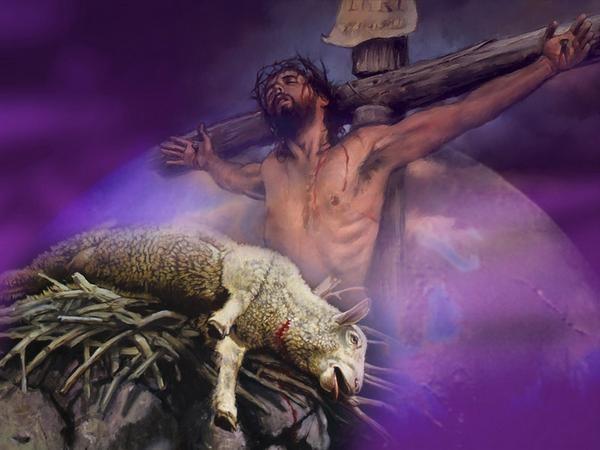
If we are to understand the immensity of the gift of the Holy Eucharist that we celebrate today in word and in ritual, then it begins there–with thanksgiving for the one who offered his life so that we might live. Placing himself upon the butcher’s block of the cross, he offered his life, giving us a second chance at a full life, freed from the shackles of sin, released from the tyrannical rule of Satan.
With centuries separating us from the Jerusalem Temple, which essentially was a slaughterhouse, we have sanitized the walls and mopped up the blood from the floors so that today we stand in freshly scrubbed chambers with the scent of air-deodorizers floating around us, denying us the exposure to the hard and harsh reality that someone had to die for us to eat in this place. The brilliant and acerbic liturgist Aidan Kavanaugh once wrote something to the effect that every celebration of the eucharist passes by the butcher shop, not only a keen observation on his part, but a jolt of reality to the rest of us.
“While they were eating, he took bread, said the blessing, broke it, gave it to them, and said, ‘Take it, this is my body.’ Then he took a cup, gave thanks, and gave it to them, and they all drank from it. He said to them, ‘This is my blood of the covenant, which will be shed for many.’” This is the story that we hear today on the Feast of the Body and Blood of the Lord, a story that has a broken body and a bloodied corpse as its centerpiece.
It is a visual that offends our modern sensibilities, crashes into the walls of our denial, and forces us to see and to smell the puddle of iron-rich blood beneath the cross on Golgotha. The thin, tasteless wafer of dried bread belies the harsh reality of the ritual that we replay each time we gather around this table, this altar of sacrifice. The clean, starched altar cloths without a speck of dirt, much less a drop of blood upon them, fools us into thinking we’re at a nice restaurant, not at the meat market.
But every bit of food we eat, at whatever table we’re seated, is food that came from some life being sacrificed, plant or animal, something that once lived has died so that we can have nourishment to live, their substance becoming our subsistence. This is the essence of holy communion, a life-and-death bond between two living beings, one sacrificed for the other, one becoming a part of the other.
As the Native American hunter drew near to the deer, so close it could hear its breathing, piercing it with his arrow, he sang to the spirit of the deer, explaining the violence done to it and promising that its body would feed people who were grateful for the sacrifice it had made. As the spear is thrust into the side of the Savior upon the cross, and blood and water pour out, we also must live out the promise to him that the loss of his life will bring forth good for the world.
Sadly, not only have we washed down the walls of our gathering places, literally and figuratively, but we also have talked ourselves into believing, not only that no blood was shed before we gathered in this place, but no blood needs to be shed when we return to our everyday lives, an irreverent break of the covenant, an irresponsible rupture of the circle of life.
Augustine of Hippo, fully aware of the significance of the gathering around the table of sacrifice, urged his people to “receive what you are, become what you receive,” putting before them the covenant and the circle, making clear that simply eating the eucharistic food without becoming the food for others through a similar self-sacrifice was short-sighted and self-absorbent. It is comparable to the French royal Marie Antoinette’s reputed response to hearing of the starvation of the peasants while she ate heartily at the palace table, “Let them eat cake.”
Instead, once we have eaten at the table of sacrifice, nourished by the life that was sacrificed for us, we, in turn, must become food for others, sacrificing ourselves in a multitude of unselfish acts so that other people’s lives may be nourished and enlivened. Imitators of the one who laid down his life for us, we lay down our lives for others in the same holy communion. If we shed no blood for others, symbolically or factually, then we have failed to understand the first and the fundamental covenant that we make each time we take and eat.
At the end of the 1984 movie, Places in the Heart, a film about the terrible sacrifices required of people in a Depression-era Texas town, there is a gathering of the townspeople in the little church. After the preacher reads from Chapter 13 of First Corinthians, the communion tray is passed from person to person, each one taking a bit of bread and a sip of wine.
As the camera moves down the pews, we are shocked to see, not only the living, but also the dead, seated in the same pews, those who sacrificed their lives for those who live, reminding us again of the holy communion that always exists between the one who sacrificed and the one who still lives. As the camera pans the pews, we also see that handful of living souls that have learned to make great sacrifices in the here-and-now, laying down their lives for others, spilling blood for those they love in their world.
As the movie begins with the shedding of blood in the murder of the sheriff and has the shedding of blood as the story moves along, especially in the brutal beating of the black man who helps save the farm, so here at the end, the people in church consume a small cup that represents the blood of the one who sacrificed his life for love of the world, telling us to look carefully and to remember faithfully. A body broken and bleeding died so that we might live.
Now, if we are to show reverence to the one who died for us, we must become what we have received, meaning we also must die to self in a hundred and one real ways, allowing others to live off of us, to feed off of us, keeping intact the circle of death and life. The slaughtered Lamb of God feeds us so that we can become food for others.
–Jeremy Myers

 Sunday Brunch