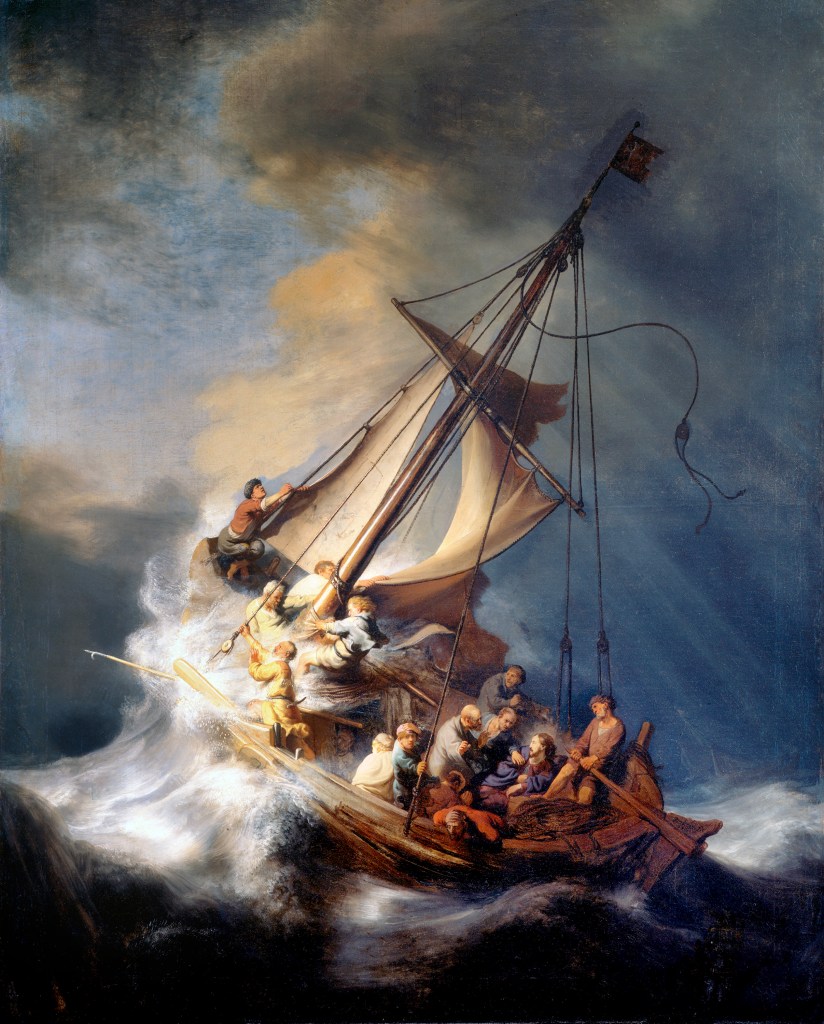
On that day, as evening drew on, Jesus said to his disciples: “Let us cross to the other side.” Leaving the crowd, they took Jesus with them in the boat just as he was. And other boats were with him. A violent squall came up and waves were breaking over the boat, so that it was already filling up. Jesus was in the stern, asleep on a cushion. They woke him and said to him, “Teacher, do you not care that we are perishing?” (Mark 4.35-38)
When Frederich Schmitt was crossing the Atlantic in the ship Rhone in 1843, a small, three-sailed boat built a dozen years earlier, he and his fellow passengers had set their eyes on a new land, on a new way of life, and on a new start. But that dream was almost taken from them as the voyage ended its 38-day passage across the ocean.
Seeing the shore in the distance, Frederich and the others began to breathe freely, thinking the end of the voyage was in sight, their fears subsiding as the coastline drew closer. But, almost without warning, the seas turned into a violent beast as the waves beat against the small boat, heavy, dark rain clouds pelting the tiny ship with cannonballs of water.
Frederich, a praying man by nature, saw this was not the end he had envisioned for himself and for his family, alongside him in the ship, so he got to his knees and prayed mightily, bargaining with God as every person does in the same circumstances. For Frederich, the price for safe harbor would be his building a church for the Most High God on those shores, should he be granted them.
Later, the length of the storm was not recorded, only its strength remembered, a strong, starved sea monster that wanted to sate its stomach on the sea vessel. Outmatched, as are most all of us by the storms of life, Frederich pledged his first effort would be to build a worthy house for the God who alone had power over the seas and all that they contained.
Some called it a miracle. Those on board did for sure. Somehow, the small ship battled its way through the storm, delayed in its arrival, but still putting down its anchor in calm waters rather than crashing into the deep, where only the calm of death awaited. Frederich, good for his word, made his way to Illinois, where his brother awaited him.
Hammer in hand, Frederich wasted no time in doing as he said he would do, erecting a small, but strong chapel to the honor of the God who had brought him safely to shore. For ten years, the people of the township went to Schmitt’s Chapel to pray, whatever their need, for they found it a good place to plead their cause. Later, a larger, grander house was built for such exchanges with the Divine One, but Schmitt’s Chapel stayed where it was.
In fact, it still stands, almost two hundred years later, although it is now surrounded by a fancy golf course and the windows have been reinforced with stronger glass to stop the flying golf balls that come at them. On occasion, descendants of old man Schmitt still swing by and give the place a good cleaning and, while there, offer a prayer or two, since it seems the right thing to do.
Frederich Schmitt’s fabled story across the seas ended well, not through anything special on his part, aside from his petition and pledge, and perhaps those were cause enough. The story in the Scriptures that we hear today offers us a firsthand look at a similar situation of peril, when the followers of the Galilean Rabbi were sure they were about to be lost at sea, bombarded and bullied by the same sea monster Leviathan that Frederich Schmitt had seen with his own eyes.
The gospels tell us that it was evening when the Rabbi and his followers put to sea, doing as the Rabbi had instructed them with his words, “Let us cross to the other side.” Already at the start, there is something ominous in the air, the mention of nighttime enough to prickle our ears and upset our stomachs, the darkness always a harbinger of something bad about to happen.
And it was not long before the demon showed its ugly face, never needing a disguise because it banks on the fear it brings with it, causing distress and desperation as it breaks through our feeble defenses, splintering the doorway to our souls, causing us to blanche at the ugliness let loose in our lives. “A violent squall came up and waves were breaking over the boat so that it was already filling it.” This is the way that the evangelist puts a face on the evil that betook the disciples as they sought to cross to the other side.
Anyone who has watched the movie, The Perfect Storm, has a keen understanding of the ferocity and the fearsomeness of the sea as the six men aboard that fishing boat stare into the face of the monster that will devour them without remorse, without respite. As the movie ends, we find ourselves in a church, the safe sanctuary we all seek when evil has shipwrecked our lives, and we hear as the tearful, but brave captain of another boat prays that these men now know fair winds and calm seas.
The final scene shows a memorial wall with the names of all the men over the years who had sailed the northeastern coast in search of a livelihood, but who did not find their way back to shore, souls lost forever in the seas. The last names on the wall are now those of these men aboard the Andrea Gail, a reminder that storms, great or small, are dangerous and diabolical.
Seasoned fishermen that they were, the Galileans in the boat with the Rabbi had seen storms before and they knew when their chances for survival were next to none. Awakening the Rabbi, who had fallen asleep in the stern of the boat, they ask the question we all ask when we are sinking into the seas, “Teacher, do you not care that we are perishing?”
That is always the cry of the person that finds him or herself in a storm on the sea. Heads turned to the high heavens, cries pouring from the deep of the heart, alone and outmatched, we demand to know if the One above cares that we are perishing, or is he sleeping soundly, unperturbed by our perilous situation?
While this is a story of a storm on the sea, a familiar storyline from the old writings, as all who have heard of Jonah and the whale know, anyone who has lived on land also understands that you don’t have to be on water to experience a shipwreck. Shipwrecks happen on land all the time, even if there is not a drop of water in sight, except for the tears that flow from our eyes. Whenever there is a cataclysmic change that comes into our lives, a brutal force that tosses and throws us off-balance and offboard, and leaves us to sink or swim, we know in our bones that we have experienced a shipwreck. If lucky or if graced by God, we survive, but we also know we will never be the same person we were before the shipwreck.
Just as ships carry many names, shipwrecks also carry many names: an unfaithful spouse, an abusive husband, a failed marriage, a bad decision, a job loss, a mental or physical infirmity, a financial struggle, an addiction or two. The list of names for shipwrecks is long and none of them is fancy or in French.
So, what do the Scriptures suggest we do in these situations when the sailboat we were in finds itself in a storm not of our choosing and we seem destined to lose anything and everything important to us? The answer, old as the heavens, is also the most difficult. Roused from his slumber, the Galilean Teacher quiets the sea with a command from his lips and he turns to his bewildered disciples, saying to them, “Why are you terrified? Do you not yet have faith?”
As a rule, the answers to both questions that he asked seem apparent. We are terrified and with good cause, our lives and our livelihoods endangered, and, sorry to say, our faith still walks on baby legs, meaning we are not ready for marathons or for matches with sea monsters. Admitting as much, we also must accept the challenge that the Teacher gives us in his question, recognizing that our faith grows, much like everything else in life, when put to the test, when exercised like muscles.
Unfortunately, we cannot have it both ways. We cannot have a robust faith and no sea battles. It is not the way faith grows. Like sun-tolerant plants, faith grows in the heat, not in the shade. It is not a windowsill plant, pampered and petite. Instead, it is like an old oak tree that has grown tall and strong only because of the winds that have continually beat and battered against it.
If all stays well in life, our faith stays unchallenged, untested, and, as a result, stays flimsy and flabby. But, put to the test, our faith grows, slowly at first, but steadily, so long as we do not jump ship. Even Rabbi Jesus suggests as much when he asks his followers if they do not have faith yet, implying there is a growth process involved in getting the type of faith he wants from them.
The person who has suffered a shipwreck or two in life learns many things, but three lessons seem to repeat themselves with regularity. First, we are not the captain of the ship. Taught to believe we are in control of life, we learn soon enough in these situations that control is a finkle girlfriend, easily ripped out of our arms by a stronger suitor.
While we may try to control the circumstances, eventually we come to see someone else is in control and we simply have to accept that reality, leaving the control of the ship in the hands of the captain, whom we must believe is capable and competent, even when the evidence is to the contrary. This attitude is what the ancient spiritual writers, men and women who knew a thing or two about tough times, liked to call abandonment to Divine Providence.
The second lesson flows from the first. It is this. We will get to the other shore, sometime, somehow, but it may not be the shore of our own choosing. Since we are not the ones ultimately in control of our fate, our destination is not in our hands. The captain of the ship is the one who charts the course. When the storm passes–and most do in time–we will find ourselves on a faraway shore, unfamiliar and unsettling, but it is still a shore, a safe harbor.
The third lesson may be the most important and the most difficult. It is to remain strong in the belief that we are not alone on the voyage. When peril and the possibility of perishing assail us, we tend to believe we are fighting against the beasts of the deep on our own. But it is not so, not for the believer who continues to hope that the One who said he would stay with us is good for his word.
While we, like the disciples, are forgetful of that promise when we are confronted by sea monsters, and cry out in that instance of insanity, as they did, “Do you not care that we are perishing,” we must remind and repeat to ourselves often that we are not alone, but always in the company of the One who commanded the waves to be still and who quieted the waters. He is with us in the boat, just as he was in the boat with the disciples as they crossed to the other side.
And quiet should not be confused with asleep. Just because we do not hear him answer our cry for help does not mean that he has not heard it. Nor should we assume that because we can’t hear any answer that no answer is coming. The likelihood is that both are mistaken. If history is any help in deciphering the ways of God, then we can assume he works quietly and discretely, often in hidden ways.
As with most lessons in life, these lessons do not come easily and often they require multiple opportunities to relearn them. Yet, they are essential lessons for the person who wants his or her faith to grow, to become stronger, faith enough to move mountains or to battle sea serpents. Curse the monsters of the night as we may want because they test and try us, we also must see that they alone have the capacity to turn us into powerful and faithful warriors, in other words, people of faith.
Some time back, a well-known scripture scholar and writer unexpectedly lost his wife of many years. After the funeral and after a few weeks away, he returned to the classroom. And, as he began his lecture for the day, his students watching closely his every move and listening intently to his every word, he spoke of the loss bravely and reflectively.
He told them that for a while he felt as if he had been swallowed up by the sea and had fallen to the bottom of the ocean, overwhelmed and overwrought by this shipwreck that had come into his life without warning, without wanting it. As the weeks passed and he felt himself sinking, he reached what he called the bottom. Pausing for a moment, measuring carefully his next words, he said to them, “And I found the bottom was solid.”
The bottom was solid. Those words were hard-earned and they are words to guide us as we struggle through the setbacks and shipwrecks of life, fearful that we will lose everything, unsure of what will remain when the storm has passed, knowing only that we feel like we are sinking into the sea, no one and nothing saving us. The bottom is solid. And because of this, if nothing else, we have less, perhaps even little cause, to be terrified.
–Jeremy Myers

 Sunday Brunch