When he had said this, as they were looking on, he was lifted up, and a cloud took him from their sight. While they were looking intently at the sky as he was going, suddenly two men dressed in white garments stood beside them. They said, “Men of Galilee, why are you standing there looking at the sky? This Jesus who has been taken up from you into heaven will return in the same way as you have seen him going into heaven” (Acts 1.10)
As a rule, tree-dwelling iguanas do fine in Florida. Being cold-blooded creatures, they like the warm temperatures, spending their days in sunny Florida, climbing trees and doing whatever iguanas do. But once in a while, they run into trouble in Florida, not because of anything they’ve done, but because of a drop in temperatures.
If the Florida temperature drops below 40, the bodies of iguanas go into a deep state of sleep, with only their hearts continuing to function, although there is very little blood flow. They are in a state of stasis, meaning inactivity, or, as we may like to think, frozen in their tracks. However, they’re not dead, even if they look like it. Instead, they’re in a state of suspended animation.
When in this state, their grip loosens and so they fall from trees, causing bicyclists the scare of their lives. They turn gray and look dead, but they’ll wake up as soon as the sun shines again. However, if it stays cold for several days, then they’re in serious trouble, and their frozen-in-their-tracks appearance turns into dead-in-their-tracks. It’s just a matter of degrees.
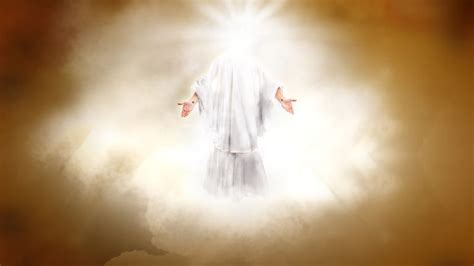
Today, we find ourselves at the site of the Ascension of the Beloved Son as he returns to his Heavenly Father, following his crucifixion and resurrection. Huddled around him are his handful of followers, most of whom had run for the high hills when trouble showed up, but whom he rounded up for his last few words. “You will receive power when the Holy Spirit comes upon you and you will be my witnesses,” he tells them.
Without much fanfare, he is lifted up and the cloud takes him from their sight, with them looking intently at the sky as he was going away. Then, as we heard, a peculiar thing happened, with two men dressed in white garments standing beside them. We can infer they’re angels, if from nothing else but their clothing.
And the pair of messengers says to them, “Men of Galilee, why are you standing there looking up at the sky? This Jesus who has been taken up from you into heaven will return in the same way as you have seen him going into heaven.” We’re told that, at this point, the disciples returned to Jerusalem, presumably waiting for the Spirit that will empower them.
As we might expect, it is an interesting choice of words that the pair of messengers says to the followers of the Galilean. “Why are you standing there looking up at the sky?” The question seems to carry a tone of impatience, suggesting that the disciples are wasting their time standing there looking up at the sky. They’ve seen the Galilean Teacher ascend, so why stick around? There is nothing more for them to see.
The word that the messengers use for stand–why are you standing there–is more than just being on your two feet. It carries the connotation of a prolonged form of stasis, like they are frozen on the spot. The word bears some similarity to what we might call hesitation, which, as we know, suggests someone is stuck, unable to move one way or another, caught in suspension.
Clearly, the messengers want to make clear that followers of the Risen Rabbi should not behave like iguanas, frozen in the moment, stuck in their tracks. The question they address to the disciples is meant to startle them out of their paralysis, light a match underneath them, get them out of this comatose state. It is as if the messengers eavesdropped on the conversation that the Rabbi had with these trusted followers, telling them they are to be his witnesses in Jerusalem, throughout Judea and Samaria, and to the ends of the earth.
Perhaps this explains why the disciples, on hearing the question from the messengers, return to Jerusalem, something clicking in their heads, reminding them that they can’t stand there doing nothing. They have a commission to live, a promise to fulfill, work to do. Standing there staring into space is one step towards stagnation, which is what happens to people who are stuck in a rut.
Choosing instead to step away and to take a step towards Jerusalem, they are taking the first step of the many steps that will become the journey they will make as witnesses of the Crucified Jesus who was raised from the tomb by the hand of his Loving Father. As we see, they never answer the messengers’ question with words. Instead, breaking free of their hesitation, they put one foot in front of the other, walking towards Jerusalem, where they will receive the power from the Spirit that was promised them, a power that pushes them into the streets of downtown Jerusalem and from there to the steps of the Roman Coliseum.
That is the question we also are left to consider today as we stand in the same place as those first followers, “Men of Galilee, why are you standing there looking at the sky?” The question puts before us the same choice put before the men of Galilee, to stand staring into the sky or to rouse ourselves out of our lethargy and to return to Jerusalem where work waits for us.
Certainly, there is something that tells us to stay where we are, to do nothing reckless, to be content looking for the Resurrected Lord up in the clouds. That is the temptation that comes to every would-be witness, a comfortable place where next to nothing is required of us, where we stand on the sidelines and never get into the game. But it is no place for true witnesses, for men and women of Galilee who want to continue the way of the Teacher in this world.
“To do good you actually have to do something.” The adage comes from an old TV ad, but it has an ageless truth, reminding us that doing nothing is the same as doing nothing good. A witness for the Resurrected Galilean is called to do good by actually doing good. It was the way of the Teacher and it is the way of the witness. “They do not love who do not show love,” Shakespeare wrote ages ago, making the same incontestable argument.
The problem, it would seem, is that we live in an age of inaction, a period in human history when, as one commentator wrote, we are living with “quiet satisfactions, the banality of normality.” We are content to stare into the sky, satisfied with the scenery, no desire to stir up things. We are in a state of stasis, inaction, indecisiveness, hesitancy.
“Are we without heroes?” one newspaper headline read, asking us why it is that we seem unable to find heroes in our world today, instead putting in their place “a fast-changing clutter of celebrities,” or what the writer calls the “fast-food throwaway version of a hero.” The answer may be as simple as this: in an age of inaction, heroes are few and far between.
As we surely can see, heroes do not hesitate, do not find themselves in a state of suspension. When the moment of doing something is put before them, to be or not to be, they choose action. Occasionally, we read or hear of such a person, a woman who jumps into a river to save a drowning person, while others stand on the bridge staring into the water. Later when asked why she did it, she simply answers, “I had to do something.”
For the follower of the Resurrected Beloved Son, it is the same. Confronted with a choice between hesitation or heroism, between inaction or action, between stagnation or stepping up, the true follower of the Galilean does not delay, doing something because doing nothing is not an option. The disciple is not lost in a maze of indecisiveness.
Seeing a hungry person, the witness of the Galilean Teacher gives him food to eat, not hesitating to help. Finding a desperate person down on her luck, the witness, without second thought, reaches into her pocket to assist. Watching a person from the wrong side of town kicked to the curb, the witness immediately steps into the foray to protect the unprotected.
“Men of Galilee, why are you standing there looking at the sky?” It is the question that stirs us to act, that snaps us out of our lethargy, that shakes us out of stasis. If we allow ourselves to hear the question, we find in it a challenge to our hesitation, a jolt to our inaction, a preventative to our stagnation. As witnesses of the One who walked this world doing good, we cannot hesitate to do something good in our world.
The Biblical scholar William Barclay once shared a story he had picked up somewhere. He said that a minister was told to take over the pastorate of a certain church. Although he had been warned that the congregation was, for all practical purposes, dead, he regarded the call as a challenge, accepting it. Sure enough, soon after his arrival, he discovered that the community was indeed dead.
Regardless of his planning, his exhortations, nothing could rekindle a spark of life into the group or reawaken a response of any kind. So one Sunday the new pastor announced that since the congregation was dead, he was going to perform a funeral for the community. On the appointed day, a coffin was brought into the church and placed in the center aisle, as it would have been done for any other funeral.
Wreaths of floral arrangements lined the sanctuary, as one might expect at a funeral. A crowd showed up, wondering what the pastor had in mind as he performed the service. Then, at the close of the ceremony, the pastor asked everyone to walk past the casket for a final viewing. As they approached the opened coffin, they were shocked to see nothing in it.
The box was open and empty. But the bottom of this coffin was not made of wood. It was a mirror. As each person looked into the coffin of the dead church, they saw only their own face. The pastor had made his point. Because the community showed no sign of life, no desire to do good, no effort to witness to the Risen Lord, they were as good as dead. And they had nobody to blame but themselves.
“Men of Galilee, why are you standing there looking up at the sky?” Today, as we recall that ancient event, we hear the same question asked of us. Hopefully, our answer is found, not in our being frozen to the spot, but in our many footsteps that take us to Jerusalem, doing good as the Teacher did good, helping others immediately, without a moment’s hesitation on our parts.
–Jeremy Myers

 Sunday Brunch