They were startled and terrified and thought that they were seeing a ghost. Then he said to them, “Why are you troubled? And why do questions arise in your hearts? Look at my hands and my feet, that it is I myself. Touch me and see, because a ghost does not have flesh and bones as you can see I have.” And as he said this, he showed them his hands and his feet. (Luke 24. 35-40)
In Charles Frazier’s epic novel, Cold Mountain, he tells the story of Inman, a wounded Confederate soldier who deserts his unit so he can return home to his wife, Ada, whom he left behind to tend to the family farm. So begins the long and difficult journey of 300 miles that Inman makes as he walks on foot across North Carolina, hoping to escape capture and praying that he will find his way back to Ada.
His journey back home is brutal, a weaker man surely breaking from the many setbacks and struggles that confront him. But not Inman. As the months drag on and as the perils increase, Inman’s commitment to make it to Black Cove where Ada waits grows stronger. Along the way, we see that the many challenges change Inman, impacting his character, making him not only stronger, but even heroic.
At last, holding Ada in his arms, he tells her that he has loved her ever since he sat in the church pew behind her many years before, looking at the back of her neck. Frazier then writes, “He talked to her of the great waste of years between then and now. A long time gone. And it was pointless, he said, to think how those years could have been put to better use, for he could hardly have put them to worse.”
He told her that “There was no recovering from them now. You could grieve endlessly for the loss of time and damage done therein. For the dead, and for your own lost self. But what the wisdom of the ages says is that we do well not to grieve on and on. And those old ones knew a thing or two and had some truth to tell, Inman said, for you can grieve your heart out and in the end you are still where you are. All your grief hasn’t changed a thing.”
“What you have lost will not be returned to you. It will always be lost. You’re left with only your scars to mark the void. All you can choose to do is go on or not. But if you go on, it’s knowing you carry your scars with you. Nevertheless, over all those wasted years, he had held in his mind the wish to kiss her on the back of her neck, and now he had done it. There was a redemption of some kind, he believed, in such complete fulfillment of a desire so long deferred.”
Inman, we can say, has come to see that scars cannot and should not be hidden because, in the end, they become a part of us, making us who we are, signposts on the journey that is our life. Any attempt to deny our scars serves only to cause more harm, adding insult to injury. Instead, they should be shown like the medals that decorate the chests of soldiers who have fought the fight.
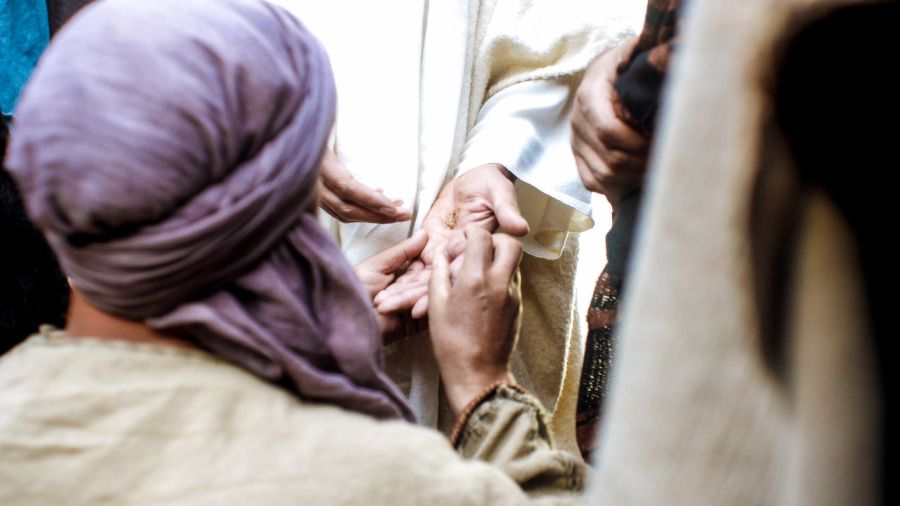
This is a lesson that the wise of the world learn. Today, another man who had fought the fight shows his scars to those who wait for him in an upper room. Standing before them, he tells them, “Look at my hands and my feet.” Startled and terrified, his friends, the scriptures tell us, stare at the nail marks on his hands and his feet. Pointing to his scars, the Crucified One says to them, “It is I myself.”
Aside from his sudden return to them, inexplicable and impossible because he had died on the cross, these words he spoke to them also left an indelible impression, one that has endured through centuries of retelling his story. He told them who he is by showing them what he has suffered, his identity forever after conjoined to his scars. He is the one who has suffered for others.
Take away his scars and he is not the same person; he is not the one who was nailed onto the cross for hours. Now, risen from the grave, he is known first and foremost by the nail prints in his hands and in his feet. Without the scars, he could not have been identified by his followers as truly the one who was beaten by leather straps, crowned with a headpiece made of thorns, and hammered to a beam of wood like the carcass of an animal.
Once we have understood that the identity of the Risen Lord is inseparable from his scars, then we are faced with an equal truth. It is this–our identity as his followers is dependent on the scars that we carry upon our bodies, signs that we also have suffered for others as he did. Those who would look at us must see the nail prints on our hands and our feet if they are to know we have followed the Crucified One.
As one spiritual writer said, “If you want to follow Jesus, then you had better get used to looking good on wood.” His words make the same connection between our identity and our scars as the Risen Lord made between his identity and his scars. As his followers, we are literally marked for life as those who have suffered for others in the same way that the Crucified Lord suffered for others.
Father Gregory Boyle, the Jesuit priest who has spent his life working with gang members in South Los Angeles, spoke in an interview about a young man from the streets whom he knew whose name was Jose. Father Boyle told Jose’s story without any attempt to soften it. Boyle said Jose was six years old when he heard his mother tell him to kill himself because no one wanted him. When he was nine, she abandoned him.
When his grandmother took him in, she brutally beat him. Not long after, Jose turned to gangs and drugs and crime. Ending up in prison within a short while, Jose said it was the best thing that could have happened to him. There, within those walls, he heard the message of Jesus. There, he learned that Jesus was the embodiment of God’s love and that he came to die for us on the cross.
Leaving prison, Jose turned his life around. Visiting with Fr. Boyle one day, he showed him his scars from his childhood beatings. He told Father Boyle he was no longer ashamed of his scars. As he said, “How could I help other wounded people if I did not make friends of my wounds?” Jose had come to see his scars, not as something to hide, but as something to bring him closer to others who also had scars.
That insight is the same that spiritual writer Henri Nouwen expressed so beautifully in his book, The Wounded Healer, wherein he looks at the sufferings of the world and the sufferings of people, expressing the belief that there is a fundamental woundedness in human nature. Allowing others to see our own wounds, internal and external, is a way of welcoming people, ministering to them, inviting them to find strength in their scars.
“Who can take away suffering without entering it?” Nouwen asks. For the follower of the Crucified One, the answer is simple. We cannot take away the suffering of others without entering into it, sharing in it, and finding healing in the shared experience. We save wounded souls by suffering with them, as Jesus saved a wounded world by suffering with it.
A woman who was dying of lung cancer was visited by a young chaplain during her last weeks. Not an easy woman to like, the woman seemed never to have any family or friends visiting her. Despite her efforts to push away the chaplain, he continued to come by her room. One day she asked him if he could get her a crucifix.
Answering her that he would try to find her one, he asked why she wanted it. “None of your damn business,” she answered. He found a small crucifix on a string of rosary beads that he brought to her. She took it without any comment. Each time after when he visited her, he found the woman holding the crucifix to her chest, even as she breathed heavily.
On the next to last day before she slipped into a coma, she unexpectedly said to the chaplain, pointing to the crucifix in her hands, “You know why I wanted this?” He answered that he really would like to know. She said, “He, he has been there,” showing him the tiny figure of Christ on the cross. “He’s been there. He knows. There’s nothing that they did to me that they didn’t do to him. He knows.” The woman died two days later with Christ on the cross clutched in her hands.
Reflecting later on the experience, one that stayed with him for years, the chaplain decided that the suffering woman could look at that crucifix and see God. In his words, “She saw Jesus, Jesus on a cross, like a great magnet drawing the suffering, needy ones to himself.” And how was it that she able to see Jesus? Because his scars proved to her, as she said, that “he had been there.” He knew suffering, as she knew suffering.
As his followers, we will draw people to us, not with our spit clean and starched-shirt lives, but with our scars and our wounds, indicators that we also have known pain and suffering. Our scars will show us as people who have been through the crucible, people whose souls have been made stronger by our suffering, people whose innermost character has been branded by these scars.
This truth is not an easy one for us, particularly in an age that abhors suffering of any sort, denies any personal imperfections, and pays good money to have scars removed. We are quick to turn away at the sight of scars on others and we hide our own beneath shaded makeup or layered clothes, believing these imperfections take away from who we are, rather than add to who we are.
So the story of the Risen Lord standing in front of his startled disciples, purposely drawing their attention to his battle scars, forcing them to look at his hands and his feet so that they know “It is I myself,” as he says, makes us uncomfortable, not only for him, but for ourselves. Quick to brandish our credentials as his followers, we are confronted with our own hesitancy to follow him to the cross, to suffer as he did for others.
And in that moment of truth, we realize our journey to discipleship is not yet completed. We simply do not have enough scars. We are left without an answer to the question that was posed by the philosopher Charles Peguy in a story he told about the man who died and went to heaven. When he came to the angel at the doors to heaven, the angel said to him, “Show me your wounds.”
The man, confused and shaken, answered, “Wounds? What wounds? I have not got any.” Whereupon the angel asked him, “Did you never think that anything was worth fighting for?” That same question requires an answer from each of us, especially those who would espouse the ways of the Crucified Lord, the one who fought for the poor, fought for the hungry, and fought for the underdog, showing his wounds to his first followers on the night of his resurrection from the tomb.
Was nothing worth fighting for? We learn today that, in the end, God will recognize us as one of his own, not by our worldly accomplishments, not by our scholarly sheepskins, but by our visible scars. If he finds them on us, then he will know we surely have lived as one of his son’s followers. If he sees none, then he will know we found nothing worth fighting for.
–Jeremy Myers

 Sunday Brunch