Pilate answered, “Do you want me to release to you the king of the Jews?” For he knew that it was out of envy that the chief priests had handed him over. But the chief priests stirred up the crowd to have him release Barabbas for them instead. Pilate again said to them in reply, “Then what do you want me to do with the man you call the king of the Jews?” They shouted again, “Crucify him.” Pilate said to them, “Why? What evil has he done?” They only shouted the louder, “Crucify him.” (Mark 15.9-13)
Born in Columbus, Georgia in 1917, Carson McCullers often wrote about the Deep South, her books providing a portrait of the isolation and denigration of misfits and outcasts in small southern towns. Her last novel, called Clock Without Hands, published in 1961, tells the story of four men in such a town. At one point in the book, McCullers presents a conversation between two of these men, a pharmacist in town who is dying of leukemia and an old judge who believes in white supremacy and promotes vigilante violence.
Wanting to share his ideas about human nature, Judge Clane offers Mr. Malone this explanation for the inherent conflict between people. He explains, “You and I have our property and our positions and our self-respect. But what does Sammy Lank have except those slews of children of his? Sammy Lank and the poor whites like that have nothing but the color of their skin.”
Continuing, the Judge says, “Having no property, no means, nobody to look down on–that is the clue to the whole thing. It is a sad commentary on human nature but every man has to have somebody to look down on. So the Sammy Lanks of this world only have the [Black man] to look down on. You see, J.T., it is a matter of pride. You and I have our pride, the pride of our blood, the pride in our descendants. But what does Sammy Lank have?”
Bigoted and belligerent for all of his life, easily enforcing Jim Crow laws in his courtroom, Judge Clane offers in those few words, not only an explanation for Sammy Lanks’s hostility towards the black man, but also a rationale, although without introspection, for his own indecency and intolerance. Every man has to have somebody to look down on.
Readers of McCullers’ works still find her words haunting and harrowing more than half a century later, probably because human nature seems sadly consistent, whatever the time or the place. While the externals of our world change over the years, the internal terrain of our hearts remain the same across the many seasons, its chambers continuously creating somebody we can look down on.
So, with that in mind, we approach the scriptures today with their terrible message about the humiliation, harassment, and hanging on a cross of an innocent man whose only sin was he didn’t believe in the cruelly concocted barriers placed between persons because of caste, color, or creed. Unlike others around him, he didn’t stomach the belief that every man has to have somebody to look down on.
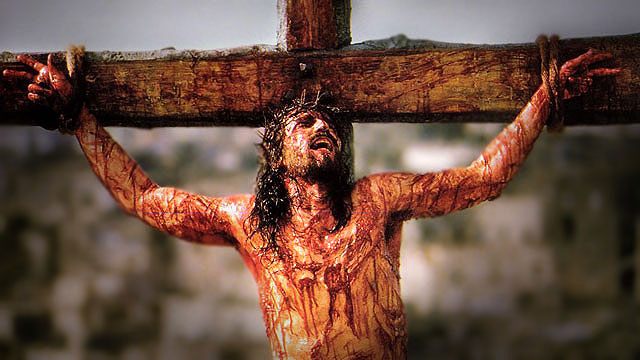
And that belief, so contrary to his times and so challenging to the darkness in the human heart, wrote his death sentence, spelled out on a wooden plaque nailed to the cross beam above his head, the words written in his own blood, “King of the Jews.” It was one final insult hurled at him as he struggled to breathe on the cross, taunting him as his life seeped out of him in sweat and blood and agony, this slapstick mockery, calling him a king, putting a crown of thorns on his head, and hanging a purple cloak around his shoulders.
They did it because it sent a chilling message to others who might want to espouse similar doctrines that challenged societal beliefs, such as feeding the hungry rather than letting them starve, seeing sinners as a brother or sister rather than seeing them as someone to look down on, touching the sick with compassion rather than staying miles away from them for fear of contagion. The message was clear–do as he did and you will be crucified.
Every man has to have somebody to look down on. That belief oils the cogs of so-called civilized people. Even Pilate, the long arm of the law, could see through the plots and ploys of those who wanted the Galilean punished and put away, even if it did not change his sentencing the man to death. “What evil has he done?” he asked the conspirators and court officials.
Unable to give a clear answer, since that would require an honest look into their own hearts, where depravity and pugnacity had long set up house, they only shout the louder, “Crucify him,” the clamor electrocuting the weak protest of the last crumb of their conscience. Choosing the life of a heartless criminal over the life of a good samaritan, they exposed the ugliness that spews forth from a corrupted heart.
Trained in the politics and wars of Rome, a premier school for learning the dark deeds that humans are capable of doing, Pilate knew it was out of envy that the chief priests had handed the man over, because, truth be told at last, they couldn’t look down on him, so much better, so much kinder, so much gentler was he than they were. Given the option of becoming like him or doing away with him, they chose the easier course, as broken humanity always does.
So Barabbas, the criminal, walked away a free man on that day, and the Galilean, nicknamed the King of the Jews, trudged up the rocky hill where he would be nailed to a cross, left to bleed out like a lamb, and roundly mocked by the peepers and voyeurs who enjoyed the blood and the gore. The naked wrongness of the dastardly deed cried out to the heavens for justice, but they were silent, even as the man wept out the words, “My God, my God, why have you forsaken me?”
But perhaps what seemed like silence on this side was anything but, as sobs and shock shook through the ethereal sphere, the Creator’s own heart broken in that moment as he saw his son suffering at the hands of the creatures he had created, creatures he had made for love, not for hatred; creatures he had designed for morality, not for cruelty; creatures in which he had planted a spark of divinity, not this specter of darkness.
We deceive no one but ourselves if we believe these events on that day in Jerusalem were singular and sporadic. They were not. And we dishonor the Crucified One If we weep for him, all the while we crucify the same ones he loved, the bodies and nobodies and somebodies who we look down on, for no good reason, except we want to see them as different, as deviant, as despicable because of class, color, or creed. If we weep for him but do not weep for them, then our tears are wasted.
Falling to the ground, the heavy wood impossible to carry, he spoke cautionary words to the women on the sidelines, saying to them, “Weep not for me, but for your children,” his words echoing through the ages because he understood that the hatred that is within the human heart is not innate, not put there by our Creator, but it is something taught to our children, put there by our prejudices.
If for no other reason, then, his crucifixion stands as a constant challenge to our proclivity to divide, to differentiate, and to dissect others into cliques, clubs, and outcasts. If we weep today, then it should not be because of what others did to him, but because of what we do to others, warm puddles of blood still gushing from beaten bodies, sharp nails of derision still hammered into broken bodies, ugly name-calling still hurled at anybody who dares to look, sound, or dress differently from us.
“Hail, King of the Jews!” The names may change, but the damage inflicted on those we mock, coldcock, or lock away stays the same, our words dehumanizing the one we look down on, our name-calling turning the other from a who into a what. Once we have turned a person into a what by our name-calling, then we find it easy, just a small step, to treat him as a thing, not as a person. It is always the first trick in the toolbox of treachery, to label someone, denigrating them, killing their spirit, allowing us to treat them as a sport.
As Eugene, the hard-working, right-hand, black man who works for the old woman Lousia in the movie “Wish You Well,” says to George, the ornery, bigoted farmer next door, after years of having been called by him the derisive nickname, “Hell-No”, his voice suddenly strong and sure, “My name is Eugene, not ‘Hell-No,’ and you better start calling me by my name.” Risking his life by confronting the white man, Eugene reclaims his humanity, demanding to be called by his rightful name, no longer bowing to the browbeating nickname “Hell No.”
At this time each year, the story of the Crucified Jesus is retold to us, reminding us of those horrific hours when the inhumanity of man reached its nadir, begging us to rediscover our better angels at long last. Unless and until we do–and the bloody evidence is clear on this–his crucifixion continues, done over and over again as “one of these least ones” is put on a cross by our own doing. It is a pitiable day, today, for all concerned.
A decade ago, a Jesuit priest born and raised in Africa, wrote a book that told of the world that he had known, a place where tribal animosity between the majority Hutus and the minority Tutsis resulted in the slaughter of thousands of Tutsis, for no good reason except the ones with the power wanted to look down on the ones without the power.
All the stories are told through the eyes of the children caught up in this world of partisan hatred. The most appalling story–even if by only a matter of degrees when confronted with the atrocities in the other stories–is about a Hutu man married to a Tutsi woman. Their nine-year-old daughter, who narrates the story, describes her Papa as looking like most Hutus, very black, with a round face, a wide nose, and brown eyes. Her mother looks like a Tutsi, with high cheekbones, a narrow nose, and skin so light you can see the blue veins on the back of her hands.
The tribal animosities come into their village and soon the Hutus are going house to house, chopping up with a machete any Tutsis they find. Monique’s mother prepares her for the assault, sure that it will come to them, frantically telling her daughter “when they ask you, say you’re one of them.” The mom insists that Monique promise her that she will answer the attackers in this way, seeing this as the only way to save the young girl’s life. This warning gives the title to the book, Say You’re One of Them.
Soon enough, the worst happens, and Hutus are pounding on the door, and the little girl is spared because the leader of the Hutus tells the others “she is one of us.” But Monique’s mother does not escape. As the girl and her brother watch, the mob demands that the children’s father kill his wife right in front of them, using a machete to cleave her head in two.
The leader of the mob, a man called the Wizard by the people, tells the husband, “We must remain one. Nothing shall dilute our blood. Not God. Not marriage.” Weeping as he stands before his wife, the man brings the machete down on her head. After the mob leaves the house to wreck the same murderous hatreds on other Tutsis in the village, the young girl grabs her mother’s broken crucifix and runs into the street.
And this is what she sees. “There are corpses everywhere. Their clothes are dancing in the wind. Where blood has soaked the earth, the grass doesn’t move. Vultures are poking the dead with their long beaks.” Then she sees her brother, Jean. “Jean is driving them away, stamping his feet and swirling his arms. His hands are stained, because he’s been trying to raise the dead. . . His eyes are wide open, and there’s a frown on the babyish forehead.”
Monique, with her brother on her back, slips into a nearby brush, hiding behind a bush, one hand holding the crucifix, the other shielding her eyes from the tall grass and the branches, her feet cold and bracing for thorns. She says to her little brother, “Maman says do not be afraid.” Then the two lie down on the iridescent crucifix to hide its brightness. “We want to live, we don’t want to die. I must be strong,” she says to herself.
As she watches, the mob runs past them, dragging her mother’s body out of the house and setting it on fire. She looks around. Everywhere is dark and the wind spreads black clouds like blankets across the sky. Her brother is playing with the glow of the crucifix, babbling Maman’s name. And there the story ends, with a crucifix, as does the story in the scriptures today.
If we want a different ending, then we will have to write it ourselves.
–Jeremy Myers

 Sunday Brunch