And this is the verdict, that the light came into the world, but people preferred darkness to light, because their works were evil. For everyone who does wicked things hates the light and does not come toward the light, so that his works might not be exposed. But whoever lives the truth comes to the light, so that his works may be clearly seen as done in God. (John 3.18-21)
In telling the story of the early settling of the German-Catholic community of Windthorst in North Texas in his book called Mesquite Does Bloom, the history writer, Father Albert Schreiber, an orphan boy brought to Windthorst in its earliest days, included an anecdote about those times when the settlers needed to go to Henrietta for supplies, the nearest town with a railroad, some thirty-plus miles away.
Given the transportation of those times–horse and wagon–and the lack of real roads–trails in the prairie grass–the trip was neither easy nor short, difficult for us to imagine in our more travel-friendly times with paved roads and with GPS-guided cars. Because the trip often would mean coming back after the sun had set, when the open prairie was covered in absolute darkness, the settlers devised a means of providing direction for the travelers so that they would not become lost, no familiar landmarks visible to them in the night.
Using a tall cross that had been hammered into the rocky ground of a high hill–the highest point in the area–by the founder of the community, Father Joseph Reisdorff, indicating the site of the church that would be built on the hill, the settlers would light a lantern and place it on the horizontal beam of the cross planted atop the hill.
When darkness descended, the light from the lantern swinging from the cross could be seen from miles away, providing a clear signal for the settler trying to make his way back home in the darkness with his tired horse and loaded wagon. Keeping his eye on the flickering light from the far-away lantern, the settler knew where he needed to go, ensuring that he arrived back in the small settlement safe and sound, even as the darkness of night surrounded him.
That anecdote, tucked away in the pages of the old book, provides an apt image for our study of the scripture passage that is presented to us today in the Fourth Gospel. That passage, the greater part of which is well-known to most readers of John, tells of the conversation between the Galilean Teacher named Jesus and the Pharisee named Nicodemus.
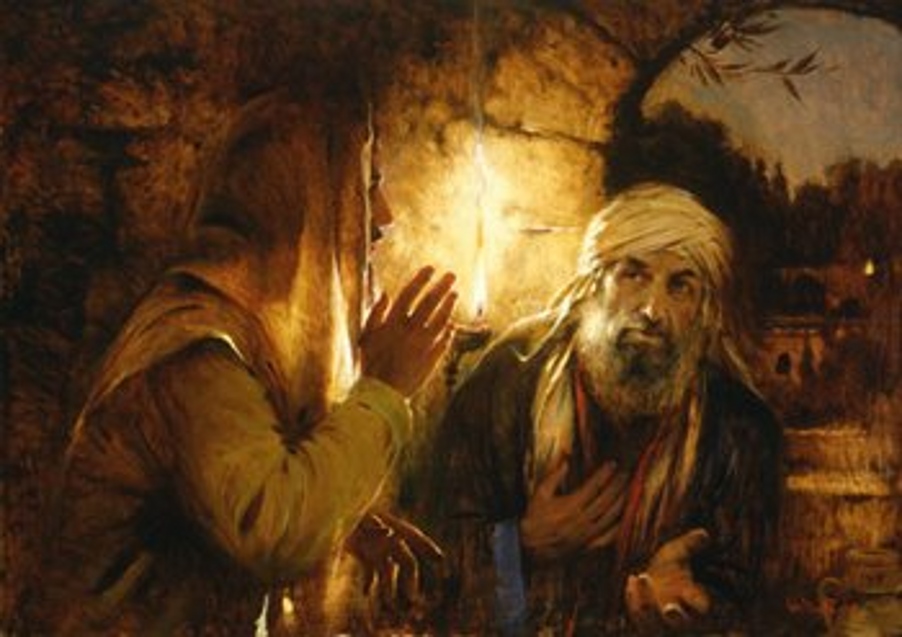
John, the master of symbolism, begins the encounter with a seemingly simple sentence, “Now there was a Pharisee named Nicodemus, a ruler of the Jews. He came to Jesus at night and said to him, ‘Rabbi, we know that you are a teacher who has come from God, for no one can do these signs that you are doing unless God is with him’” (3.1-2).
Knowing John always works with symbolism in his telling the story of the Word Made Flesh, we should slow down in our reading of these words, sensing that his reference to this visit as occurring at night is like a speed bump, alerting us not so much to a specific time, but to a specific theme. That theme–light in the darkness–will play out in the conversation that follows, the meeting serving as a platform for a theological truth that John wants his readers to understand, summarized in the short phrase now known throughout the world, spoken by Jesus to Nicodemus, “For God so loved the world that he gave his only Son” (3.16).
As the Galilean Rabbi, the only Son of God, instructs the religious leader of the Pharisees, he speaks of his entrance into the world as a light. “The light came into the world,” he says, expecting the Pharisee Nicodemus, who has come to him in the darkness, to understand the importance of light, necessary for one to see with the physical eye and with the spiritual eye.
Nicodemus, listening to the Rabbi explain his purpose in terms of light in the darkness, realizes he has come to the light that penetrates, not only the darkness of the night, but also the darkness of his soul. The Pharisee, using the night as a way to hide his shame in being seen with the Galilean, comes to the insight that his insecurities are exposed in the light of the Rabbi’s words.
Fearful of his fellow Pharisees and their criticism, Nicodemus, filled with cowardice and confusion, chooses the opaqueness and obscurity of the dark night, not risking exposure and exclusion that would come with meeting the Teacher once the sun has cast light on the city square. He wants to hide his actions from scrutiny, although he also cannot resist going to the Galilean, who, ironically, brings to light everything that is hidden.
“People preferred darkness to the light,” the Rabbi tells Nicodemus, who hangs his head, understanding that the Rabbi, with a clarity of vision that penetrates the night, has seen even into his soul, as well as into the soul of the world, a place populated by people who, like rodents or robbers, scurry about in the shadows committing their sins.
Using the cover of darkness, the inhabitants of the world do their evil, abhorring the light because, as the Rabbi says to Nicodemus, “Everyone who does wicked things hates the light and does not come toward the light lest his works be exposed.” In short, we all like to live in the shadows because the heart of darkness is not a work of fiction, but a way of life.
Like snakes poked by a stick, we bristle and balk at the suggestion that we prefer the darkness, knowing well how we are quick to turn on lamps in the house and headlights on the car once dusk has crept into our world, but also knowing, even if not fully admitting, that we like to keep many things in the dark, especially those things that, if exposed, would bring disfavor and disrepute to ourselves.
Even if we cannot see it because we don’t permit the light of awareness inside, like a person who refuses to turn on the light over the mirror for fear of seeing wrinkles, each of us has a dark side, that place in our souls where all the ugly stuff stays, the things we’d rather not admit, the corrosives like avarice, prejudice, and cowardice. Here in this motel room of bad smells and bad light, we stash in the dark corners the rotten things about ourselves like our indecency, our inhumaneness, and our insensitivity towards others.
These things, the Rabbi tells Nicodemus, we prefer, or translated better from the Greek, we love, an indictment of the rottenness at the core of humanity, this love of wicked things. It is not that we take wickedness out for a date and decide to drop her because we’re incompatible. Just the opposite. After one date, we’re smitten and want to marry her.
And therein is the irony and the idiocy of the situation. As the Rabbi tells Nicodemus, God loves the world, giving us his only Son, but the world loves darkness, crucifying his only Son. With clarity that only comes from living in the light, the Rabbi tells Nicodemus our works are evil, leaving little room for disputing, his eyes seeing clearly into the soul of humanity, exposing our depravement, depredation, and moral destitution.
Character, someone once said, is what you are in the dark. If that is the case, then our character is not good. Stripping us of our drag clothing and our illusions about ourselves, the Fourth Gospel does not paint a pretty picture of people like you and me. The point is not to condemn us, as the Rabbi also makes clear, telling Nicodemus that God did not send his Son into the world to condemn the world. Rather, the point is to try to save us.
And that salvation only comes if and when we allow the light that comes from the Son to guide us on the path of life, showing us the right way, warning us against potholes in the road. Sent by the Father who loves the world, the Son walks before us, love and life and light in every step he takes, asking us to follow him, doing as he did, opening our souls to the purifying light of God’s love, like a dank and dark room whose windows are suddenly opened, allowing fresh air and sunlight to enter.
Speaking of the light and grace that Jesus brought into the world, Pope Francis, in a Christmas homily, once reminded the world that Jesus embodied light and love, but those who hate walk in darkness. As he said, if we love God and our brothers and sisters, we walk in the light. But if our heart is closed, if we are dominated by pride, deceit, self-seeking, then darkness falls within us and around us.
His point is clear. Each moment that we live as the Galilean Teacher lived, a bit more light enters the world, and, as more people do more good, the light becomes brighter, like the morning dawn breaking in the east, gradually bursting through the darkness of night, until everything is flooded with the rays of light, the world now bathed in daylight, incandescence and illumination everywhere, forcing the creatures of the night to scurry underground into dark holes where the light cannot reveal their misdeeds and their mistruths. A new day dawns each time we imitate the Son.
As these days of Lent move ahead, days when we are to walk more and more towards the light, even as the dark deeds of Golgotha steadily come into sight, we intensify our own efforts to become bearers of light rather than its executioners. So we love more and hate less; we share more and horde less; we forgive more and punish less. In a word, we bring a bit of light with us, not a pall of darkness.
No one says it is easy, especially in a world that loves darkness more than it loves light. But just as the first command that the Most High God ordered when seeing the darkness of the world was, “Let there be light,” so each of us, when seeing the darkness engulfing the world again in darkness, can find ways to say, “Let there be light.” The ways are many, whether by deeds of charity, acts of kindness, or efforts to love. The simple truth is that darkness cannot coexist with light. Every ray of light we bring with us eradicates a spot of darkness, like radiation killing a cancer cell.
If the effort to bring light seems daunting, if not impossible, when so much darkness surrounds us, we might remember something Anne Lamott said in her latest book. “Hope,” she said, “springs from realizing we are loved, can love, and are love with skin on.”
Until that realization takes root, and our lives begin to regularly show that love, we can pray the same prayers Lamott said she often prays. The first is, “Help me start walking in your general direction.” If that isn’t getting the job done, then we can try the second, or what she calls the greatest prayer. It is this: “Help me not to be such an asshole.”
–Jeremy Myers

 Sunday Brunch