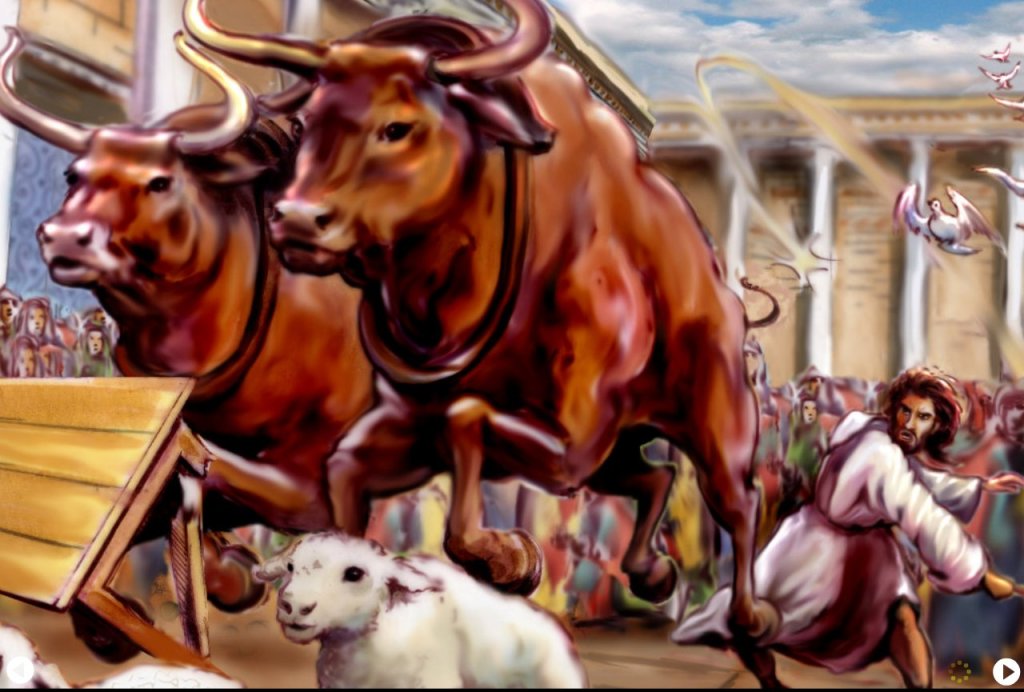
Jesus went up to Jerusalem. He found in the temple area those who sold oxen, sheep, and doves, as well as the money changers seated there. He made a whip out of cords and drove them all out of the temple area, with the sheep and oxen, and spilled the coins of the money changers and overturned their tables, and to those who sold doves he said, “Take these out of here, and stop making my Father’s house a marketplace.” (John 2.14-16)
Several years ago, a woman made a pilgrimage to the holy well of the sixth century monk, Saint Colman, who lived in the rugged Burren mountains in the west of Ireland. Before the group began their walk to the site, the guide instructed the six pilgrims to choose a stone with sharp edges from the ground around them. They were, he said, to take the stone with them on their climb.
He offered these instructions to the pilgrims, “As you walk across the slabs of limestone and shale, slide your hand in your pocket. Finger your jagged stone while you think of the jagged stone in your life. Consider the thing that irritates you, confounds you, frustrates you, holds you back. And while you are doing that, as you walk across the Burren, pay attention to everything. Watch and listen.”
The woman did as the guide had said, walking along and thumbing the rock in her pocket, identifying it with her daughter-in-law now in the midst of a divorce from her son. She thought of the little girl that had come from the marriage, feeling fear and dread for what would become of the child. As she rubbed the stone, she thought of the frustration in her heart over her inability to do anything about the bad situation.
Trudging along the path, she felt the long nights of anxiety, the sorrow for her son, the ache for his broken heart. Finally, she, along with the other pilgrims, found herself at the cave where the monk had lived his solitary life. As she stood before a gurgling pool of cold, clear water, the guide instructed the pilgrims, “Take your stone. Take your worries and your fears and your anxieties and cast them into the well.”
The small group did as the guide had told them, casting their stones into the pool, blessing themselves with a bit of the water after dipping their hands into the pool. Reflecting on the moment, the woman wrote, “Long before Saint Patrick ever set food in Ireland, the pagan Celts believed their island was a thin place, a holy place, where the veil between heaven and earth, time and eternity disappears.”
She concluded, “It seemed to disappear that gray morning, as we headed back, silent and unburdened. My pocket was empty. The stone was gone, and my worries disappeared, too, at least for a while. I prayed prayers of gratitude. I prayed for my ex-daughter-in-law, and for my son, and for their child. I prayed for healing.” She added, “I think we all prayed for healing–washed in the waters of Colman mac Duagh’s holy well.”
Her story showed an unburdening of her soul, a means of expelling those things in her heart that brought her misery, that mired her in sadness, and that made her days heavy. Casting the sharp-edged stone into the well, she cast away the painful things that polluted her soul, cleansing it of these malevolent intruders that stole her peace of mind and hindered her growth towards God.
When Rabbi Jesus entered the Temple in Jerusalem that particular day, he did much the same thing. According to the text from scripture, he threw out of the temple everything that was polluting this sacred space, including sheep and oxen, money-changers and vendors. The evangelist uses a particular word to describe this action by the Galilean Teacher, stating he “drove out” the animals.
That word, “exebalen,” is the same word that the scriptures use when telling of those occasions when the Rabbi of Galilee drove out demons from those persons who were possessed by evil spirits. Coming face to face with these demonic forces, the Galilean Teacher drove them out of the persons whom they had overtaken, purifying their souls, lifting their spirits, renewing their hopes.
Again, in Jerusalem this time, Rabbi Jesus does an exorcism, not of a person, but of the Temple, driving out the evil that had invaded this place that he called “my Father’s house.” These unholy trespassers had entered the holiness of the sanctuary, trampling the clean ground with unclean feet, stealing the sacred space and installing pens for animals. Once a place where a person could find the presence of the Most High God, now the pilgrim found the presence of hawkers and brutes.
Without hesitation, the Galilean dislodged the vendors from their booths and destroyed the tables where money-changers made a buck off of pilgrims to the holy mountain. He drove out the animals and dealt a blow to the commercial shops set up for the day. With each swing of the whip and with each shout from his lips, he exorcised the place, sending the evil out the door along with the oxen and the offenders.
Rightly, the incident would be remembered as the cleansing of the Temple, just as other incidents would be remembered as the cleansing of possessed persons. In both instances, something malevolent had taken over something or someone, and restoration required driving out the invaders and emptying the space of these intruders.
Reflecting on the event, especially during these days of Lent, the obvious lesson for us is to do as Rabbi Jesus did, removing from our hearts anything and everything that has brought a toxicity to our spirits, exorcising those demons, great or small, that have set up house in the sacred space of our souls, purging our lives of those dark forces that prevent our growing closer to the Source of our life.
As with any exorcism, it begins with calling the demon by name, in this way recognizing who and what it is, and gaining control over it by bringing it into the light, rather than allowing it to live and grow in the darkness like mold and mildew. The animals that we have allowed into the sanctuary of our souls are not sheep and oxen, but they have the same brute force and the same untamed ferocity.
Perhaps the first of the demons that we must drive out of our hearts is the one that bears the name idolatry, first because it is the primary desire of demons to lead us away from the true God, first because almost all the dark things that swirl around us are rooted in idols, and first because it is the primordial offence against the Most High God, to put another in place of him.
Our idols are as numerous as the wood-carved idols of Rome, one on every street corner and one or two with every step taken in one direction or another. While the names of our idols are not the same as those of the old Roman idols, they do the same work–stealing the place of honor from the Most High God and putting in his place something of our own making.
The philosopher and teacher Sam Keen once offered his students an example of idol worship. He asked them to take out their wallets or purses and to spread out on their desks the items they held. As the students did as Keen had asked, he pointed out their money, their credit cards, their social security cards, business cards, and insurance cards.
Then, Keen asked them to take a dollar bill and tear it to pieces. Only a few of the students did it. They considered it a sacrilege to destroy the money. Keen looked at them and said to them, “These then are your gods.” Like the Hebrew slaves, we dance around golden calves everyday, blinded by their opulence, enamored by their resplendence, and bamboozled by their appearance. Dutiful and dependable worshippers, we are quick to fall to our knees before them.
Of course, today we have a pantheon of false gods that we worship, each one becoming a demon in time because it is the nature of false gods to grow larger and larger, consuming more and more of our spirits. Always, these false gods unleash a demonic force that takes control of our lives, leaving us their playthings and their peons.
Their names are legion, as the scriptures attest, some called tribalism and cynicism, others called narcissism and hedonism, still others called obstructionism and indifferentism. These are not just a few bad apples or black sheep. Demons always come from large families with numerous offspring, including materialism and consumerism, pharisaism and quackism, racism and egoism.
Sadly, we have opened the doors to the temple of our souls, inviting inside these dark forces, as well as others, such as enmity and hostility, resentment and entrenchment, blindness and tightfistedness, until our temple is as full of brutes and shady dealers as ever was the Temple in Jerusalem, that is, until the Galilean stepped inside and, whip in hand, drove all the demons out the front door.
As he did, so we must do, if we are to cleanse the sacred space that we call our souls, the sanctuary within us where the divine presence abides, the quiet place where God speaks to us in silence. With a whip in our hand, we also have to show the same commitment as Rabbi Jesus did, driving out the demons that have squattered in our souls, shutting down the marketplace that rightly belongs to the One we call our Father in heaven.
As we continue the arduous task of joining Rabbi Jesus in cleansing the temple, this time not within the city limits of Jerusalem, but within the city limits of our souls, and this time not a one-time deal, but a life-long effort, we want to remember the story told by an elder of the Cherokees who wanted to teach his grandchildren an important lesson about life.
He said to them, “A fight is going on inside me. It is a terrible fight between two wolves. One wolf represents fear, anger, envy, sorrow, regret, greed, arrogance, self-pity, guilt, resentment, inferiority, hatreds, false pride and superiority.”
He continued, “The other stands for joy, peace, love, hope, sharing, serenity, humility, kindness, benevolence, friendship, empathy, generosity, truth, compassion, and faith. This same fight,” he said to them, “is going on inside you, and inside every other person in the world.”
The grandchildren were silent for a moment until one of them asked his grandfather, “Which wolf will win?” The old man offered a simple answer. He said, “The one you feed.”
–Jeremy Myers

 Sunday Brunch