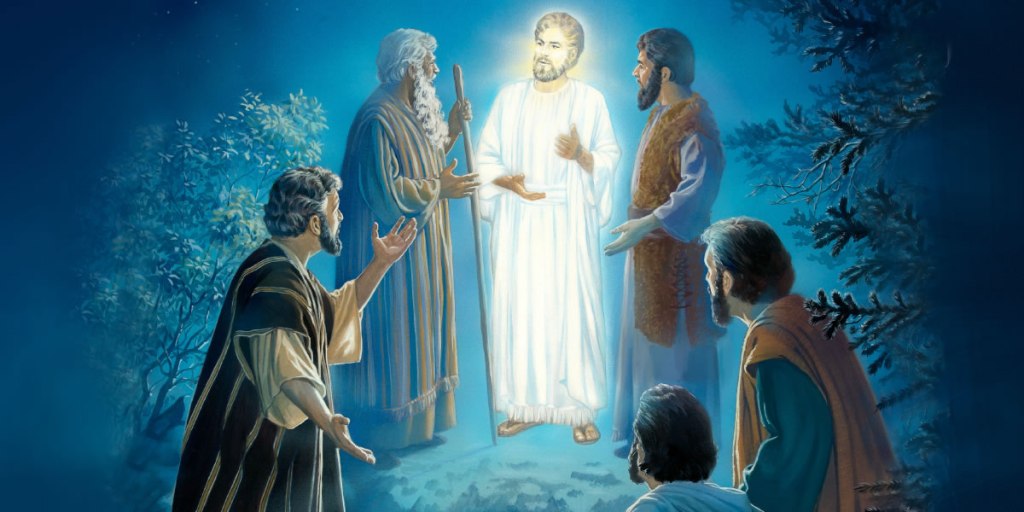
Jesus took Peter, James, and John and led them up a high mountain apart by themselves. And he was transfigured before them, and his clothes became dazzling white, such as no fuller on earth could bleach them. (Mark 9.2-3)
Speaking of his work with gang members in Los Angeles, Father Gregory Boyle recalls the time that one gang member, Lencho, came to his church office, complaining that he was having a hard time finding a job. Lencho was two days fresh out of Corcoran State Prison where he had been locked up for ten years. Now twenty-four years old, every inch of his arms was covered in tattoos.
“Most startling of all,” Father Boyle said, Lencho had “two exquisitely etched devil’s horns planted on his forehead.” Father Boyle told him to show up the next morning at one of his work facilities, Homeboy Silkscreen, a job site that had employed five hundred gang members over the years. Giving Lencho a day to get used to the job, Father Boyle called him up two days later to see how the first day on the job had gone.
“It feels proper,” Lencho tells him. “In fact, I’m like that vato in the commercial–you know the guy–the one who keeps walkin’ up to total strangers and says, ‘I just lowered my cholesterol.’ Yeah. That’s me right there.” Unsure of exactly what Lencho meant, Father Boyle waited. Lencho explained, “I mean, yesterday, after work, I’m sittin’ at the back a’ the bus, dirty and tired, and, I mean, I just couldn’t help myself. I kept turning to total strangers–’Just comin’ back, first day on the job.’”
(He turns to another.) “‘Just getting off my first day at the work.’” Reflecting on Lencho’s obvious joy at having a job, Father Boyle pointed out to the reader, “At Homeboy Industries, we seek to tell each person this truth: they are exactly what God had in mind when God made them–and then we watch, from this privileged place, as people inhabit this truth. Nothing is the same again. No bullet can pierce this, no prison walls can keep this out. And death can’t touch it–it is just that huge.”
It was a moment of transfiguration for Lencho. Nothing would be the same again. He had finally found his place in the world and “it felt proper,” as he said. A similar experience happened when the Galilean Teacher stood on a mountaintop with three of his friends and a voice from a cloud spoke these words, “This is my beloved Son. Listen to him.”
As Lencho had experienced, so the Rabbi experienced–a moment of transfiguration, when, in so many ways, the Rabbi came to see his call clearly, his purpose set in place. And it felt proper. There, on the mountaintop, Rabbi Jesus heard the voice, not only with his ears, but with his heart, and understood exactly what God had in mind when his Heavenly Father had sent him to earth. Now, in the years that remained, all he had to do was, as Father Boyle said, “inhabit this truth.”
And the way the Rabbi inhabited that truth, as we know from the scriptures, is by becoming the living manifestation of God’s love to all he met on his journey, especially to the misguided, the misunderstood, and the misjudged. Opening his arms to all those in need, he showed them that each of them was a special child of God, conceived in love, carried in his heart, and called by name. No one was overlooked and none was left on the side of the road.
That mountaintop experience clarified and concretized the purpose of the Galilean’s life on earth, focused and finalized his path in this world, the voice from above calling him the beloved son, answering once and for all who he was and who he was meant to be. While the experience lasted but a moment, it stayed with him for the rest of his life, framing his life as one spent in service to others, even to the point of laying down his life for those who hated him.
Called a moment of transfiguration because of the luminosity that surrounded the Teacher, it could just as easily have been called a moment of enlightenment because of the luminosity that entered the Teacher, setting him on the way to a life that mattered, a life with purpose. In that moment, he not only heard who he was, but saw who he was. There was in that momentary flash an alignment of divine intent and human response. He would spend the remainder of his life “inhabiting that truth.”
A decade or more ago, the writer Rick Warren wrote a popular book that challenged his readers to come to that same transformative moment. The book called, The Purpose-Driven Life, sought to provide an answer to the existential question every human eventually gets around to asking, “What on earth am I here for.” His book offered a compendium of insights that, if allowed residence in our hearts, moves us towards a greater understanding of our purpose in life.
Foremost among his recommendations is the belief that the answer to our purpose in life is found in becoming what God created us to be. As he stated, “You didn’t create yourself, so there is no way you can tell yourself what you were created for.” Or, in another place, he offered these words, “You were made by God and for God–and until you understand that, life will never make sense.”
For the serious searcher, these aphorisms make sense and set the person on the proper path to finding purpose. Rabbi Jesus, having come to clear-sightedness about his purpose in life when he stood on the mountaintop simplified it even further, saying, “Come, follow me.” With these words, he told others that if they did as he did, they also would find their purpose.
To do as he did would only require that we learn to love others unconditionally, that we forgive others unhesitantly, and that we embrace others non-judgmentally. Cultivating a lifestyle that puts service to others ahead of service to self, he said, brings purpose and results in a life that matters.
A meaningless life, on the other hand, the Galilean made clear, is a life concentrated on self, devoid of concern for anybody else, empty of consideration for anything but self-aggrandizement. If we choose to fatten ourselves on self-indulgence, we end up selling our birthright for a bowl of soup, and our purpose becomes little different than bloated geese who stuff themselves on food to become a dish of pate de foie gras.
Sadly, we find just such people in our world who are much more satisfied in feeding themselves than in feeding others, an appetite and an apathy that will bring nothing of lasting value, nothing that really matters in the end. And because so many today refuse to follow the teachings of the Galilean, because we do not listen to him as the voice from heaven asked us to do, we find a world too often inhabited by shallow and superficial people, soulless and spineless persons who cannot commit to anything bigger than themselves, persons sure they are going somewhere in life, but who are, in fact, only hamsters spinning on wheels.
The remedy for this sickness of self-promotion that threatens to weaken us and to destroy our society is to go to the mountaintop, as Rabbi Jesus did, there to listen for the voice from the heavens that reminds each of us of our calling and our purpose, opening ourselves to the One who created us for a specific purpose and allowing his voice to answer the question of what on earth we are here for.
Should we heed the divine imperative in that transitional moment of transparency, it will be as transformative for us as the transfiguration was for Rabbi Jesus, putting us on the path we were always meant to walk, pointing us to the place we were always meant to go, providing us with the possibilities we were always meant to have.
In another of Father Boyle’s books, he told of another young man from the barrio who broke down before him one day, explaining to Father Boyle that he seemed always to be frustrated in his attempts to get a fresh start, always stopped in his efforts to become more than he was. With tears in his eyes, the young man finally said to Father Boyle, “I just want to fly.”
I just want to fly. In the end, that is the same thing that the Heavenly Father wants each of us to do–to fly. He wants us to fly like the beloved son or beloved daughter that he created us to be, someone meant to do something that matters, a song meant to be sung.
Years ago, a wise spiritual writer suggested that we should not waste our time worrying about the many questions we believe our Creator will ask us when our lives are over and we will make an account of them. There will be only one question he asks, said the spiritual writer. And that question will be, “Why didn’t you become you?”
–Jeremy Myers

 Sunday Brunch