On leaving the synagogue, Jesus entered the house of Simon and Andrew with James and John. Simon’s mother-in-law lay sick with a fever. They immediately told him about her. He approached, grasped her hand, and helped her up. Then the fever left her and she waited on them. (Mark 1.29-31)
In his beautifully written book on spirituality, The Alphabet of Grace, Frederick Buechner makes this stunning observation. He writes, “I say that feet are very religious too.” Anticipating confusion on the part of the reader, if not contradiction, he explains, “I say that if you want to know who you are, if you are more than academically interested in that particular mystery, you could do a lot worse than look at your feet for an answer.”
Considering that we are not still convinced, Buechner continues, “When you wake up in the morning, called by God to be a self again, if you want to know who you are, watch your feet. Because where your feet take you, that is who you are.” There, in that last sentence from Buechner, we find, not only the rationale for his saying that our feet are very religious, but perhaps also the clearest litmus test of our being a follower of the Galilean Rabbi, people whose feet are supposed to in lock step with his footsteps.
As we find ourselves listening to that passage from the Gospel of Mark that is provided to us today, we learn, if we give it more than a quick glance, that Mark–within just a few verses of the start of his telling the story of the Galilean–makes a case for the same statement that Buechner proposed, implicitly drawing our attention to the movement of feet.
Cleverly inlaid into the narrative, like shiny pieces of glass in a mosaic, Mark describes a lot of foot action in these few sentences. A sampling of his phrases easily confirms this subtle emphasis on feet. Here, a handful of selected phrases suffice to prove the point. Mark writes, “On leaving the synagogue Jesus entered the house.” “He approached and helped her up.” “They brought to him all who were ill.”
Or again, “The whole town gathered at the door.” “Rising very early, he left and went off. Simon and those with him pursued him.” “He told them, ‘Let us go to the nearby villages.’” “So he went into their synagogues.” These few examples suffice to show us that the evangelist clearly intends us to see that proclaiming the good news is just as much an action of feet as it is an activity of the mouth.
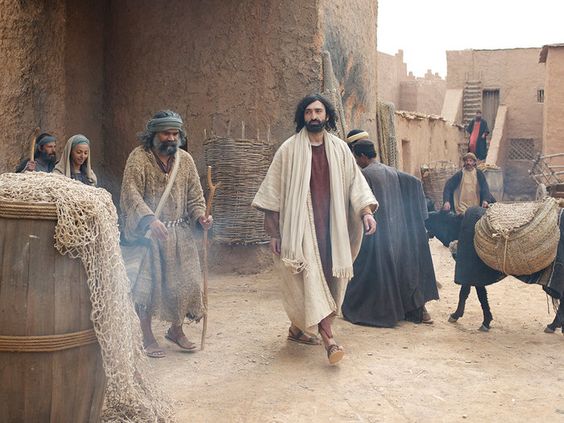
Of course, the overarching symbol in this gospel, as in the others, is Rabbi Jesus’ walking from town to town, everywhere preaching and healing, his journey throughout Galilee done on foot, confirming again Buechner’s thesis that where your feet take you, that is who you are. As we shall see soon enough, the Rabbi’s feet always take him to those in need, such as Simon’s mother-in-law in this particular passage.
But it will be the same throughout these pages, the Galilean Teacher’s footsteps directed towards the leper who cries out, or the little girl who has died, or the poor widow who has given away everything she has. Watch his feet and we will know who he is. Watch our feet and we will also know who we are. As one spiritual writer once wrote, “My mind and my tongue may deceive me, but my feet tell me the truth.”
So the obvious question for the follower of the Galilean is to ask if our feet are taking us in the same direction as the Rabbi, or are they taking us in a different direction, far from his path and his way. The answer is not difficult to determine, no different than a skilled hunter studying the footprints of an animal in the wild. Anyone studying our footprints knows soon enough which direction we went.
In another place in the sacred texts, this time in the First Letter of John, we find this often overlooked passage. John the Beloved writes, “This is the way we may know that we are in union with him: whoever claims to abide in him ought to walk just as he walked.” Again, these few words have the ability to define and to refine what it means to follow the Galilean. We ought to walk just as he walked.
With that as our GPS, we will find ourselves walking towards the poor man in need rather than away from him. We will move towards the lonely person, offering our time and our company, rather than offering the excuse that we are too busy to be bothered. We will step away from those who would judge or condemn others rather than joining in the ridicule and in the rash judgment.
Our feet don’t lie. So when the Galilean says, “Come, follow me,” the answer we give him is always found in our feet. It is like the story of the little girl who was playing with her toys one day. Her mother, who was folding laundry across the room, saw that the little girl’s shirt was dirty, so called to her to come to her so she could change her shirt. After calling her two times, the mother, using the girl’s full name, always a sign of seriousness, asked, “Did you hear me?”
Hearing the tone of her mom’s voice and looking up from her toys, the little girl answers her mom, “Yes, Mama. My ears did, but my feet didn’t.” Hearing that story, do we find ourselves giving the same answer to the Galilean’s call to follow him. “My ears did, but my feet didn’t.” The truth is it will benefit no one–not ourselves and not others–if our ears hear, but our feet do not.
Unfortunately, we live in a time when we too easily find our feet moving with the mob, rather than moving with Rabbi Jesus, caught up as we are in the commotion of conflict, lured away from the path of truth by snake-oil salesmen of mistruth, failing to realize we are on a very dangerous path, finding ourselves in a place far from Galilee.
As Tolkien has Bilbo Baggins say in The Lord of the Rings, “It’s a dangerous business, Frodo, going out of your door. You step into the road, and if you don’t keep your feet, there is no knowing where you might be swept off to.” We may want to heed Bilbo’s words of caution, finding cause to be vigilant about keeping our feet on the path of righteousness.
In ancient Greek mythology, the Siren was a creature who lured sailors to destruction by the sweetness of her song. As we know, at a certain point in his journey, Odysseus, finding himself and his men in danger of being seduced by the Siren, ordered his men to plug their ears with beeswax and to bind him with rope to the mast of the ship, in this way preventing his being led to certain death by the enchanting sound of the Siren.
Clearly, as is always the case with these myths, there is more than a simple story at play here. Living as we do in an age where there is not just one siren, but a sea of sirens, we will need more than a bit of wax and a length of rope to stop our feet from moving in a direction that promises only personal damage and widespread destruction.
At the very least, we will need to regularly offer this prayer, as Buechner urges upon us, “Guide thou my feet, O Thou invisible, in this visible day.” Buttressed by this prayer, sincerely spoken, we may find ourselves with the courage necessary to keep our feet aright, not straying off the way, our feet finally answering the call of the Galilean to follow his way.
Southeast of Rome, about half a mile outside the Gate of Saint Sebastian, is a small church that carries the name, “Chiesa del Domine Quo Vadis.” According to ancient tradition, it is here that Simon Peter met Jesus when Peter was fleeing persecution in Rome. As the tradition goes, when they met, Peter asked his Teacher, Domine, quo vadis? (“Lord, where are you going?”) The teacher answered him, “I am going to Rome to be crucified anew.”
Humbled by the answer and shamed by his cowardice, Peter turned his feet around and walked back towards Rome, choosing to follow the Teacher even if it meant danger and death, rather than running in the opposite direction, even if it promised safety and security. In the center of the church, a marble slat can be found, showing the inlay of two feet, said to be those of the Galilean Teacher when he appeared at this place to his first follower, Simon, who had chosen to flee, rather than to follow.
The slab gives name to the more ancient title of the church, even if rarely used and hardly known, Chiesa di Santa Maria in Palmis, here the word palmis meaning the soles of Jesus’ feet. As we hear the evangelist Mark today tell us where Jesus’ feet took him as he began his ministry of proclaiming the Good News throughout Galilee, we may want to listen closely to the words he speaks to us in these times, “Follow me.” Then, with the grace of God and with the guidance of the Galilean, let our feet answer the call.
–Jeremy Myers

 Sunday Brunch