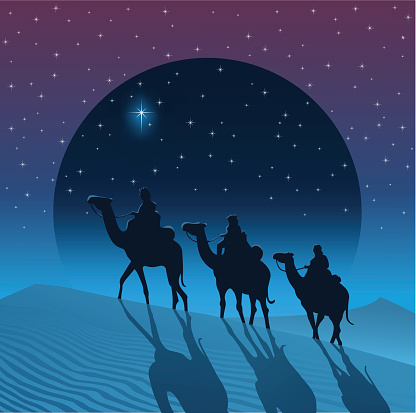
Behold, magi from the east arrived in Jerusalem, saying, “Where is the newborn king of the Jews? We saw his star at its rising and have come to do him homage.”. . After their audience with the king they set out. And behold, the star that they had seen at its rising preceded them, until it came and stopped over the place where the child was.” (Matthew 2.1-2,9)
In Wendell Berry’s book, Jayber Crow, he tells the story of the town barber, Jayber, who was orphaned at age ten and who returned to his native Port Williams years later to be, not only the barber, but a keen observer of human behavior. At one point in the book, he makes this confession of his own pilgrimage through life.
“If you could do it, I suppose,” he says, “it would be a good idea to live your life in a straight line–starting, say, in the Dark Wood of Error, and proceeding by logical steps through Hell and Purgatory and into Heaven. Or,” he says, “you could take the King’s Highway past appropriately named dangers, toils and snares and finally cross the River of Death and enter the Celestial City.”
Then, he admits, “But that is not the way I have done it, so far. I am a pilgrim, but my pilgrimage has been wandering and unmarked. Often what has looked like a straight line to me has been a circle or a doubling back. I have been in the Dark Wood of Error any number of times. I have known something of Hell, Purgatory and Heaven, but not always in that order.”
He continues, “The names of many snares and dangers have been made known to me, but I have seen them only in looking back. Often I have not known where I was going until I was already there. I have had my share of desires and goals, but my life has come to me or I have gone to it mainly by way of mistakes and surprises.”
“Often,” he says, “I have received better than I have deserved. Often my fairest hopes have rested on bad mistakes. I am an ignorant pilgrim, crossing a dark valley. And yet for a long time,” he concludes, “looking back, I have been unable to shake off the feeling that I have been led–make of that what you will.”
The unshakeable feeling that I have been led. Many of us, maybe most of us, if we admit we are ignorant pilgrims, can identify closely with the words of the town barber, having found our way forward through mazes and places we never thought we’d get through, uncertain of where we would go, but dead certain of not going in a straight line.
And for that same reason, the story of wanderers from the east, told to us today by the evangelist Matthew, is a paradigm for all ignorant pilgrims, people who understand that life’s journey never goes in a straight line, people who hold on desperately to the unshakeable feeling that, regardless of the twists and turns on the road, they are being led, somewhere, somehow.
For those pilgrims from the east, they claimed a star had led them, seeing it, they said, as it rose, determined to follow it wherever it led them, at times bright, but at other times, dimly lighted. When they could see it in the night sky, they moved with more certainty. When they could not see it plainly, the darkness too deep, they moved with confusion, unsure of where to go. “Where is the newborn king of the Jews?” they asked the court officials in Herod’s palace, at a point in the journey when they were less sure they were on the right path.
Told the answer they were looking for could be found in Bethlehem, the least likely place on all the earth for a king to be found, they went forward and, much to their delight, again the star that had been seen at its rising preceded them, until it came and stopped over the place where the child was.
We are told that they were overjoyed at seeing the star, as any of us would be, all of us needing guidance on the way, especially in the dead of night, which so often surrounds us, groping our way blindly, rejoicing, as they did, when there appears a blink of a light ahead, beckoning us forward, just enough to get us out of the darkness, at least for a day or so.
The human journey, like the pilgrimage of those men from the east, begins with the question of where. Where do we want to go? For some of us, the question has an easy answer, but for most of us, the question takes a lifetime to find the answer. The dialogue between Alice and the Cheshire Cat in Lewis Carroll’s classic book, Alice’s Adventures in Wonderland, is a conversation we’ve often had.
“Would you tell me, please, which way I ought to go from here?” Alice asks. “That depends a good deal on where you want to get to,” said the Cat. “I don’t much care where,” said Alice. “Then it doesn’t matter which way you go,” said the Cat. “–so long as I get somewhere,” Alice added as an explanation. “Oh, you’re sure to do that,” said the Cat, “if you only walk long enough.”
Our true journey begins when it isn’t enough just to get somewhere, but when we decide on a direction to go, listening usually to that inner voice that urges us to go this way, and not that way. For some, the voice is not so much inner, but outer, listening to guides or gurus, preferably people who have made the same trip and lived to tell about it. For the travelers from the east, the voice spoke to them from the night sky, a blinking, twinkling star, urging them to go towards a certain place.
For these travelers, that place was Bethlehem. For us, our Bethlehems are many and varied, which requires attentiveness to the inner voice within our chests, or to the outer voice coming from stars or saints or shepherds, who, in the end, are all the same, guides for the way, GPS for the soul.
If the story holds true to form, and it almost always does, then our Bethlehem is not going to be what we expected or where we planned, just as those weary wanderers never thought their many miles would end at a stable in a one stop-sign place called Bethlehem, so off the beaten track that it didn’t even warrant a dot on the map. It’s called the “following stars and finding stables” phenomenon.
So, the traveler learns, soon enough, that his or her Bethlehem has a surprise element to it, sometimes a shock, leading us to ask ourselves just how we got to this place or, more importantly, if this is the right place, with no sign outside the city limits bolding announcing, “You’ve arrived.”
For the unwary and the unsure, it is healthy to stay with the confusion for a while, because, as a rule, it clears up in time, and when it does, and if we’re where we belong, then we will find the answer right before us, sometimes looking like a child in a crib, other times looking like a child in a classroom, oftentimes looking like a person in need.
And when the moment of clarity comes, the pilgrim sees that he or she is just as much a person in need as the person who stands before them, recognizing in the other’s face our own face, all of us in the search together, looking for the same answers, sometimes grasping at straws, but, if smart enough, staying together because it is the best way to find our way through life.
Then, like the pilgrims from the east, the thing to do, when we’ve found our way to Bethlehem, is to rejoice, if, for no other reason, it is where we have been led, if we were brave enough to follow. “Peculiar travel suggestions are dancing lessons from God,” the writer Kurt Vonnegut wrote in his novel, Cat’s Cradle, about the best description we’ll ever find on this planet for the journey to Bethlehem.
At that moment, if the dancing lessons haven’t ruined our knees, we can prostrate ourselves before the crib, as the wise men from the east did, offering whatever gifts we might have packed in our luggage, nothing quite as fine as gold, frankincense and myrrh really expected, but a gentle smile and a kind word or a sweet prayer always appreciated by the One who has led us to this place where who I am and where I am suddenly click into place, like the last two pieces of a complicated jigsaw puzzle.
Always elucidating, the writer Frederick Buechner tells us in his book, The Sacred Journey, about the search that stays within the soul of every person from the first breath to the last breath, writing, “One way or another the journey through time starts for us all, and for all of us, too, that journey is in at least one sense the same journey because what it is primarily, I think, is a journey in search.”
He writes, “Each must say for himself what he searches for, and there will be as many answers as there are searchers, but perhaps there are certain general answers that will do for us all. We search for a self to be. We search for other selves to love. We search for work to do. And since even when to one degree or another we find these things, we find also that there is still something crucial missing which we have not found, we search for that unfound thing too, even though we do not know its name or where it is to be found or even if it is to be found at all.”
That unfound thing that Buechner describes so well those wise men found in Bethlehem, and it is our life’s work to find the same thing, elusive and evasive as it may seem to be over the course of our lives. If we are to be like them and find Bethlehem, then, like them, we must go where the light leads.
And we must accept, borrowing the words of one Jesuit writer, that “our journey to God is one of movement, change, and the willingness to strike out into unknown territory, [believing] that the star is the kindly light that will guide us home.”
–-Jeremy Myers

 Sunday Brunch