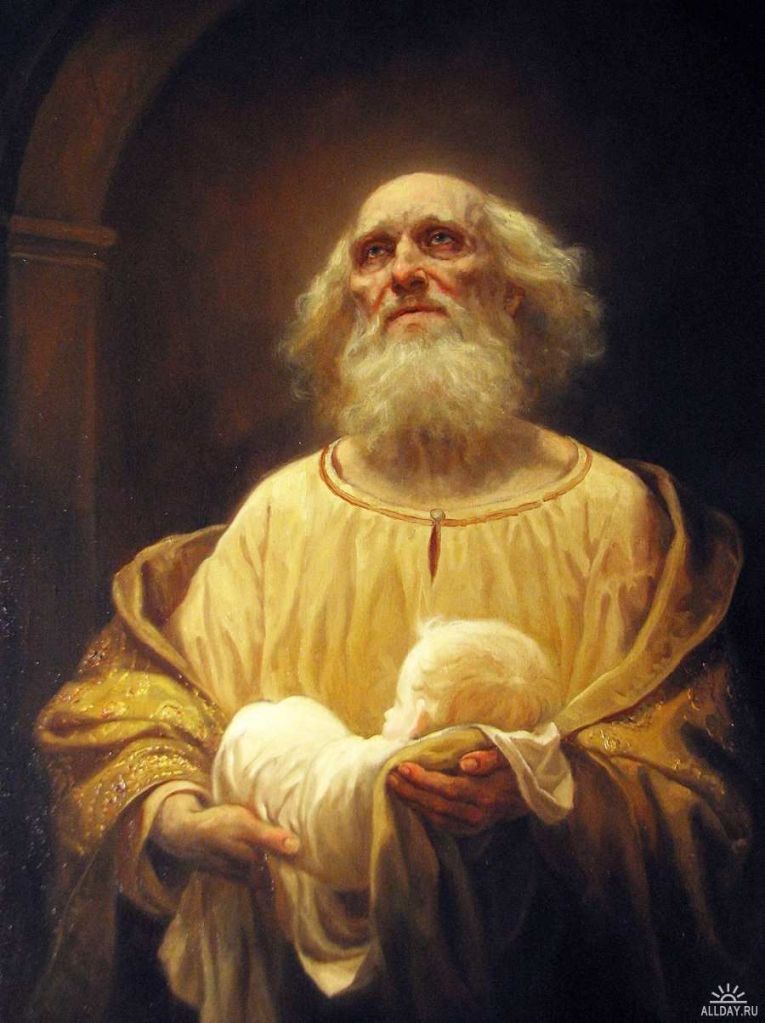
Now there was a man in Jerusalem whose name was Simeon. This man was righteous and devout, awaiting the consolation of Israel, and the Holy Spirit was upon him. It had been revealed to him by the Holy Spirit that he would not see death before he had seen the Christ of the Lord.” (Luke 2.25.26)
Picturesque and steeped in the past, The College of William and Mary in Williamsburg, Virginia is the second oldest institution of higher learning in the United States, only Harvard older by half a century. Founded by a written order by William III and Mary II of England, it soon provided an education to some of the most well-known early Americans, including Thomas Jefferson and James Monroe.
However, its beautiful building suffered from use and abuse by both Confederate and Union soldiers during the Civil War, so much so that in 1881 the college closed its doors, the physical plant in ruins. The faculty had long since disappeared as had the student population. The leaky roofs allowed rain to seep through the empty buildings. But the president of the college remained.
Every morning for seven long years, President Benjamin S. Ewell rang the chapel bell, as he had done when the college had been open. He never failed to do it, the lone figure on the campus, refusing to give up hope, always looking for the day when the school could open its doors again.
In 1888, William and Mary resumed operations, the Commonwealth of Virginia passing an act that appropriated $10,000 to support the college as an institution for training teachers. President Ewell was allowed to retire after his many years of waiting to see the college reopen, the son of John Tyler following in the footsteps of Ewell.
If there were another man with the same blind hope that Ewell had, it would be Simeon, the man we meet in the scriptures today, a man described as righteous and devout, who had spent years in the temple in Jerusalem, “awaiting,” as we are told, “the consolation of Israel.” Like Ewell, Simeon refused to give up hope, believing that the day would come when the promises made to Israel by its God would be fulfilled.
Year after year, Simeon stayed at his station in the temple, keeping watch like a sentinel in the night, the Jewish world so often shadowed in darkness, Roman soldiers garrisoned in its streets, the people of Israel subjected, not only to occupation by foreign military, but to defamation of their ancient religion. Things looked hopeless, but Simeon looked for consolation, braced by a promise that he would not see death until he had seen the Savior of Israel.
Hundred of years before, when the people of Israel were subjects of still another foreign power, this time Babylonia, a prophet promised them consolation, even if their spirits were inconsolable, their hope near rock-bottom. “Comfort, give comfort to my people, says your God,” Isaiah said, promising them that their God wanted them to be consoled, not distressed by the circumstances that bled their spirits each day.
Remembering that promise, just as certain of the same promise made to him, Simeon wandered the walkways of the temple in Jerusalem, counting the days until the promises would be fulfilled, when his eyes would see the salvation assured him by prophets and apparitions alike, unsure of when or how, but buoyed in the hope that it would come at long last.
And that day came, long expected but unexpected when it came, when he saw a baby held close to the bosom of its mother, its father alongside the two of them, as they offered prayers of thanksgiving to the Most High God for their newborn son, giving thanks through a gift of doves, as poor people such as themselves did, unable to afford a greater or grander gift.
Spying them as they made this sacrifice, Simeon, inspired by the spirit in the moment, seized his sternum as he felt his heart race irregularly, moving on weakened legs towards them, taking the child into his arms, and, in so doing, taking both parents by surprise. “Now, Master,” he said, his voice shaky and his breath short, “you may let your servant go in peace, according to your word, for my eyes have seen your salvation, which you prepared in the sight of all the peoples, a light for revelation to the Gentiles and glory for your people Israel.”
Tears dropping down his cheeks, his eyes clouded by age but now seeing clearly, Simeon blessed the parents of the child, telling them that their child was destined to be the fall and rise of many in Israel, a prophecy that neither of them understood, but which time would prove true, their son, a baby suckling at the breast, in time becoming the incarnation of divine consolation.
In that moment of revelation, Simeon knew hope was not folly, understood that his stubborn refusal to acquiesce to hopelessness, as so many others had, was rewarded, realized that a promise made by the Most High God was a promise kept by God. As the angels singing a song to shepherds had raised their hopes for a new start, rushing to a crib to see the child swaddled in clothes, and as a star shining in the dark sky had fed the hopes of weary travelers from a far, falling to their knees when their eyes found the child in the dim light of the cave, now Simeon’s hopes for a new day took on flesh and blood when he gazed upon the same child, carried in its mother’s arms, his father’s protective arm around both of them.
Writing some years ago, Kathleen Norris defined hope, boiling it down to its essence, saying hope is the belief that, despite considerable evidence to the contrary, good will prevail in the end. That stance–that good will prevail–considered foolishness by the cynical, simple-mindedness by the clever, was what Simeon held onto, and it is that same hope that every believer must hold onto, despite considerable evidence to the contrary.
And that hope is not without basis, as the story of Simeon shows us, because the God of promises is a God of his word, his Word becoming flesh and dwelling among us, showing us the consolation that had been promised, the comfort that had been assured to a long-suffering people, their hearts broken and their backs bowed from the heavy burdens of life.
For three years, that Incarnate Word walked the same roads that we also walk, roads rough and rocky, long and laborious, stopping every few steps to serve others in need, consoling the widow, comforting the afflicted, supporting the weak. In whatever way, he could, he eased the suffering of the person who stood before him, burdened, broken, beset with worries beyond counting.
To the hungry, he gave food; to the sick, he gave healing; to the soul-weary he gave strength. The comfort promised by the prophet and the consolation awaited by Simeon lived among us in Jesus of Nazareth, fulfilling the promise and proving the wait was not in vain, restoring hope to a hopeless people, reminding them that God had not forgotten them, nor had he forgotten his word to them. “You will be my people and I will be your God,” a promise made to Hebrew slaves, a promise becoming flesh in the fullness of time.
Separated by years from Simeon, but not far removed from the same threats, whether to body, to mind, or to soul, we can find in this story a reason to hope again, to believe again, to trust again, because the story of Simeon proves to us that God takes pity on us, consoling and comforting us as a mother does her child, assuring us that his presence is always near at hand, not far off in the high heavens.
In Hebrew, the word for hope is gawah, a curious word, really, because it means to twist, to twine, like one would do with strands of rope, or with thin vines wrapped tightly together, strands intertwined until you have something strong, stout, suitable for holding onto, especially in moments of fear, when a person feels like he is falling or falling apart. Hope, for the Hebrews, is a hundred strands twisted together, strong enough to hold us up or hold us together, whether it is ferocious winds that beat against us, or deadly diseases that break our bodies, or hard blows that weaken our spirits.
Over his many years of waiting, Simeon had twisted the thin strands of hope, turning them into a thick and heavy rope, impossible to unravel, impossible to break, strong enough to sustain his belief that God would not fail to keep his promises. Like Simeon, our task is to take our own strings of hope, thin at first, and intertwine them as the tests of life come our way, until the strings are formed into something strong enough to pull us through the long day of the body, or the dark night of the soul.
This time last year, a mother of a seventeen-year-old son wrote about a bicycle accident that he suffered, changing his life and altering her days. She explained that, as a result of the accident, her son is plagued with severe headaches, often causing him to faint or to feel nauseous. He can stand for only a few hours before feeling weak. This has been his life for the last two years, leaving her unsure if he will be able to finish school.
Along the way, she says, she has learned what it is to hope. At first, she admits, her hope was for miracles or for magical solutions. Now, she says her hope is “about the long haul and the long darkness.” She describes her newfound hope as “robust and muscular and ferocious and long suffering.” As she deals with her son’s sickness, she says “hope finds and names God in the world’s most desolate places. Hope kneels on hard ground and yearns without shame.”
She describes it in these words, “Hope gets in apathy’s face and says, ‘No, not good enough. Try again.’ Hope sits in the darkness–outwaiting torture, humiliation, crucifixion, and death, until finally a would-be gardener shows up at dawn and calls us by name.” Reflecting on the experiences of the two years past, she says, “Hope is my tether, my footing, my solace. It’s a bridge, wider and sturdier than I imagined it would be, that connects me still to the God who loves my son.”
As we listen to her words, coming from a place deep within her that tells her good still might prevail, some day, somehow, she is Simeon, unflinching, unbending, unrelenting, and like Simeon, she awaits the consolation of Israel, sure that, as a child proved the old man in the temple nobody’s fool for still hoping, a child in a crib will also prove her hopes not unfounded. Meanwhile, she twists and twines the strands of her days into a thick rope that pulls her forward, towards a new day, ever-hopeful.
–Jeremy Myers

 Sunday Brunch