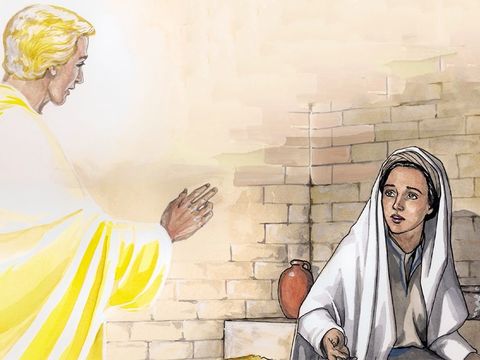
The angel Gabriel was sent from God to a town of Galilee called Nazareth, to a virgin betrothed to a man named Joseph, of the house of David, and the virgin’s name was Mary. And coming to her, he said, “Hail, full of grace! The Lord is with you.” (Luke 1.26-28)
Called “the lady with the lamp,” Florence Nightingale, the founder of modern nursing, received that name during the Crimean War, carrying a lantern in her hands at night as she made her rounds of the wounded soldiers under her care. Even today, over a hundred years after Nightingale’s death, new nurses still take the Nightingale Pledge, written already in 1893.
A social reformer and a prolific writer, as well as a nurse, Nightingale once offered an explanation of her calling in something she wrote. Humble and honest, she said, “If I could give you information on my life, it would be to show how a woman of very ordinary ability has been led by God in strange and unaccustomed paths to do in his ordinary service what he has done in her.” She continued, “And if I could tell you all, you would see how God has done all, and I [did] nothing. I have worked hard, very hard–that is all, and I have never refused God anything.”
Today, on this fourth and final Sunday of Advent, as we prepare in a matter of days to bring the birth of the Savior back into our minds and into our hearts, we have the start of that story, marvelous and miraculous, told to us in the scriptures. And like Nightingale’s story, it speaks to us of a lady with a lamp, whose acceptance of God’s will brought light into the pain and the suffering of this world, because she never refused God anything.
Well-known and beloved, the story becomes, if truly heard, not only a snapshot in space of a special woman, but also a symbol in every place for all of us who also are called to become that same light in the world, giving birth to the light of light physically through our good deeds and spiritually through our faithful response to the invitation to be a part of that great story retold in every time through our own lives.
As Barbara Taylor Brown, an Episcopal priest and writer, once said, commenting on the same story, “Mary wins her place in history not for her cleverness, nor for her beauty, nor even for her goodness. She becomes the most important woman in the world simply because she is willing to say yes to an angel’s strange proposal without a clue where it will lead her.”
Concluding, she writes, “Doing so, she becomes the prototype for all of us who are also invited to bear God into the world.” She’s right, but as each of us also comes to know, getting to that yes is, for most of us, a crazy and a confusing course, with slips and stumbles, falls and failings, making us look like a drunk sailor newly arrived to port rather than a highly favored person called by God to do something special for him.
Yet, we find comfort even in our confusion, realizing that Mary, the model for us in this effort to carry the light, also felt confused. “She was greatly troubled at what was said,” the scriptures tell us, “and pondered what sort of greeting this might be,” proving that no one, not even Mary, saw the course clearly and with certainty. As we can see from the story, “yes” did not immediately cross her lips, but had to work its way there.
Whenever God breaks into our world, whether through the voice of an angel named Gabriel or through the voice of a poor man on the street whose name is not known, our first response is generally unsureness, hesitation, and caution, unsure because we do not know the voice of God, hesitant because we have set our feet on another way, and cautious because we do not want to make the commitment.
Almost always, as scripture makes clear, when God’s voice breaks into our world, he also breaks it apart, throwing our neat stack of papers on the floor, destroying our nice plans for the day, and shoving us into a door we don’t want to enter. Name, if you can, one person in Scripture who heard the voice of God and liked what it said.
If there is one, it is a rarity, because God’s voice enters our world like a sonic boom, even if a sound can’t be heard, disrupting, dismissing, and disappointing our well thought-out ideas about what we want to do, putting before us a course we just don’t see ourselves taking, or, like our GPS, redirecting us another way, getting us to where God wants us, even if we are unsure it’s where we want us to be.
“How can this be?” Mary asks, when the voice of the angel announces the change in plans God has for her, “since I have no relations with a man,” her question logical and perfectly analytical, much the same as Moses’ when the voice from the burning bush told him to have a talk with Pharaoh. “How can I,” Moses asked, “when I stutter in public?” As with him and as with Mary and as with us, God pierces through our logic and plunders our analysis, until they are like rubble from an explosion.
While it all sounds so disruptive–because it is–it also is the only way to become who we are really meant to be. Thomas Merton, the contemplative monk who knew a thing or two about God’s ways, once said that if we really want to learn our identities, then we should cultivate God’s acquaintance because it is he and he alone who knows exactly who we are.
And maybe that’s why Mary arrived at yes in less time than it takes the rest of us, telling the angel, “I am the handmaid of the Lord. May it be done to me according to your word.” She had made God’s acquaintance long before the angel crashed into her kitchen and disrupted her cooking.
In that moment, she had a choice, to continue on course, becoming just like everybody else, keeping to the plans she had made for her life, or to stop–or as scripture says–to ponder another possibility, this one put before her by God, who knew her heart better than anyone and who knows our heart better than anyone else.
It is not that Mary didn’t know the cost of saying “yes” to God. Of course she did, which is why she took a moment to say yes. And even then, she couldn’t have known everything that her yes would require of her, because none of us ever do, knowing only that it will continually require more than we think we have, more than we think we can give, and more than we think we can love.
In the movie, “Simon Birch,” adapted from John Irving’s parabolic book, A Prayer for Owen Meany, the story is told of a boy who believes that God has called him to do something special. Born the smallest baby ever born in his town and never expected to live, Simon considers himself a miracle for making it.
When Simon speaks his mind, considered irreverent and argumentative, his Sunday school teacher belittles him, telling him he doesn’t belong in church with everybody else and trashing his idea that God has a special plan for him. Simon is unperturbed and continues to search for God’s special plan for him. In the meantime, he practices holding his breath underwater, always trying to improve his ability, just another thing others find odd about this oddball.
Small because of a condition that has stunted his growth, Simon is chosen to play the infant Jesus in the church’s Christmas play, being the only one who can fit in the manger, still another slight to the boy, but which becomes, as the story progresses, the moment of revelation as to who he is meant to be.
Later, when the school bus, on its way back from a church camp, Simon riding in it, skids off the slippery road, crashing into the icy surface of a lake, panic fills the bus, as the kids see it start to sink. Simon calms them down, having always believed little children listen to him because of the way he looks, and takes charge of getting them out safely.
While Simon also makes it out alive, he does not recover, and as he lay in his hospital bed, he tells his friend Joe that now he sees God’s special plan for him, all the pieces coming together in that moment when the children on the bus listened to him because of his size, when he escaped through the bus window because it was just his size, and when his ability to hold his breath gave him time to help everybody else.
Simon dies in the hospital, knowing that when God’s voice broke into his world, he was able to answer yes, knowing in that moment this was who he was always meant to be. Like Simon Birch and like the lady with the lamp, we can hope we also have the strength to answer yes when God’s voice comes to us, asking us to become who we are meant to be.
–Jeremy Myers

 Sunday Brunch