When the Jews from Jerusalem sent priests and Levites to John to ask him, “Who are you?” he admitted, “I am not the Christ” . . . So they said to him, “Who are you, so we can give an answer to those who sent us? What do you have to say for yourself?” He said, “I am the voice of one crying out in the desert.” (John 1.19-20, 22-23)
Not knowing who somebody is generally is embarrassing, especially if that person is somebody we should know, such as a public figure or a popular personality. But, even then, sometimes others still fail to know the person. Back in the 1990s, it happened to the graduating class at Southern Methodist University.
Learning that the speaker selected for the commencement that year was Marian Wright Edelman, the founder of the Children’s Defense Fund, a national advocacy group that seeks to uplift the lives of all children, especially poor children and children of color, the first response of many of the students in the class was, “Marian who?” Apparently, because they didn’t know who she was meant she wasn’t a celebrity, which is what they wanted.
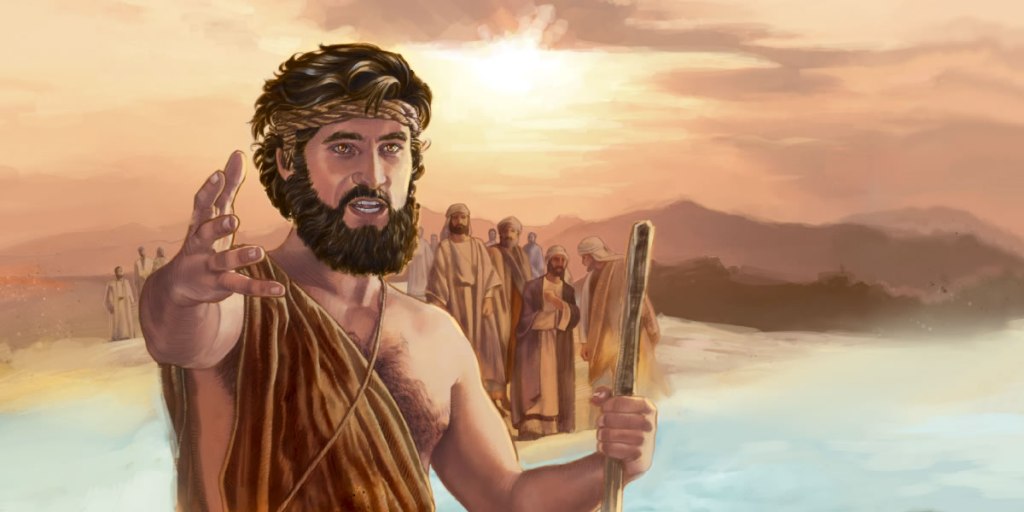
In today’s scripture passage, that same question of “who” is at the heart of the conversation we overhear between the priests and John the Baptist. Like the SMU grads, they seem not to know who John is and they’d like some answers. Who is very important to them, as it is to most people, which explains the reason for “who” being the most asked question in the world.
One of the first lessons students of journalism learn is the five w’s, some professors believing the first paragraph in a story, if not the first sentence, should answer all five w’s–who, what, where, when, and why. But the question who always leads the caravan of w wagons, each carrying important information, but none more important than the lead wagon–who.
We only have to listen to our own conversations to see the prevalence of the who question in our lives. Who won? Who died? Who is the manager? Who is your doctor? Who said that? Who gave you that? Who owns it? Who sold it? Who went with you? Who helped you? Who hurt you? Who are your parents? Who is in the movie? Who posted that on Facebook?
As we hear, John is peppered with questions from the priests and levites that work in Jerusalem, all the questions trying to find an answer to who he is. Who are you? Are you Elijah? Are you the prophet? Who are you so we can have an answer? They aren’t leaving him alone until he responds, all of them knowing he has become a popular figure with the River Jordan crowd, but not knowing who he really is.
With great patience on his part, John answers the question, but in a curious way, telling them who he is not before he tells them who he is. “I am not the Christ.” “I am not Elijah.” “I am not the prophet.” Telling them that he is not any of these people–strongly held speculations on the part of the leaders–John is steadily bringing into relief who he is, in this way dismissing their misunderstandings.
Finally, after telling them who he is not, John tells them who he is. “I am the voice of one crying out in the desert.” If they know their Hebrew scriptures, they would recognize it as a passage from the old prophet of Israel, Isaiah, who lived way back in the sixth century, his words a promise to the Hebrew captives in Babylonia that God will forgive their offense, will bring them back home, and will make the road straight for their passage from captivity.
Of course, it is an intentional use of the Isaian passage on the part of John, in this way answering their question of who he is, explaining that he is a voice calling on the people to walk on that same straight road again, breaking loose of the chains of sinfulness that hold them captives, returning them to the ways of God, a promised land for the good and for the faithful.
In this way John tells them that his duty is to point to the light, a brief flicker in the deep darkness that covers the whole world, a light that they fail to see, wrapped as they are in the darkness. “There is one among you whom you do not recognize,” he points out to them, his words a forewarning of the blindness that will prevent them from seeing the good and the holy one in their midst, the Rabbi from Galilee, Jesus of Nazareth.
Looking closely at this scene between John and the leaders of Jerusalem before us on this Second Sunday of Advent, we find in it a roadmap to discipleship, a way of becoming the follower of the Galilean that the Rabbi asks us to be, an important effort for us as we anticipate the celebration of his birth, an annual occasion recalling, not so much an event, but a way of life.
Now, as we replay that conversation at the Jordan, we must take a look at ourselves, answering the first and the foremost question that is posed to us, as it was asked of John. “Who are you?” That same question is put to us every single day and it is answered by us every single minute. Knowingly or unknowingly, we are always telling others who we are. And as professed followers of the Rabbi called Jesus, whose birth we anticipate with longing, we must be clear in our answer, so that there is no confusion about who we are.
And as John did from the banks of the Jordan, first answering who he is in telling others who he is not, we also should do, first answering who we are in telling others who we are not. With the same clear-sightedness and full-consciousness that John showed in his answers, we clarify our identity to others by separating ourselves from the pack, demonstrating that we are not to be confused with others, but standing alone and apart, if that is necessary to make clear who we are.
And how is this done? Simply and straightforwardly, we live in the way that the Rabbi of Galilee lived, a way of living in the world that is at odds with the world, our words and our deeds different from the words and deeds of those who live for themselves, not for others; who love themselves, not others; who deny nothing for themselves, while giving nothing to others.
In truth, as disciples of the one crucified on the cross for his goodness before a wicked crowd, we cannot be like others, marked and sealed as we are by baptism, called to be the continued presence of Rabbi Jesus in this world, loving others freely, feeding others generously, and welcoming others openly. Our goodness should be so true to the way of the Galilean Rabbi that anyone, in seeing us, sees his reflection, and knows who we are because they now know who he is, alive and present again in the world.
But, if others find us little different from everybody else around them, heartless, ruthless, and spineless, then we have failed to become who we are meant to be, the incarnation of the love of God born into the world through the birth of his only son and born into us through baptism. When there is not a dime’s difference between the way we choose to live in the world and the way the crowds choose to live, the same crowds that taunted and mocked and cursed the Crucified One, then we are not who we say we are.
Once we have decided we will not become like everybody else because it is not who we are, then we become a voice, as John told the leaders of Jerusalem he was, a voice that cries out in the wilderness, for the poor, for those wronged, for those without hope. Audible even in the noise of the world, a wild and wooly place, our voice announces that there is a right way to live and there is a wrong way.
In our voice, others must hear compassion, feel warmth, and find caring. And while the shouts of the crowds–hateful, scornful, boastful–attempt to silence or mute our voice, we continue to use our voice to be challenging without condemning, strong without shouting, passionate without finger pointing. When we speak, others should hear in our voice the voice of the Galilean, the same voice that healed the sick man, forgave the sinner, and welcomed the outcast.
In this way and above all else, our voice must continually testify to the light, that flicker of hope, that flame of love, that flash of faith that lights up the world, too often dark, dismal, and damp. Echoing that old 19th century Lutheran hymn, we tell others what we have heard, “I heard the voice of Jesus say, ‘I am this dark world’s light. Look unto me; thy morning shall rise, and all the day be bright.’ I looked to Jesus and I found in him my star, my sun; And in that light of life, I’ll walk, till traveling days are done.”
And then, as John tells the Jerusalem priests, when we have done these things, we are to remind others that among them stands one they do not know, the one who said he was the way, the truth, and the life, the one born in poverty, treated as a backwoods preacher, and buried in an unmarked grave, the same one who continues to be found in the poor, in the downtrodden, and in those buried in the rubble of this world.
This is who we are, people who know his story and who tell his story, a witness, as John called himself, and in sharing his story and in living it, we bring light into the darkness and give life to those in the grips of death. We do it best when we do it without fanfare, without blasthorns, and without flashbulbs, instead working behind the scenes, in the soup kitchen, in the school hallway, quietly telling people who we are, not with our loud words, but with our good deeds.
The Alaskan writer, Heather Lende, describes just such a disciple in her book, Take Good Care of the Garden and the Dogs. She tells the story of the evening she was attending a potluck dinner in her tiny community outside Juneau, when she observed a solemn, blonde-haired, little girl named Sally Chapell make her way up to one of the men in the community who was eating his meal. The little girl said to him, “I know who you are. You’re Fireman Al.”
Putting down his fork, Al answered her, “Yes, I am.” Then little Sally said, voice clear and certain, “You help people.” Al answered, “I do my best.” Her eyes looking into his eyes, the child asked him if he would fix her shoe, showing him that the strap on her Mary Janes had come unbuckled. And as Lende says, “Al pulled her up onto his lap and fastened it.”
When John the Baptist told the leaders that there was one among them whom they did not recognize, someone coming after him whose sandal strap he was not worthy to untie, he might also have told them that sometimes the one among them is recognized because he’s the one fastening the strap on little Sally Chapell’s shoes.
–-Jeremy Myers

 Sunday Brunch