Sometimes I’m amazed at the things I’ve forgotten, things buried in the past so deep that they can’t possibly find their way to the surface again, only to discover, much to my surprise, that the simplest and the mildest of triggers will unearth them, these buried memories popping out of the ground like tulips in the spring, leading me to believe that maybe nothing is ever truly forgotten.
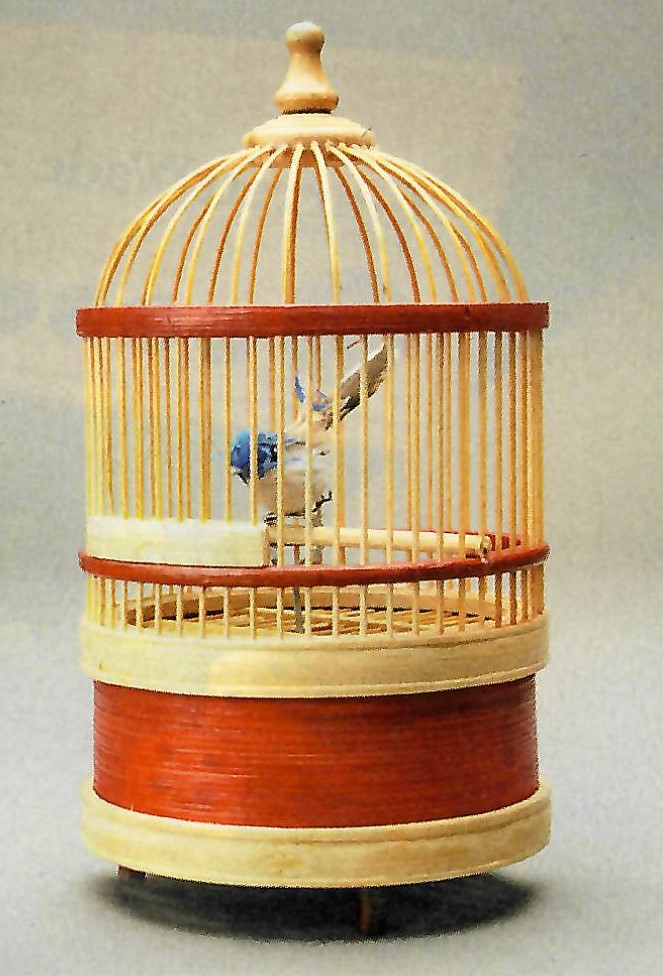
Just such a thing happened recently when I opened a magazine that came in the mailbox, offering all kinds of spectacular Christmas gifts, even a singing bird in a bamboo cage–the bird is automated, although no batteries or electricity are required–which prompted me to flip through a few pages, seeing what else was offered. And then I saw it, a memory from so long ago, returning as suddenly as a knock on the door, an unexpected, but welcomed visitor who I hadn’t seen in over half a century.
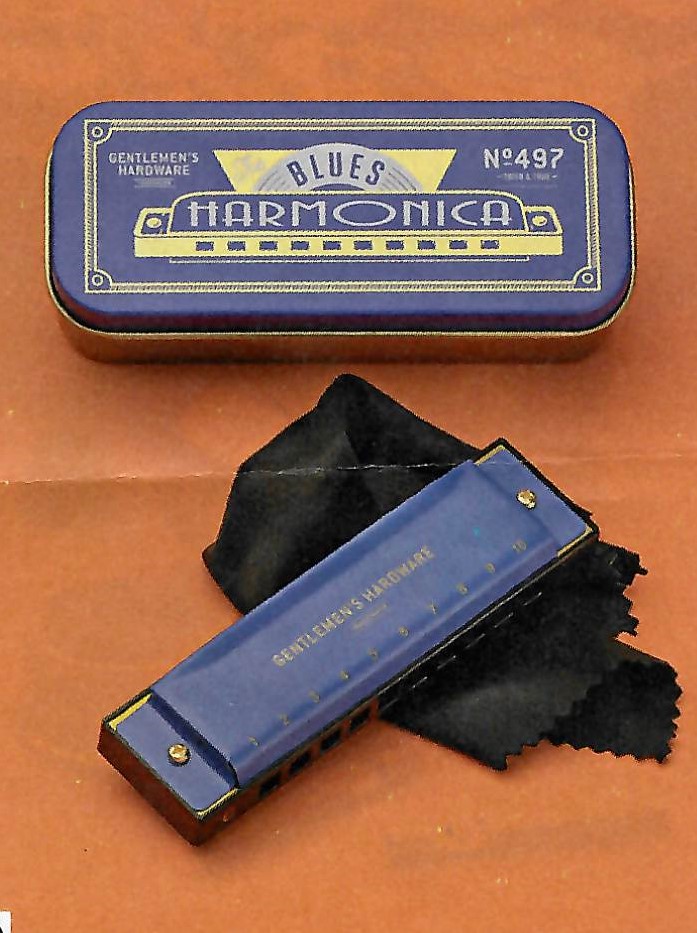
There, on the page, was a picture of a harmonica, selling for $16.50, plugged as “the ultimate portable instrument, easily pocketable and fun to bring out,” an advertisement that I knew, at least in this instance, to be true, because I had experienced just such a thing as a child, knowing for a fact that it was “fun to bring out,” having seen my grandma do it many times, on her own, or because I had begged her to play it for me.
I am reasonably sure there is not another person alive today who remembers that Grandma liked to play the harmonica–I could be mistaken, but there are few of us remaining who go that far back in time–and, honestly, I didn’t remember it either until that unsolicited magazine showed up in my mailbox and, along with the singing bird in the cage, offered for sale a harmonica, “this particular model in the key of C.”
The sweet memory that the magazine brought me was perhaps the best Christmas present I could have wanted, the only thing better being her actual harmonica, but I have no idea what happened to it after she died, if it had not disappeared even earlier, her decline in health making it difficult for her to play the last few years that she was alive. Sick as she was at that point, she simply didn’t have the spirit to play it anymore.
But there was a time when she could play it, happily, robustly, enchantingly for a little grandson, and that memory I now savor, as delightful to my ears as a Texas Roadhouse prime rib would be to my tongue. When Grandma felt the urge, or when I felt the urge, begging her to feel it also, she’d go to the shelf in the hallway where her phone rested, take from the shelf a small box, open it, and bring out the little harmonica, the wood on it old and stained from years of her hands gripping it, but the sounds from it still young and unblemished.
I have no idea where she got it or how long she had it, that information preceding my young years, but it had to have been with her for a long time, something her two surviving sons–both in their 90s–might remember, now that I have opened that door for them to long-forgotten memories of their mom. If they remember, I hope it brings them the same sentiment it brought me.
I can’t say I recall the tunes she played on it, because I don’t, but I remember how energized she became as her mouth moved across the air chambers in the harmonica, spittle flying in the air along with the music, and I swear her body swayed, her hands gripping the harmonica, while her feet danced ever so slightly from side to side, as softly as a ballerina in her slippers. And, although the harmonica hid her mouth, I know she was smiling.
That fact–that she was smiling–gives added significance to the storehouse of memories about her, because she was not a person who broke into a smile with ease or with comfort, so far as I remember, a smile from her a special treat like a glob of whipped cream on a cup of hot cocoa on a cold winter night.
Born into the harsh and hard life of pioneers on the prairies of Nebraska, where the deep sod had never ever been broken before their plow touched it the first time, and reared to be responsible and hard-working even as a child, Grandma found the joyful moments of life to be sporadic, not steady. And it takes a joyful spirit to smile steadily.
When Grandma played the harmonica, she had joy, the rush of her lips across the small instrument bringing an ever-changing cascade of musical sounds that filled her kitchen, a joy that made her feet respond with dance and her eyes shine with sparkles. In that moment, she was happy, with a happiness that was most similar, I’d like to think, to the feeling of joy she felt when she and my grandpa were courting, the two of them dancing together on the dance floor.
As a late teenager, she danced at the local dances–she told me so–always a big event for small German communities, even if the pastor frowned upon them. She told me stories of those dances, her favorite being the time when a girl close to her in age danced so freely and so ferociously that, feeling constrained by her corset, she removed it, unburdened like a sinner pardoned by a confessor.
As Grandma told the story, the girl’s father did not take the story with the same sangfroid as his daughter, packing her bags the next morning and sending her away to a convent. There are times since that I have doubted some elements of the story, particularly the harsh sentence, but I know she did become a nun and remained so all of her life.
And, I also know, late in life, the same nun reminisced how the pastor did not approve of the dances, an odd thing to remember so many years later, unless a particular incident implanted it in her memory. Remembering those early years, she wrote, “He told us he would not give us absolution if we did not promise not to dance any more. I was among those who promised and also among those who broke their promise.”
To be fair, to the Germans, music was as second-nature as breathing and as important as sunlight, so much a part of their culture that it went everywhere they went, even brought with them to faraway lands when they left the homeland. A book on German immigrants to Texas, published in 1913, bragged about their love of music–almost hyperbolically–stating, “Like the Greeks of classical antiquity the Germans are the music-loving nation par excellence of the present time, and the love of song is particularly an innate gift with most of them.”
The same writer noted, “This inherent musical sentiment follows the Germans wherever he goes, and it may be of some interest to note that the first piano on Texas soil was brought here by Robert Kleberg, Sr., who emigrated to Texas with his family in 1834.”
He adds an interesting detail, writing, “This instrument unfortunately became a prey of the flames that destroyed Harrisburg in the spring of 1836, when the hordes of Santa Anna applied the torch to that thriving little town, and many a year passed before the soft strains of a piano were again heard in Texas.” I would like to think that we may want to remember that piano, even as we remember the Alamo.
That historical detail resonates, confirmed by the fact that my grandparents bought a new piano some years after they were married, placing it in the parlor of their house on the farm, the parlor being the room where visitors entered, then hiring the services of the local director of the church choir, Mr. John Hoffman, who had studied music in a college in Wisconsin, to provide piano instruction to one of their daughters, Gertie, who, thanks to his fine instructions, would later follow his example, becoming a church organist herself for many years.
Years after, when Gertie had married and had left home, the piano remained in the parlor and, my grandmother, hoping to have another daughter play it, provided for lessons to be taught to my mom, the youngest in the family, but she didn’t take to it, a disappointment to my grandma, who never understood why my mom couldn’t carry a tune to save her life.
To my grandmother’s way of thinking, it was as if her daughter’s lack of musical talent was the same as turning her back on her German heritage, almost as grave to her as not rooting for the St. Louis Cardinals. Perhaps Grandma didn’t understand that musical talent is not necessarily guaranteed by bloodline, but sometimes requires a gift that comes, not from blood, but from God.
Later, a nun who taught in the school, similarly finding my mom to have little musical ability, would instruct my mom to sing quietly when there was a group performance in the school, solidifying my grandma’s opinion, and quieting my mom’s singing voice for many years, until another nun told her–late in life–to sing with the voice God gave her. She did, still not in tune, but letting her God-given voice be heard without apology.
Happily, my grandmother didn’t dispose of the piano when my mom failed to take to it, but kept it in the parlor, where a friend of two of my aunts, Bud Phillips, when he came to visit, would pound the ivories with dexterity, aided by divine giftedness, no sheet music ever needed to guide his fingers, making the music bounce off the walls, the house shaking with the joy that only song can bring to the heart and to the hearth. Sitting at the piano, he was like David with his harp.
Much to my grandma’s satisfaction, those two aunts, Tillie and Ellen, apparently got the music gene, both of them with beautiful voices, lending their voices to the church choir each Sunday, and gracing many a wedding with their rendition of “Ave Maria.” Each continued to sing beautifully well into old age, their German heritage on display whenever they added their voices to a song. When old age came to them, their eyes would moisten with tears as they sat in a church pew, listening to another gifted person sing “Ave Maria” with the same breathtaking beauty as they had done once upon a time.
A century later, that piano–now a family heirloom–has been passed down the generations, a cousin of mine, Sherry, now the custodian of it and its long history, its place in her living room sacred, the music heard from it even if the keys have not been touched in years. Like all old things, that piano tells many stories–if one would look and listen–the keys yellowed, the wood scraped, the strings needing tuning. Still, it has a song in it.
When, where, and how my grandma learned to play the harmonica are questions without answers at this point. However, German inventors are generally credited with its invention, not a surprise really, even if the harmonica is also called a French harp, probably because a French Jesuit priest brought something similar back to France with him after he had lived in China for a while. Later, after the Germans had designed and manufactured harmonicas in the 1800s, these musical instruments also acquired the name “mouth organ,” a quaint name, if you think about it.
Apparently, some of the Germans brought their harmonicas along with them to the new country, again not a surprise, in this way bringing a part of home with them, holding onto a part of their native culture in a wildly different culture. Some historians say Abraham Lincoln carried one in his shirt pocket, although we know he was not German. Others say soldiers on both sides had them during the Civil War, their plaintive tunes bringing comfort to them, surrounded as they were by the fierceness of the fight.
Later, as we know from the movies, the harmonica would become associated with cowboys, these mouth organs providing them with company while alone on the range, the music also calming the cattle so that they didn’t stampede during the night. Eventually, Hollywood picked up the theme, Western movies having cowboys around the campfire playing tunes on the harmonica considered de rigueur.
As chance would have it, the harmonica became more well-known after the White House Christmas tree in 1925 was decorated with fifty of these instruments, although it is unclear if Calvin Coolidge, the president, knew how to play one. Radio shows during the era often had harmonica music and some programs offered lessons on how to play one. Maybe that’s how Grandma learned to play it, although I tend to believe she, being German, simply had an ear for music.
Aside from her, the only other person I knew who played the harmonica was an old guy who I met much later in life and who, frankly, did Grandma one better, playing the harmonica and the accordion at the same time, the harmonica held to his lips by a wire band around his head, his head moving across the small wind chambers like a bobblehead. Much the same as Grandma, his body swayed and his feet tapped as he made music, a fiddler-on-the-roof fellow if I ever saw one.
Near the end of her life, Grandma couldn’t play the harmonica any longer, but her love of music didn’t die. When the nearby church installed some new, fancy sound system that played taped music through speakers in the steeple–this was in the late 1960s when 8-track tapes were a thing–the pastor played Christmas music on the system so that people living near to the church could hear the seasonal songs.
Whenever he played the Christmas tape, Mama would open the outside door to Grandma’s bedroom and, while Grandma lay in bed, her body fading and her legs failing her, she listened to the Christmas songs floating on the air from the church steeple into her sickroom, the sounds bringing a smile to her face again, even in those heartbreaking circumstances.
Her favorite song was “O Holy Night,” composed in 1843 by a Frenchman this time, not a German–a fact, I assume, Grandma did not know or chose to overlook–later translated into English in 1855, thirty-three years before Grandma was born in a small German community on the plains of Nebraska.
Doubtless, it would be a number of years before she would become familiar with it, but, once hearing it, she always called it her favorite, the song almost always moving her to tears. Because it was her favorite, it would become my favorite, although I knew a German didn’t write it. It can still send a chill down my spine, as all good music should do.
Even now, the speakers in the church steeple sound out the same Christmas songs each holiday season, although the system has been upgraded from tapes. But I never hear those sounds that I don’t think of Grandma, nearing the end of her life, listening to them, finding a bit of joy in the music. And when I think of her, gone from me, but surely having a place among the heavenly choir, I see the angels with their harps and Grandma, in the middle of them, playing her harmonica, a smile now always on her face.

–Jeremy Myers

 Sunday Brunch