Some friends of mine tell me that their twenty-something son wants to refurbish an old school bus, converting it into living quarters, providing him with a mobile space to live, without locking him into a six month or longer lease, as would an apartment. He’s already drawn up plans for the renovation, figuring out how to get the most use out of the limited space, even considering raising the roof a bit, since he is tall, to allow more headroom as he moves around the interior of the bus. It sounds like a plan to me.
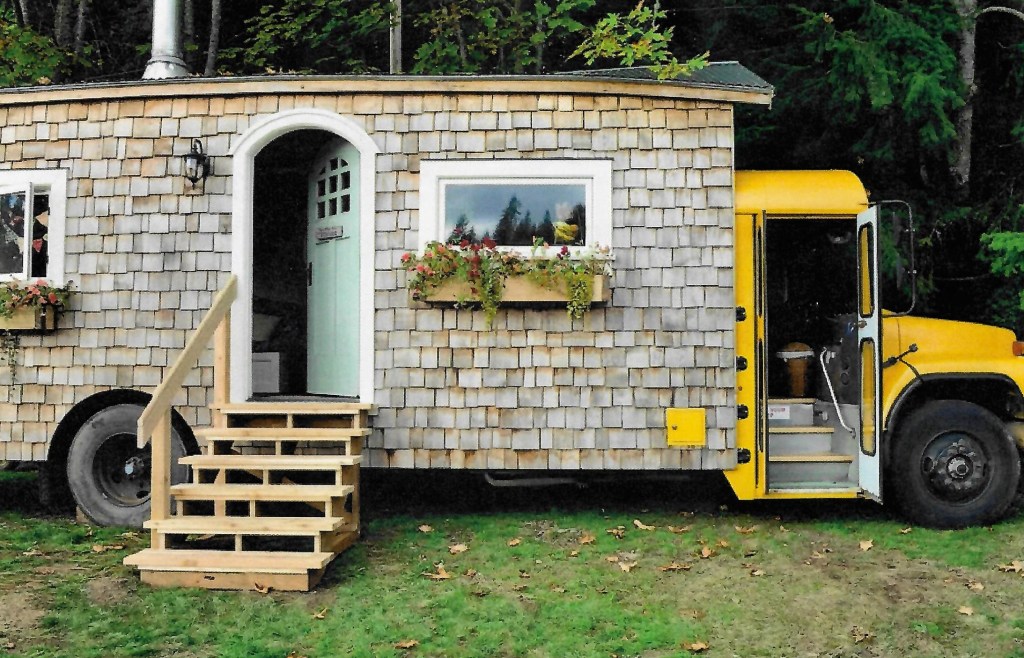
Not that long ago, I watched a program on TV where a young guy had done the same thing, the show offering the viewer a progressive slideshow of the redesign of the bus, an impressive transformation, I must say. The idea has become so popular that the internet offers all kinds of pictorial suggestions for turning a bus into a little house, some of the suggestions both innovative and intriguing and certainly interesting.
To my knowledge, I haven’t seen on the highways one of those little houses framed inside a school bus, not yet, but I can’t be certain. Like everybody else, I’ve met a lot of buses on the road and I suppose it would be difficult to know for sure, without getting inside the bus. Unlike a Trailways bus that digitally pops the destination on the front window, these don’t say, “I’m really a house, not a bus.”
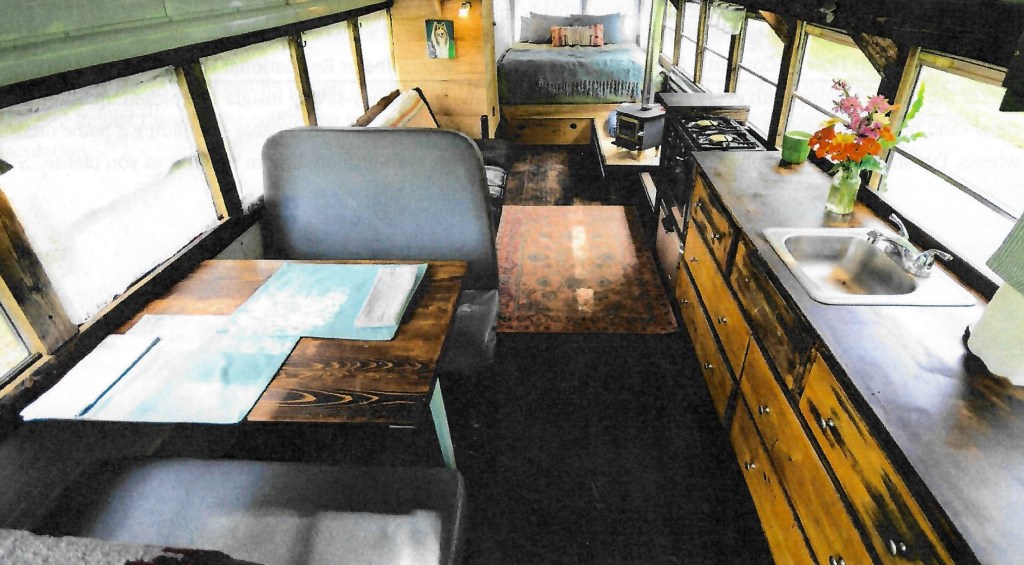
To me, this is all old news, really, because my dad did the same thing sixty-five years ago, long before the fad started. Like the modern versions, his plan was purposeful, needing the bus as a motel on wheels, but unlike the modern miniature homes, which are designed with every convenience under the roof, even window flower boxes, his plan wasn’t beautiful, the interior stark and simple, three or four bunk beds crammed into the space, with no flowers growing outside any window.
Always looking for a way to make ends meet, especially with his family growing, my dad decided to become a custom combiner, this happening in the late 1950s, meaning each summer he would combine the wheat crop for farmers who were his customers, beginning here at home, but then moving further north, following the ripening of the wheat through the golden fields of Oklahoma, Kansas, Nebraska, and even South Dakota.
Anybody who’s done it knows it’s not a one-man job. It never has been, even in the days before machines that did the work of separating the wheat from the chaff. So Daddy hired six or eight young guys, some still in high school, who wanted to make a buck during the hot summer months and who wanted to escape the boredom of their small town, a desire as old as Tom Sawyer, putting them to work as his combiner crew. They were greenhorns for sure, but they grew into the job, still talking about those summers long after they had grown into men. I often heard them tell their stories.
Of course, having a crew meant needing a place to keep them at night, especially important in some rural parts of the wide-open Plains where there were no local motels. So, Daddy impoverished, as he was famous for doing, coming up with the plan to outfit an old school bus to serve as sleeping quarters for his young roustabouts.
Simple and without room service, the inside of the bus provided a cot to sleep on and a place away from the elements, although the windows doubtless were put down so that a breeze would circulate in the close space during those hot summer nights, about as near to air-conditioning as a person could get in 1950s rural Kansas. Also, there was a propane tank attached to some primitive stove, permitting them to warm up a can of pork and beans at the end of the workday.
My brother, two years older than me and twice as smart, tells me that Daddy bought two used buses, not one. As he recollects, the first was a 1951 Chevrolet that still ran, being five or six years old at the time. He used this one as a parts wagon, filling the inside with spare parts that the crew might need on the road. The second bus, another Chevrolet, but from the 1940s, didn’t run, so Daddy hooked a hitch to it, allowing the first bus to pull the second bus, this one becoming the bunk bus.
Being a young boy in the 1950s, I don’t remember fully the bus when it served as a bunkhouse for the wheat harvesters, but I remember it shortly after that time, after my dad had switched from a custom combiner to a grain elevator operator. Still needing hired help, this time my dad employed young guys from Mexico, entering Texas by way of the Rio Grande River, looking for a job that paid a few dollars more than they could earn in Mexico.
Almost certainly these guys didn’t have papers to enter, a small legal technicality for my dad back in the day, some of them becoming so familiar to us that they were thought of as part of the family. Again, the old school bus served occasionally as a makeshift bunkhouse for them until they could find a better place to sleep.
Not long after, my dad moved it close to his hog farm, where the bus was tucked into a grove of mesquite trees that we simply called the pasture, allowing it to serve as a place for these Mexican laborers to stay overnight, keeping them close to their work on the pig farm. I am not sure which direction the wind blew, but I hope it was away from the bus, although it would have been a sacrifice to go without a breeze at night.
With it being sheltered and tucked into the mesquites, it also permitted a sanctuary of sorts from the prying eyes of Border Patrol agents who periodically canvassed the area, looking for illegal immigrants. We never liked the day when the phone rang, someone forewarning us that these guys were in these parts, making a sweep. Like I said, these guys from Mexico were like family.
If a cat has nine lives, that bus also had nine, maybe more, lives. When it was no longer needed for workers at the pig farm, it stayed there in the pasture, becoming a clubhouse for my brothers and me, our using it as an overnight camp, especially during the summers, the bus some two miles or so from home.
Always using materials at hand, we found the bus to be the perfect clubhouse, complete with the bunk beds that provided overnight accommodations, even though the mattresses were dusty and smelly and old as Moses. Boys that we were, country boys at that, we liked to rough it, never complaining about the lack of amenities.
Often, Mama would put us six boys in the car, drive us to the pasture, help us make a small fire out of mesquite branches, after which we would have a weenie roast, followed by a marshmallow roast–using a coat hanger as our choice of skewer–and, seeing us fed and watered, she would leave us to spend the evening exploring and hiking through the pasture, promising to return the next morning to pick us up.
Growing up in a different era, before helicopter parenting became the thing, we were given great latitude, Mama trusting us–or our guardian angels–to keep out of trouble, without her continuous supervision, which, I must say, was an act of great trust, considering my big brother was 10 or 11, I was 8 or 9, and the three younger brothers further behind us, the youngest a toddler just old enough to walk and talk.
That is not to say we weren’t up for some mischief, proved the morning when Mama came early to pick me up so that I could go to church to be an altar server. Unknown to my baby brother, who had slept through the wake up call, I was busy at church doing my duties when he woke up later in the morning. Awake and aware one of his brothers was missing, he asked my big brother where I was.
With a Tom Sawyer streak of troublemaking in his head, he told “Baby Boy,” as he was called then, simply and logically–in our minds–because he was the baby boy, that coyotes had come up to the bus in the middle of the night, snatching me out of the bus and eating me for their meal. Having heard the howls of the coyotes the night before, Baby Boy knew they existed and he also believed they were to be feared.
Greatly saddened by the news of my disappearance, he asked my big brother if there was anything left of me, but my brother assured him I was all eaten up, not a bone left in sight. Accepting my sad fate, he took a deep breath, and readied himself for Mama to pick up everybody, knowing it would break her heart to find she now had one less boy in her house.
When she stepped out of the car, Baby Boy ran to her, pulled on her arm, tears flowing down his cheeks, sputtering out the words to her that he had the sad duty to tell her that I had been eaten by coyotes overnight and there wasn’t anything left of me. He was disconsolate in his grief, which warms my heart.
Knowing exactly where I was, she looked at my big brother, who found it highly amusing that Baby Boy had been so gullible to his high jinx. Even now, sixty plus years later, I am touched by Baby Boy’s shedding some tears over my demise. My older brother, however, still laughs every time he tells the story. I’m not sure what that means.
As the years passed, the bus remained in place, still in the open clearing, surrounded by mesquites, weathered and even more worn-looking than ever, but nonetheless always a good place for boys to get away from the rigors of civilized living, as my younger brothers and their cousins did, allowing them, for a short while, to regress to their more Neanderthal tendencies, meaning no shirts and no shoes. Obviously, there were no baths and no bathrooms, neither really an inconvenience for boys in the wild.
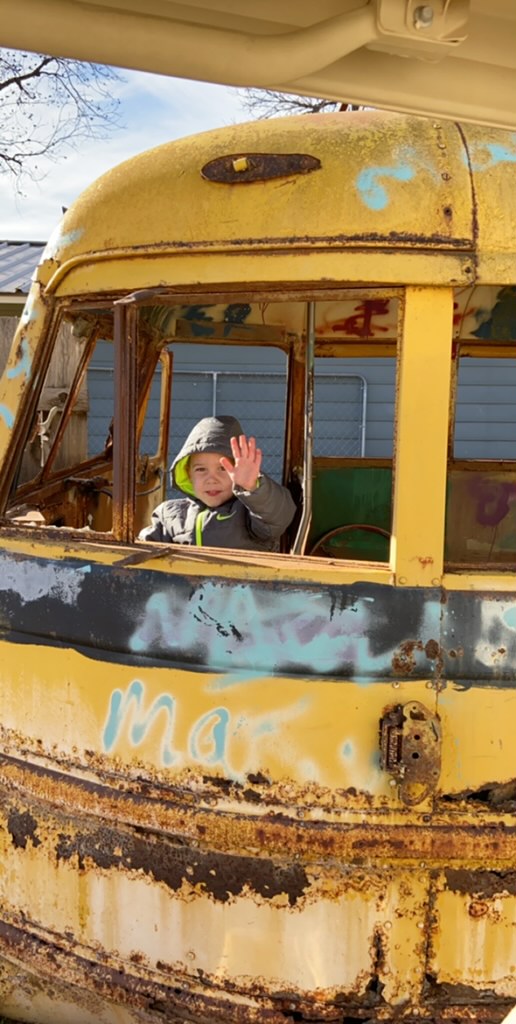
My younger brothers continued to use the bus as a clubhouse and, as they became teenagers, used it as a point of interest for entertaining their girlfriends, who, I am sure, did not find it nearly the same perfect courting spot as they did, always the presence of wild animals–the real kind, not my brothers–a real possibility. To my knowledge, none were eaten by coyotes.
When Daddy put farming behind him and the pasture was turned over to other people, the bus eventually found its way back to town, hitched to a pick-up truck to make the two mile trek, and placed in my Dad’s junkyard, alongside other old vehicles and outdated trucks, a sad demotion for this erstwhile school bus turned bunk house turned clubhouse. I am sure it was greatly embarrassing to be seen in such company as that junkyard contained.
Adding insult to injury, my three young nephews, receiving bb guns one Christmas, decided to make target practice out of the windows of the old cars in the nearby junkyard, including the windows of the school bus, fun for them while it lasted, but hell to pay when my brother found out what they had done, their butts now the target for his belt, still believing, as he did, sparing the road spoiled the child. But that is their story to tell.
There the old bus stayed, now without windows to dress it up or to keep out the birds and squirrels, but some wild morning glory vines with bright blue blooms hiding its old age wrinkles, the years passing, no sign of children’s laughter heard much in it anymore, except for the few occasions when some of the younger nephews and nieces decided to explore its interior to see what was there. Usually they found nothing, maybe the evidence of rodents making a nest in it. Sometimes they’d sweep it clean and use it as a clubhouse, as we had done, until their interests moved to greater feats and cleaner places.
That changed when my youngest brother, Baby Boy, but now called by the more mature name John, decided, on a lark, to move the old, dilapidated, windowless bus to his backyard, where, remembering his childhood days in it, he thought it would make a great playhouse for his young son, at this time about the same age as he was when he thought he had lost a brother to a pack of starving coyotes.
Jake, his son, following family tradition, made it into his clubhouse, finding it a place of adventure and possibilities, as we had done years earlier, spending many hours inside it, bringing life back into it, doubtlessly the bus rejoicing to hear the laughter of children again. The school bus shook with fun and games, rambunctious boys racing inside, outside, around, in and out of the aged bus, still strong and steady enough to withstand the sport.
My brother, in an effort to appease his wife, placed the bus on the other side of the driveway, but, even then, there was no hiding it was a piece of junk in her pretty backyard. No offense to the school bus, mind you. And while no coyotes snatched up a boy from the bus this time, they did take a small dog who, unwisely, wandered outside in the deep of night, never to return, proof that my big brother wasn’t entirely off base when he swore I had been taken by coyotes one moonless night in that pasture of mesquite trees.
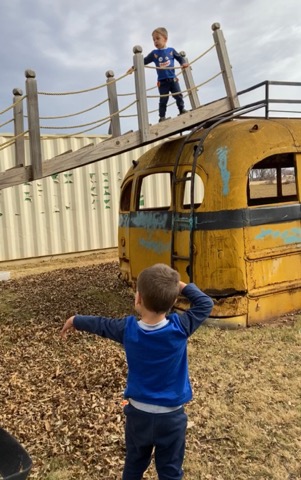
When Jake outgrew the bus, one of my sisters had her husband hitch the bus to a vehicle, dragging it–now that it had no wheels–down the road to her yard, where her granddaughter could make a playhouse out of it. However, once it was put in place, she had her husband dress it up, adding a pirate’s nest on the backside, a sandbox next to it, converting the whole area into a playground, with the old school bus the centerpiece, a stark contrast between the old and the new never more apparent.
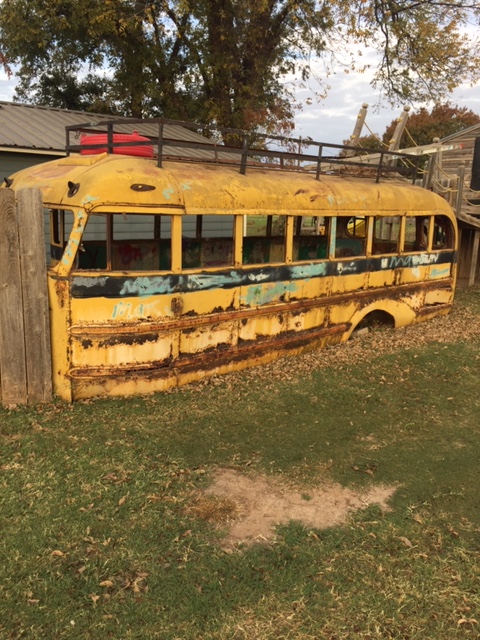
Always creative, with an eye for detail, she added a ship’s plank, connecting the bus to the pirate’s nest, changing it from a clubhouse to a theme park, pirates now living in it, an idea Tom and Huck would have favored greatly. I’m assuming girls played some version of pirates in it, perhaps damsels in distress. However, should they have not, she also positioned a playhouse, complete with a tea set, nearby, certainly a sight none of us boys would have ever allowed in our day.
Never being a boy, my sister didn’t go for the rough look of the bus, but preferred something more aesthetically pleasing, although she couldn’t make something new out of something so old, no amount of Botox actually able to fool anybody about its years, but she did put a panel across the front to hide the hitch, probably a smart move to stave off some scratches and scars from kids trying to skip over it or slap it up and down.
Even today, on a sunny afternoon, the sounds of laughter and play, occasionally an argument or two, can be heard from the old school bus, small children continuing to play inside and outside the bus, the fourth generation bouncing down the aisle of that bus–that’s not counting the children who actually went to the school in it– all of which is proof that kids can have fun, even if they don’t have Disney World nearby. For them, an old bus is all they need, along with a lot of imagination.
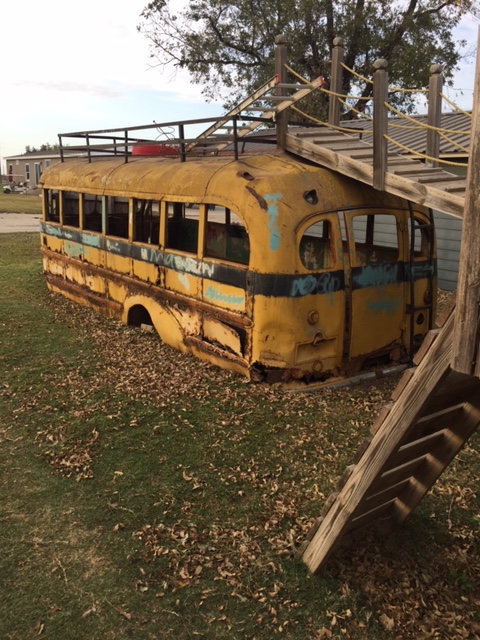
Hearing the noise drift across the fields to my house, I’d also like to think the old bus smiles each time kids push open the door and step inside, even if, now decrepit, the bus creaks under the weight of the tiny steps bouncing atop it. The sounds of children at play bring back good memories–to it and to me.
–Jeremy Myers

 Sunday Brunch