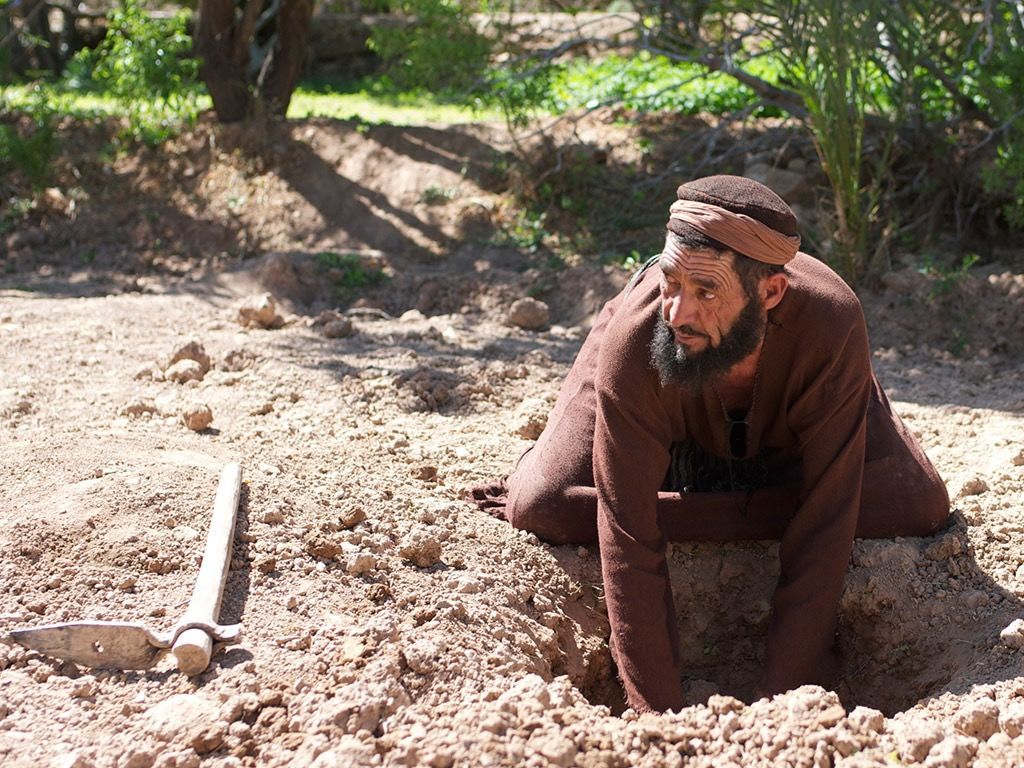
Jesus told his disciples this parable; “A man going on a journey called in his servants and entrusted his possessions to them. To one he gave five talents; to another, two; to a third, one–to each according to his ability. Then he went away. Immediately, the one who received five talents went and traded with them, and made another five. Likewise, the one who received two made another two. But the man who received one went off and dug a hole in the ground and buried his master’s money.” (Matthew 25.14-18)
At one point, near the halfway point in Mark Twain’s classic work, Tom Sawyer, written in 1876, he tells how Tom and Huck and Joe Harper, who is Tom’s best friend, decide they’re going to run away from home. Their destination is Jackson’s Island, where they want to enjoy the life of pirates. That first night away, as the boys sit around a fire deep in the forest, having cooked some bacon in a frying pan and ate half the cornbread they had brought, they reflect on what a fine life it is to be a pirate.
“It’s nuts!” said Tom. “What would the boys say if they could see us?” Joe answers, “Say? Well, they’d just die to be here–hey, Hucky!” Huck agrees, telling the other two that he is well suited to the life. “I don’t want nothing better’n this.” Tom agrees, saying, “It’s just the life for me.” He explains, “You don’t have to get up, mornings, and you don’t have to go to school, and wash, and all that blame foolishness.”
He continues.” You see a pirate don’t have to do anything, Joe, when he’s ashore.” Joe readily agrees with Tom’s assessment, adding, “Oh, yes, that’s so, but I hadn’t thought much about it, you know. I’d a good deal rather be a pirate, now that I’ve tried it.” Meanwhile, Huck, gouging out a corn cob, and working a stem into it, loads it with tobacco, and, taking a light from the campfire, begins blowing a cloud of smoke into the air, Tom and Joe watching and resolving to acquire the practice soon themselves.
What the boys find in their escape to Jackson’s Island, as they play act pirates, is a life with no responsibilities, and each one finds its much to his liking, doing little more than eating bacon and cornbread, smoking a corncob pipe, and fantasizing about how wonderful it would be to be a real-life pirate.
Today, when Rabbi Jesus tells his followers a story about three guys, each of whom is left with some part of their master’s possessions when he takes a trip abroad, he also is talking about how people handle responsibility, with two of the servants working to please the master while he is away, while the third, like Tom Sawyer, finds having no responsibility is “just the life” for him.
Looking carefully at the text of the Rabbi’s story, three words stand out, anchors that hold the story in place, providing us with a greater understanding of what the Rabbi wants us to take from the story. At the start, Rabbi Jesus says that the master entrusts his possessions to the three servants, the word used here meaning he surrendered what he had to them.
Surrendering implies turning over ownership and responsibility to another party, in this instance the servants, the master transmitting his vast wealth to them, so completely that when he returns he will either have something or nothing, depending entirely on how responsible his servants were with his possessions. As we can see, to entrust to them everything he has, as he does, is a radical act of faith on his part.
Next, we hear that the master gives his possessions to the three, each according to his ability, again an interesting word, the origin of which is the Greek word, dynamin, which means, force or power, the same word that gives us dynamic or dynamo or dynamite, these words, as we understand, indicating great energy or big activity. So, the story implies that the master believes that each servant has an immense capacity for doing something with his possessions, an innate and powerful force for getting the job done.
Which leads us to the third important word in the story, this word being used to describe what the last servant does with his part of the master’s possessions. According to the text, this servant “dug a hole in the ground and buried his master’s money,” the word buried literally meaning he burrowed into the ground, as an animal would do to hide or to protect itself because of fear.
These three words, then, tell the story. The Master entrusts or surrenders his great wealth to his servants, believing each one has the ability or power to handle the responsibility in an energized way, but one of them, to the contrary, buries the money, much like a pirate, burying it where it can do no good for anyone, just rotting away in a hole in the ground.
Reflecting on those three important words, we more readily understand the point of Rabbi Jesus’ story, finding in it instruction and warning to his followers who will have the responsibility of continuing his mission and his ministry, his possessions, so to speak, which he is entrusting to them, surrendering to them after he has gone away, as does the master in the story.
And they, like the three servants in the story, have the power, the energy, the force to do good with his mission, now entrusted to them, unless they shirk the responsibility, shrinking away from the task, as did the one servant, burying their heads in the ground, doing nothing, making no gains with the Rabbi’s mission in the world.
The story becomes all the more important when we see that the Rabbi tells it as his mission on earth is coming to an end, he and his disciples now in Jerusalem, where, in a short while, the Rabbi will be put to death, and his mission, if it is to continue to be a force for good, will do so only because his followers accept the responsibility of making it grow once he has gone away.
Pondering the Rabbi’s story, the point might be just as clearly expressed in a simple statement that a girls’ track coach used to tell his high school athletes. Right before any important race on the field, he’d offer the girls this instruction, all his coaching over the past weeks now condensed into one line. He’d look at them and say, “The race is in your lane.”
The race is in your lane. That is what the Rabbi is telling his followers, calling forth from them the force or power that is within them, entrusting to them the continuance and the completion of his mission on earth, a mission entrusted to him by the Most High God, now surrendered to them as he surrenders his life on the cross. For his part, he has run the race. Now the race is in their lane. He can do no more. It is now their responsibility, win or lose.
And therein lies the challenge, the everyday call for us to use our energy as a force for good, as the Rabbi did, bringing some bit of light into a dark world, becoming the last hope for desperate people, and breaking loose the chains that prevent others from living freely, fully, and festively as beloved children of the Most High God.
That many have done so through the countless centuries since speaks well of them and how they carried the responsibility placed on them, these fierce followers who changed the world by their lives and who, like the two servants in the story, received praise from the master upon his return, who said to them, “Well done, my good and faithful servants. Since you were faithful in small matters, I will give you great responsibilities. Come, share your master’s joy.”
And yet, as the story also cautions us, there are always some who do not accept the responsibility of caring for and continuing the mission of the Rabbi of Galilee, but prefer to do little or nothing or not enough, content to get by or bury themselves in lives that do nothing to advance the Kingdom of God, in this way avoiding all responsibility for making the world a better place, especially for the least, for the last, and for the lost.
Years ago, a Christian in South Africa wrote a prayer that states well the poor performance of just such a fearful and fickle follower of the Crucified Lord, writing these words:
You asked for my hands that you might use them for your purpose.
I gave them for a moment, then withdrew them for the work was hard.
You asked for my mouth to speak out against injustice.
I gave you a whisper that I might not be accused.
You asked for my eyes to see the pain of poverty.
I closed them for I did not want to see.
You asked for my life that you might work through me.
I gave a small part that I might not get too involved.
Lord, forgive my calculated efforts to serve you only when it is convenient for me to do so,
only in those places where it is safe to do so, and only with those who make it easy to do so.
Lord, forgive me, renew me, send me out as a usable instrument that I might take seriously the meaning of your cross.”
His prayer, honest and from his heart, expresses the fear that always saps the energy of the would-be disciple, suffocating the desire to do good, strangling efforts that could change the course of the world. How very much like the third servant in the Rabbi’s story, whose best excuse for doing nothing is fear.
“Master, I knew you were a demanding person,” he says, “harvesting where you did not plant and gathering where you did not scatter, so out of fear, I went off and buried your talent in the ground. Here it is back.” Never sadder words were spoken, greater potential not fulfilled, higher hopes not realized, than here with this servant, because he was afraid to act, avoiding responsibility and absconding in fear.
Sadly for that servant who buried the treasure, and unfortunately for the follower of the Galilean who refuses the responsibility that comes with discipleship, the rebuke from the master is brutal and fatal, “You wicked, lazy servant!” the master says, instructing the others to “throw this useless servant into the darkness outside, where there will be wailing and grinding of teeth”
Certainly, the point could not be any clearer, the Rabbi of Galilee ending his story with a forewarning for those who are too unconcerned, too unenergetic, too unwilling to do the work entrusted to them, otherwise expending their energy on efforts that evade their responsibilities, rather than expressing that energy in endeavors that externalize the mission assigned to them by him as he approached the cross.
Fifty years ago, Nikita Khrushchev, then the leader of the Soviet Union, held a news conference in New York City, where written questions had been submitted to him by reporters for his answers. One question, anonymous, was this, “What was he, an important figure in the Soviet Union, doing during all those crimes of Stalin that he had exposed and denounced after the fact?”
Enraged and embarrassed by the question, Khrushchev demanded to know which one of the reporters had asked the question. “Who asked the question?” he shouted. “Let him stand up!” Nobody did, all afraid by the outburst. Then Khrushchev, calming down after a bit, said in a low voice, “That’s what I was doing.” With that soft-spoken answer, he challenged the crowd, its silence because of fear no different than his silence because of his fear of Stalin.
What were you doing? That is the question at the heart of the Rabbi’s story and that question is now ours to answer, our responsibility laid bare.
–Jeremy Myers

 Sunday Brunch