My big brother is the type of guy that will get in a car and drive across three state lines to spend Thanksgiving with me, all because he didn’t think it was right that I had to have Thanksgiving away from family. He did it more than once, in fact several times, he and his wife putting their three little boys into the backseat of the car, the youngest barely taking steps the first time they made the eight-hour trip to see me.
That was over 40 years ago, but he’d still do it if I didn’t live a short walk down the road from him, as I do now. I know because that’s the kind of person he is, was, and always will be. Trying to figure out why he feels so responsible for his siblings–I’m just one of many–I’d say without hesitation it’s because he’s the oldest, the one who had the role of look-out, protector, and trailblazer thrust upon him all his life, for no better reason than he was born first, a toss of the dice, some would say.
Last year, when I drove to Nebraska one weekend in the middle of October, I texted him once I was in my motel room, letting him know where I was, sure he would want to know where I had gone when he didn’t see me for a day or two. His response to my text was short and without sentimentality, “Good to know. I was wondering where you were.” Then he added, “I wouldn’t hang around that part of the world too much this time of year. Weather can really go south on you.” His forecast was taken to heart. I left the next morning. Always the big brother, he had my back.
Firstborns, as they are called, have garnered a lot of attention over the years, put under the psychological microscope, put in labs like white mice, studied at length to see what makes them tick. As a result of the intense scrutiny they’ve been subjected to, as the National Enquirer might do to sighted aliens, a clearer image of firstborns has gradually emerged, the same as would the shadow of a deer standing on the side of the road when the headlights of your car flash upon it.
After all the picking and probing and psychologizing, the conclusion seems to be that a good many firstborns get the responsibility gene, which pushes them to perform, to succeed, to respond to high expectations, while the middle children, without the same pressure put upon them, go the opposite direction.
As we know from experience, the babies of the family, unlike the firstborns, end up needing to do nothing to prove themselves, waiting for the world to adore them, as their parents have always done. Anyway, this is the short answer about birth order, if you happen to believe, as I do, that the number you get on your team jersey the first day of tryouts makes a difference.
Historically, as anybody knows, a lot of pressure has been put on firstborns. The ancient Hebrews said they belonged to God, at least if they were males, just like the first bushel of grain that was harvested, and so parents had to barter with God to get their baby boy back, sacrificing a couple pigeons to him, in this way keeping their child.
I’ve always wondered about that transaction, questioning the whole theory, even while appreciating the idea that God should get the first portion, this skepticism rooted in the fact that–given the choice–God almost always chooses the younger or youngest brother in all the Biblical stories. Name, if you can, one story where he chooses the first born for one of his MI6 assignments.
Remember, he liked the second-born brother Abel better than he liked Cain, who was born first. He favored Jacob over Esau, even though Jacob cheated his older brother out of his inheritance. He handpicked David to be king of Israel, bypassing seven older brothers. Joseph, the guy who liked flashy clothes, was way down the line of the twelve sons of Jacob.
Based on the evidence, the case seems solid. God chose last born sons. Maybe it can be explained away in that he wanted to honor the deal he had made concerning their older brothers, letting Mama and Daddy keep them for a fair exchange, but it still makes me wonder. Maybe he knew first-born sons already had their plates full without more work from him.
As a first born son, if it wasn’t enough to know you technically belonged to the Most High God because you were the first to leave the womb, there was always more thrown your way, like becoming the heir to daddy’s throne, if you happened to be born into a royal family, or inheriting the family farm, if you happened to be born into a farming family. All the choices seemed to have been made for firstborns, their consent irrelevant to the business at hand. You see why I’ve never envied my brother’s winning first place.
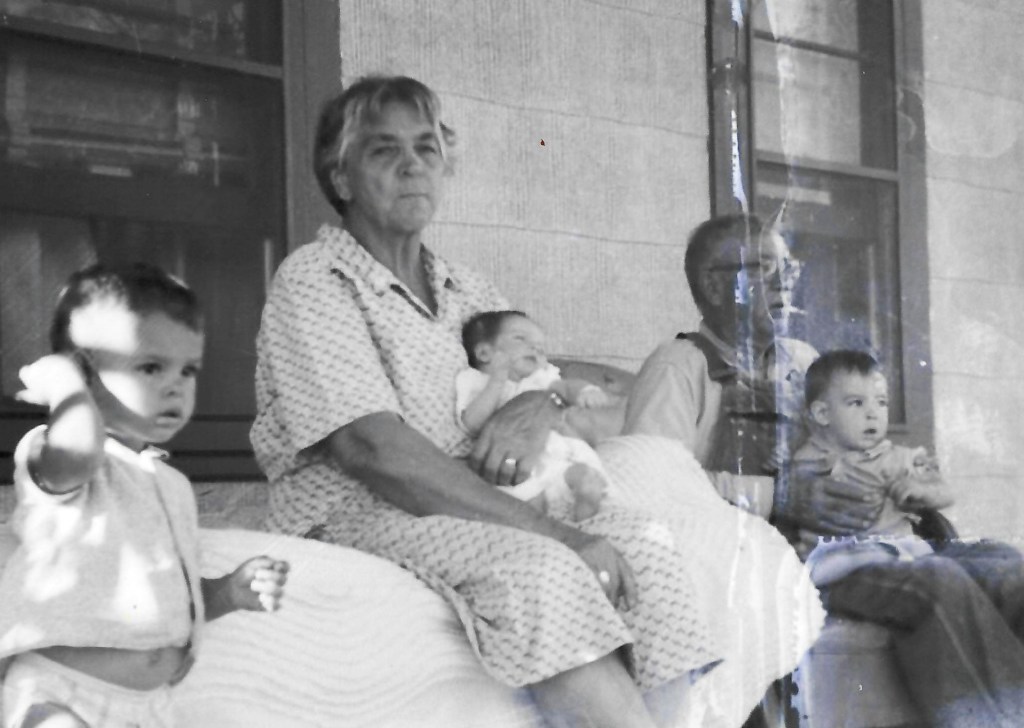
One thing I know, Mama always kept a special place in her heart for her firstborn, as I think lots of mamas do, if they’re being honest, even if they don’t say it, not wanting to give fuel to the fire of sibling rivalry. Mama’s eyes always carried a special spark when she talked about my oldest brother, a sentiment, I liked to remind her, that made little sense because his was the most difficult birth of any of her babies.
Apparently he was in no rush to enter the world, making her labor for over a day, and then almost ripping her apart when he finally decided to quit fighting the inevitable, entering the world on a hot August day in the county hospital twelve miles away where there wasn’t even an air-conditioner to cool the room. He was a cute baby, undeniably, but, even so, he didn’t enter the world on a snow sled.
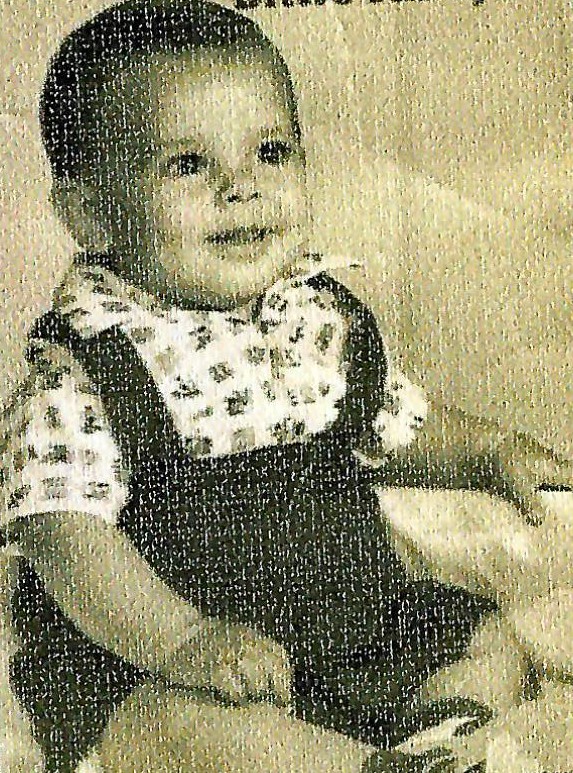
Mama never held the difficult birth against him, that was clear, and I’d like to think she liked him so much that she decided to have a few more, maybe more than a few, hoping they would be as cute as he was, his setting the gold standard for the rest of us who followed.
Daddy, a man of his times, named my big brother after himself, which, the experts now say, puts another heavy load on to young shoulders, the namesake always striving to live up to the name or, somewhere along the line, deciding to jump ship, pretty much destroying the name. These days, we want every baby to have a unique name, not the one already found in the family Bible, which, I suppose, has its merits, although uniqueness quickly becomes unpronounceable.
Most everyone would agree that my oldest brother has become pretty much like my dad in his ways, more so as he ages, talking like Daddy (no filter), manufacturing homespun aphorisms like Daddy (not repeatable), and spicing every sentence with a salty word or two like Daddy (no need to look for a five-lettered word when a four-lettered one works just fine).
It really couldn’t be otherwise, since my brother spent more time with my dad than any of us, again his position as the oldest inferring more work on him, beginning at an early age. When still a boy, he would spend lots of time in my dad’s mechanic shop, learning about all the tools and how to use them, his little hands black with grease almost the same time he was holding a bottle in them.
Later, when my dad tried his luck at farming, not a good move, my brother was the first of us to drive a tractor, although he could barely see over the steering wheel of that John Deere 4020. There also was a time when Daddy got interested in raising hogs–an odious business–my brother the one, more often than not, who was expected to keep the hogs fed and watered.
When the sows had their babies, he also was the one who spent the night in the stall with them, making sure the piglets got to the dinner table and protecting them so that the mother sow didn’t–for some inexplicable reason–decide to eat one of her own. As I said, it was not a pretty business, but my big brother did it.
He got a head start with all of it, learning to drive long before he had a license to drive. One afternoon, doing just that, on his way to feed the hogs, he was t-boned by another car, damage done to the vehicles, but none to either driver. The highway patrolman, called to the scene, gave the ticket to my uncle, explaining he was the one who had told my brother to go feed the hogs, knowing my brother didn’t have a driver’s license.
When we were young boys, my big brother and I would play Tarzan, an impossible game now that I think about it, because here in West Texas there are no trees to swing from, no chimpanzees to play with, and no waterfalls to jump from, but still we did it, under the cover of night, running down the dirt road in our underwear, which was as close to having something like Tarzan’s loincloth as we could get.
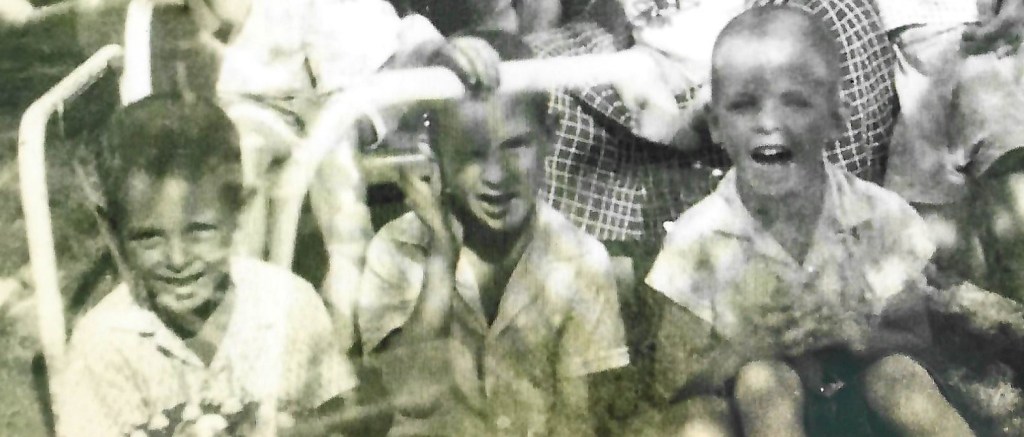
Looking back, I think the part we liked the most and the reason we attempted the improbable game, even if the closest jungle was continents and oceans away, was Tarzan’s full-throated call to the apes. There was something appealing about that Johnny Weissmuller yell–a sound that only happens when howling meets yodeling–and while we never fully replicated it, we got close enough to think we were a young Tarzan in the wild, even without any jungle or any Cheeta.
Childhood games didn’t last long because responsibility came early to my brother. He never batted an eye when it came to him. Once, when my sister–having the misfortune of being born between five brothers–had climbed atop a flat roof, probably following one of us, she unknowingly touched an exposed electrical wire, the current seizing her, making it impossible for her to let go of the wire. It was my big brother who grabbed her and pulled her away, saving her life in the process. I would guess he was 8-years-old at the time, smart enough and responsible enough even at that young age to get done what had to be done.
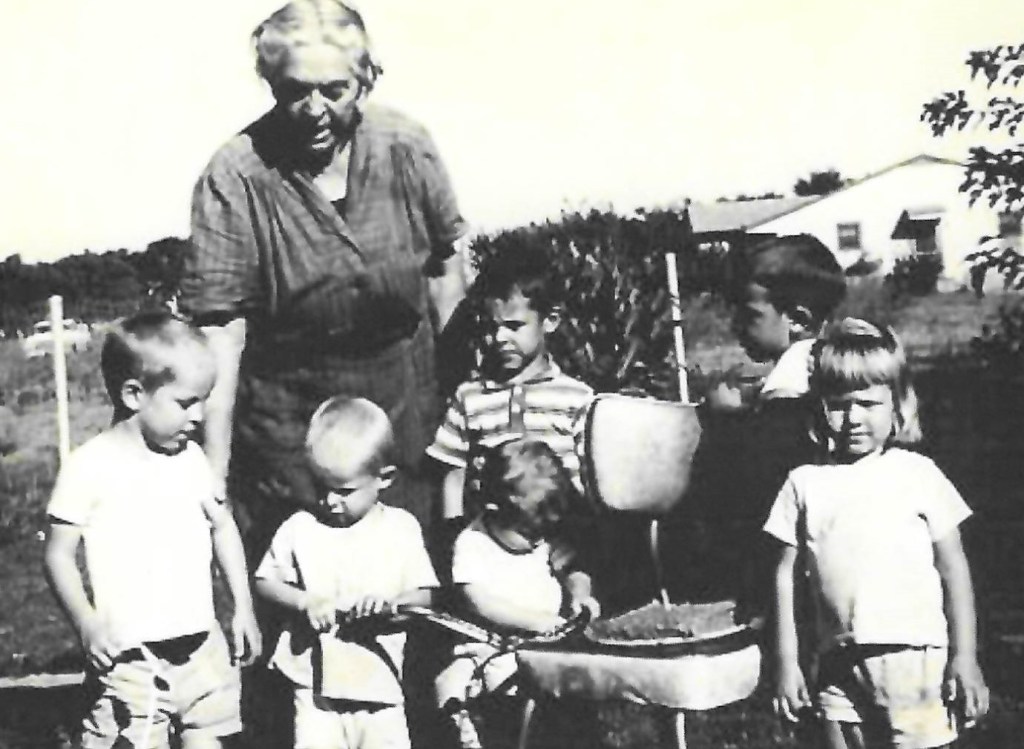
Years later, the same roof of the house would come in handy when my youngest sister was in need of entertainment, my brother tossing a stray cat onto the lower edge of the roof and catching it as it slid down, my baby sister tickled by the sight. I guess you could say we never were cat people. No harm done, I promise, the cat never injured, maybe even enjoying the flight through the air. Anyway, cats have nine lives. And I can vouch my big brother hasn’t played the game since then.
Speaking for most of the family, I’d say we’re dog lovers. My big brother has had several. He went through a period where he had small bulldogs, fond of the breed because they decorated Mack trucks, which he drove for a while. He told me one time that people were stealing the chrome miniature bulldogs off the hood of those trucks. He found that thievery wrong for two good reasons–it wasn’t right to rob the truck of its decoration and it was no way to treat a bulldog.
In more recent years, he seems to divide all dogs into two breeds–smart and dumb. I’ve never heard him describe any dog in any other way. One dog I had was smart. But another one was dumb. So he said, although I’m not sure what he based their IQ on. He calls his grandson’s dog Diesel one of the dumbest dogs he’s ever met. I believe Diesel will get smarter with age, but my brother doesn’t think so. He might be right. After all, very few humans smarten up with age.
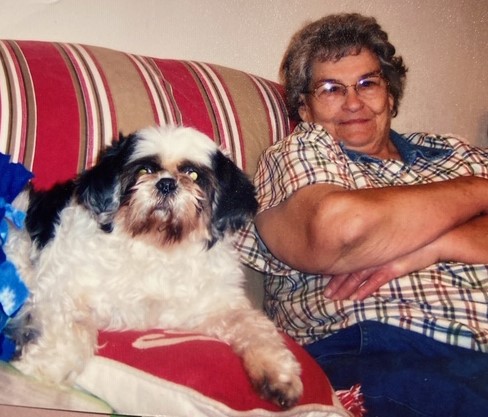
Being the oldest, my big brother was the first to join a peewee softball team, the Braves, as I recall the team being called. I tried my hand at it, but never was any good. He played shortstop. If I played, I was put in left or right field. We both knew I couldn’t catch a fly, but he never criticized me for it. Maybe he looked a little sad, but otherwise went on with the game. I quit after the first season, maybe the second, but he stayed at it, as he did with most things.
I followed him into the scouts, with pretty much the same results. While he learned to tie a hundred and one different rope knots, I struggled to tie one or two. He’d show me how they were done, but my brain stalled, never kicking into gear. I passed the Tenderfoot exam, managing to tie a few knots, none of which would secure a boat, but my interest waned sometime afterwards, the weekend campouts spent cooking with a tin pan over a campfire not my cup of tea. I was the classic little brother, always tagging behind, but never measuring up, Beaver to his Wally.
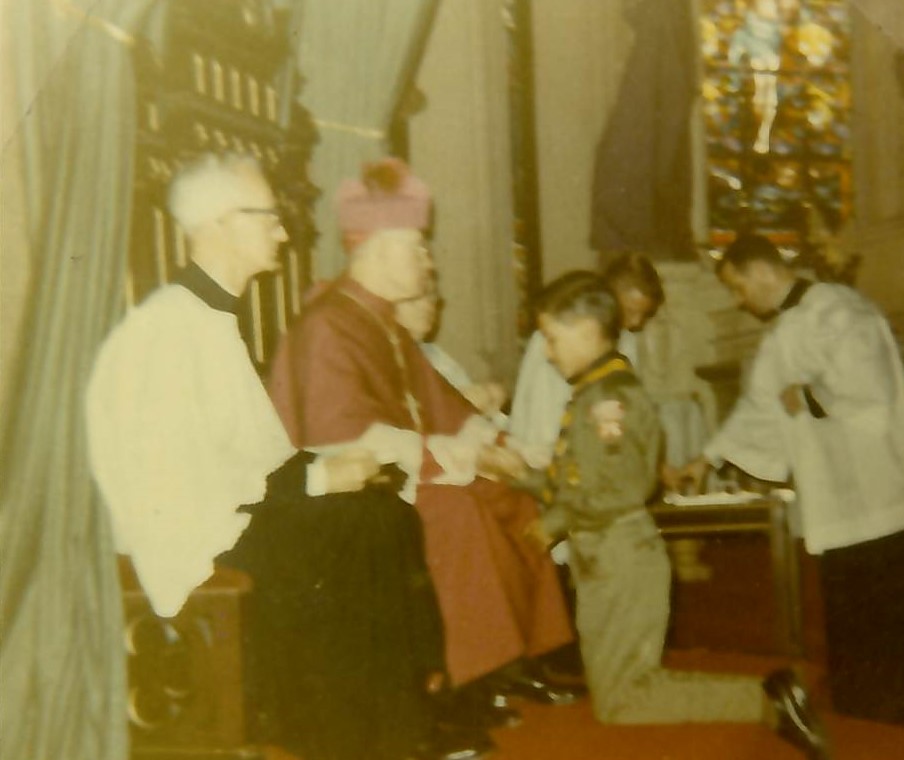
For a long time, he was the only one of us who could swim, having been selected to go to a two-week summer camp sponsored by the Knights of Columbus, coming back home a certified swimmer, which came in handy because Mama felt better now when we went to a cow tank or to the river to play in the water. He assumed the new responsibility with the same nonchalance as he did everything else.
Each year, when Christmas came around, as we searched a nearby pasture for the perfect tree, my brother carried the ax and chopped it down, the rest of us incapable of the task. He’d help Mama carry the tree to the car, while we watched him tie it to the roof, never wondering why he got all the tough jobs, just assuming he’d do the work because, after all, he was the oldest.
When he got his first job in high school, working in a tractor repair shop in a nearby town, he bought Mama a new set of dishes with his paycheck and, when she needed it, he’d give her money to buy groceries, something I didn’t know until years later, when she told me how bad she felt having to take his money, but I could still hear something more in her broken voice–the sound of deep pride in her firstborn who clearly had a good heart.
On a few occasions, mostly during the summer, we’d take a short road trip, all of us, always in a used car, meaning the tires were bare and the motor was about to blow a piston, my brother riding in the backseat behind Mama, claiming one of the windows where the wind could blow on his face, cool even if it was a hundred degrees, a small privilege granted him–without question–because of his firstborn status. But if there was any trouble with the car, a tire went flat, or something under the hood went wrong, he was the one everyone expected to fix it, his knowledge of all things both assumed and underappreciated.
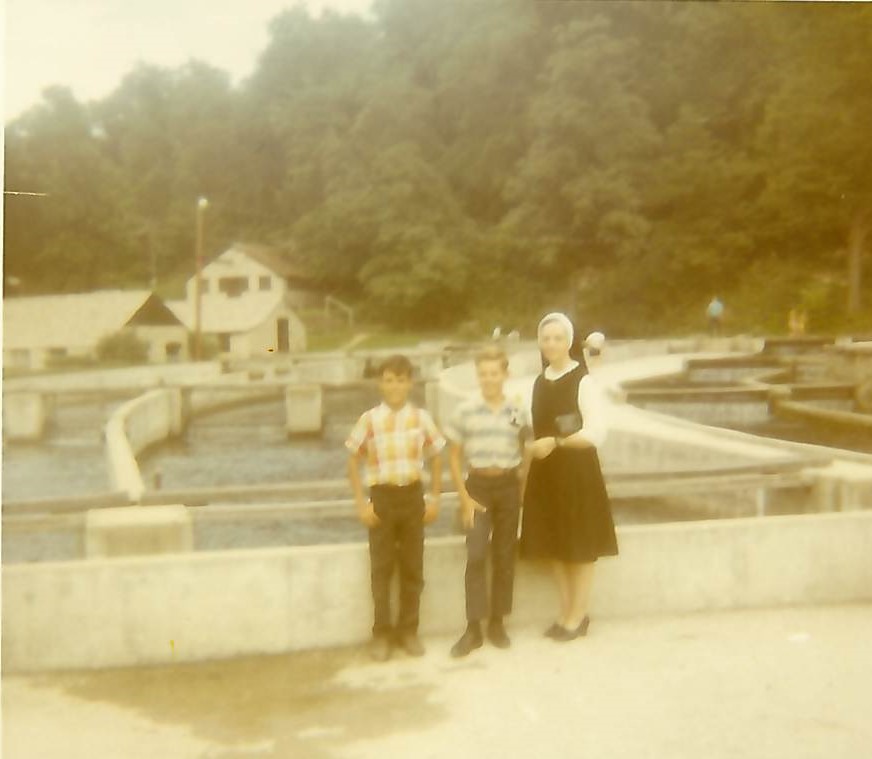
Even now, when I have lawnmower problems or a dead battery on the car, I call my big brother. Patiently, skillfully, he comes up with the answer, as he always does, never questioning my stupidity on such matters. I have decided that he believes humans, like dogs, are of two types–dumb and smart. If I were to guess, he classifies me as falling in the dumb category, even if he won’t say it out loud.
Naturally, he was the one who taught me how to drive, again requiring patience and tact of him. One night, as he let me behind the wheel, the lights of an ongoing car blinded me and I began to drift across the line. He simply said to me, “You might want to get back in your lane.” I did, but explained that the lights had blinded me. His answer was simple. “Then don’t look at the lights. Keep your eyes on the stripes.”
During my college years, when I had to fly out of the airport, nine out of ten times he was the one who drove me there, almost always getting me to the drop-off on time, one time getting me there with not a minute to spare, not his fault really, the blame more rightly going to the patrolman who stopped us in that predawn hour on an otherwise empty highway. Since then, my big brother has grown to dislike most of them because of their sneaky ways, with only rare exceptions. He also doesn’t like snakes one bit, but I don’t know which he likes less, although I might make a wager.
His disdain for snakes, I argue, has its origins in his childhood, when, a little more than a year old, just old enough to walk, he wandered away from Mama, getting outdoors and playing in the dirt in the front yard. When my uncle saw him, he was next to a rattlesnake. I’m sure there was a quick response from my uncle, followed by cries from Mama, all the fuss turning my big brother against snakes, teaching him early on that snakes bring nothing but trouble.
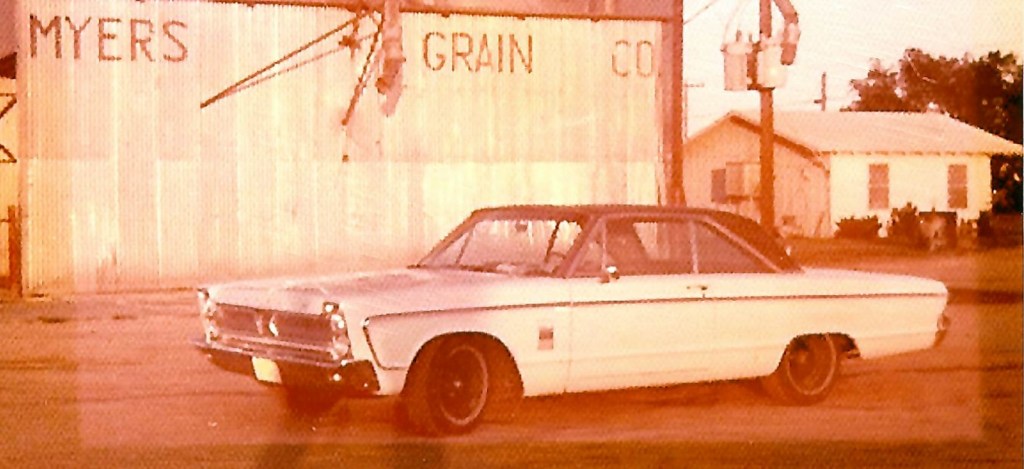
His first car was a 1966 Plymouth Fury that he handled with care, almost affection. Prior to that, he drove a 1966 Dodge Truck that belonged to Daddy, my big brother naming it “Mighty Fast,” a name that needs no explaining, the same kind of vehicle patrolmen drove back in the day, before they got fancy and switched to girly cars like Mustangs.
Much like other eldest sons throughout history, my brother never really left home, except for a few months when he went to a diesel mechanic school. As was expected, he returned home to work in my dad’s shop, in time becoming the head mechanic, his expertise today known across the area, maybe even the state. He’s been known to get a call late at night to go fix some big truck stranded on the highway. With a few tools and with his know-how, the truck generally is back on the road in an hour or so.
It’s his shop now, his tools, his rules. His hands still are streaked with black grease and his nails are broken and chipped from working around big trucks. I never let him see my hands. He’d be embarrassed for me. He’s also turned the place into a certified car inspection place, so that people in these rural parts don’t have to go to the city to get their cars inspected each year. He also puts the sticker on my windshield for me because he knows my limited skill set.
These days, he cusses new cars because they’re computerized to the point that a man can’t flip the hood and fix it anymore without a backup of computers and a hotline to the manufacturer, gone the days when a man who knew his way around a car engine could fix it with just a few wrenches. Now, as he says, they’ve got everything so crammed together underneath the hood that you can’t get to any part of it without bruising a knuckle or breaking a finger.
More accustomed to long-distance driving than I am, I asked him to take me to Colorado a few years back, needing to attend a funeral there. As always, he said yes, because that’s what big brothers do. Not trusting his GPS, he carried along his worn and torn Atlas map, a good thing to have, I learned. Along the way, he explained to me the maneuvers a semi-truck had to make on those mountainous inclines and drop-offs, my respect for truck drivers growing with each curve in the road.
Before we left Colorado, he wanted to see some diesel shop mechanics outside Fort Collins, mechanics much like him, people he called for parts regularly and for advice occasionally. That morning, after we had eaten breakfast, he said he needed to go back to his room because he wanted to change into his work uniform before meeting them at their shop, my learning something so deep and so moving in that moment that I’ll never forget it, even if my mind goes.
Because he was stepping into a shop, meeting face to face for the first time fellow mechanics, he wanted them to see him as one of them, a mechanic in his shop clothes, his name and his shop’s name on the white patch above his pocket. He returned downstairs a few minutes later, dressed in his navy uniform, ready to enter the sanctuary of that diesel shop, dressed the part as much as a minister stepping into the sanctuary of his shop on a Sunday morning.
When Mama got old, my big brother checked on her every evening after work, something he had done for years because he ate lunch with her every day of the week, except weekends. Now that she couldn’t cook anymore, he’d still sit at her table and talk with her, always calling her “Ma,” their conversations ordinary as the day behind them, but never mistake for a moment the special connection they shared, an unbreakable bond between them, there from the first moment he was put into her arms six decades and some years before, and while there would be many more children that she would have, he would always be the first to her, and nobody could take that from him.
In a few days, we’re about to celebrate the second Thanksgiving without her, and I know it weighs heavy on my big brother’s heart, as do all things related to family, because now that she is gone he has the job of being the head of the family, a job he accepts with the same equanimity as he has accepted everything else that came his way.
As the head of the family these days, he’s expected to remember all the family history, since, after all, he was there to experience all of it, and to show up at all the important events–weddings, birthday parties, big holidays–and to represent us at more formal occasions, such as the funerals of distant relatives. If he is not the face of the family, which I believe he is, then he is the most recognized face in the family, knowing just about everybody worth knowing.
Here at home, he is the one that can be counted on in still another way, to clean up any leftovers, taking the last scoop, the last slice, the last sausage so the pan can get washed in the sink. He was always willing to help Mama that way, since she didn’t like to throw away any food.
It is just one more thing on a big list of things a big brother has to do, but it’s nothing new for him. He’s been doing it since he was in diapers. With three sons of his own now grown and with ten grandchildren who call him Paw, his list only gets longer. Lucky for me, I’ve always had him as my big brother. In fact, I have two of them. Apparently, God knows I need all the help I can get. So, on this Thanksgiving, I’d like to say, for the record, “Much appreciated.”
–Jeremy Myers

 Sunday Brunch