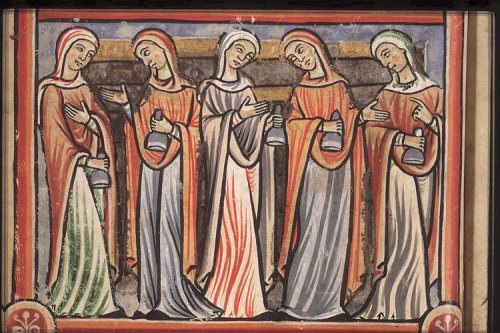
While they went off to buy oil, the bridegroom came and those who were ready went into the wedding feast with him. Then the door was locked. Afterwards the other virgins came and said, “Lord, Lord, open the door for us!’ But he said in reply, “Amen, I say to you, I do not know you.” Therefore, stay awake, for you know neither the day nor the hour. (Matthew 25.10-13)
In his book, Living a Life That Matters, the well-known writer Rabbi Harold Kushner offers this important insight, “In my forty years as a rabbi, I have tended to many people in the last moments of their lives. Most of them were not afraid of dying. Some were old and felt they had lived long, satisfying lives.Others were so sick and in such pain that only death would release them.”
He continues, “The people who had the most trouble with death were those who felt that they had never done anything worthwhile in their lives, and if God would only give them another two or three years, maybe they would finally get it right. It was not death that frightened them; it was insignificance, the fear that they would die and leave no mark on the world.”
He concludes, “The need to know that we are making a difference motivates doctors and medical researchers to spend hours looking through microscopes in the hope of finding cures for diseases. It drives inventors and entrepreneurs to stay up nights trying to find a better way of providing people with something they need.”
“It,” Rabbi Kushner says, “causes artists, novelists, and composers to try to add to the store of beauty in the world by finding just the right color, the right word, the right note. And it leads ordinary people to buy six copies of the local paper because it has their name or picture in it.”
As Rabbi Kushner rightly points out, each person wants his or her life to have purpose, meaning, and significance, the paths different and diverse for each person, as unique as the divine spirit that breathes in and out of every person that walks upon the earth. And as the history of humanity shows, some find purpose in walking the path of good, honoring God and others, while some find purpose in walking the path of evil, serving only themselves while ignoring others.
The scriptures today offer us Rabbi Jesus’ final teachings, his time on earth quickly drawing to a close, his days numbered as the powers of the world conspire to take his life. Seeing the forces of evil surround him and knowing their end game, the Galilean Rabbi offers his followers lessons on how to find purpose and significance in life, as he has done, a way to live that brings good into the world, light where there is darkness, and love where there is indifference.
Using a story to clarify his point, one of the four stories in this section that is called “the Judgment Discourse” in Matthew’s gospel (Chapters 23-25), the Rabbi tells of two types of people–wise and foolish–whose lives take different trajectories because of their decisions. Using the wedding metaphor, as he often likes to do, he speaks of bridesmaids, half of whom are prepared to meet the groom when he walks his bride from her parents’ house to his home, the other half not prepared, resulting in their missing the big moment.
As with all of the Rabbi’s stories, the plot and the participants in this story symbolize other things, here the wedding symbolizing the end times, the groom referring to the Lord God, and the bridesmaids indicating the people who find themselves either prepared or not prepared for this personal encounter when their days are done and when the Just Judge evaluates the lives of those who stand before him.
Many years ago, the beloved pope John XIII offered this counsel to his listeners, “Do not walk through time without leaving worthy evidence of your passage,” a far more profound statement than the “Kilroy was here” graphic and graffiti that American servicemen would etch on walls in cities in Europe during World War II indicating that they had passed that way.
The Galilean offers the same counsel, but injecting a sense of urgency into his story, reminding his followers that time runs out, requiring that people use their days in a good way, not lollygagging, not postponing, not delaying. “Stay awake,” he cautions, “for you know neither the day nor the hour,” his words a clarion call for vigilance.
The word “vigilance” shares the same root as “vigil,” both words derived from the Latin word vigilia, which means to watch, to be awake, to be alert, as a watchman or sentinel might do who is on watch during the night hours, waiting for the dawn of day. As we know, the word “vigil” became associated with religious celebrations, referring to the night before such an event when the participants would not sleep, but would remain awake in anticipation of the big day ahead.
Although we do not often think of it in such a way, all of life is a vigil, at least in some sense, with each person’s life–however long or short the night–a watchful waiting for the new day, when the night of this life is done and the light of eternity dawns. Like the bridesmaids in the story the Rabbi tells, that time of waiting can be spent in slumber or it can be spent in leaving a mark on the world, a mark for good if we follow the way of the Galilean.
Years ago, the cartoonist Roz Chast published in The New Yorker magazine a cartoon called “Creation: The True Story”, with Chast depicting in a series of panels a different take on the Book of Genesis. The cartoon has been reprinted on T-shirts and coffee cups because it speaks so succinctly to our attitude towards recreating the world, as the Galilean urges us to do.
The first panel shows God on the first day with these words, God created nothing because he had plenty of time. The second panel indicates same deal with God saying: Why rush? The third panel reads, On the third day, he created a list, the hand of God putting x’s on things done. The fourth panel shows God exhaling a sigh. It reads, On the fourth day, he was not in the right mood.
Moving to the second set of panels, the fifth panel reads, On the fifth day, all this stuff was going on. You don’t want to know, with God portrayed as holding his hands to his head in frustration, followed next by the sixth panel that reads, On the sixth day, God created the whole shebang,with a hodgepodge of creatures drawn beneath the caption. The last panel reads, On the seventh day, he rested,” God shown on a sofa, all worn out.
While humorous, the cartoon also is highlighting the human propensity for postponing, for not getting the job done, for finding excuses, reminding us what the creation of the world would have looked like if God had acted like we do, people who can’t seem to find “the right time,” people who excuse themselves from helping out because we “are swamped with work,” people who like to say, “Don’t worry, I’ll get to it,” lines worn thin as old socks in the drawer through overuse, excuses repeated with regularity because we act like the foolish bridesmaids who don’t get it that time is a gift not to be squandered.
Like those silly girls in the gospel, we tell ourselves that there will be time later for us to do the work of God, that we’ll get down to serious business about doing good down the road, that right now we just don’t have the energy to make the changes we need to make, meanwhile time slipping through our fingers, the calendar pages flipping until the day comes when we see, much to our disappointment, as did the bridesmaids, that we’ve run out of time and there are no more pages to flip.
Some years ago, Richard Sewall, who was a professor of English at Yale University, gave the convocation address at Williams College, an address that was personal, painful, and prophetic. In his address, he spoke these words to the students: “I want to share with you a little of what I have learned this year, the high-water mark of my experience as a human being. Two things, intimately bound, are closest to my heart now: love and death.”
He continued, “You’ll have to know that my wife, Matilde, died of cancer of the pancreas in November, and from that experience I have learned this: Never be embarrassed to talk about hallowed things like love and death. We Americans are a bit finicky about both. There is very little serious talk about love, and as for death, we hide from it.”
Then he said, ”What has tortured me these months since Matilde died are the things I didn’t say, the love I didn’t express. Why,” he asks, “was I so dim, so finicky, so inhibited, so embarrassed?” The question he asks is one we all have to ask ourselves, finding we so often are like the foolish bridesmaids, meaning we are so dim, so finicky, so inhibited, so embarrassed, so late to the party.
Rather than be like the foolish girls in the story, we always have the option to be like the wise women who were prepared for the groom’s arrival, keeping their lamps burning brightly, their oil not running low, their light shining even though the night was long. That wisdom belongs to those who understand the importance of every moment, each moment an opportunity to leave a mark on the world by deeds of charity and by acts of kindness, recreating the world moment by moment.
When we are able to do that, then when the groom arrives, we will be ready, without the regrets of the foolish bridesmaids who ran out of oil and who missed out on the celebration. Writer and speaker James Dobson once put before us the same option–to be wise or to be foolish–when he wrote, “When I reach the end of my days, a moment or two from now, I must look backward on something more meaningful than the pursuit of houses and land and stocks and bonds.”
“I will,” he said, “consider my earthly existence to have been wasted unless I can recall a loving family, a consistent investment in the lives of people, and an earnest attempt to serve God who made me. Nothing else,” he wrote, “makes much sense.” His words, stark and simple, tell the same story that the Galilean Rabbi told, who reminded us that wise people use their time wisely, while foolish people use their time foolishly.
–Jeremy Myers

 Sunday Brunch