When Jesus saw the crowds, he went up the mountain, and after he had sat down, his disciples came to him. He began to teach them, saying, “Blessed are the poor in spirit, for theirs is the kingdom of heaven. Blessed are they who mourn, for they will be comforted. Blessed are the meek, for they will inherit the land.” (Matthew 5.1-5)
In Gregory Boyle’s book, Barking to the Choir, the Jesuit priest tells about the time a young Latina mother came to visit him in his church office in South Los Angeles, located in the heart of the war-torn turf of some of the toughest gangs in the City of Angels. Accompanied by her son, a first grader at the Mission School there, the woman stood in front of his desk, sharing recent events in her life.
Father Boyle had known the woman for a number of years, even before she became a mother, when she was, as he said, “a wild woman fully dedicated to her gang.” All during the conversation the two of them had in his office, the woman’s young son continued to stare at Father Boyle, sometimes his mouth open, oftentimes looking almost as if he were in a trance.
Finally, at some point, the boy tugged on his mom’s t-shirt, saying to her in his child-like voice, “Mom, for Halloween, I’m gonna dress like Father Greg.” His comment, earnest and sincere, brought laughter from both the mom and Father Boyle. “Why?” the boy’s mom asks her son. Looking at his mom, the boy answers, “Cuz the teacher says that we have to come to school dressed like a saint.”
The boy’s comment silences Father Boyle, humbled by the small child’s words. Father Boyle relates that the young mother then bent down to eye level with her son, saying to him, ‘Honey, Father Greg is no saint.” Telling the story later, Father Boyle still laughs as he remembers how the young mom put him in his place, humbly him in letting her son know Father Greg was no saint.
Of course, that young mother was responding to her small boy with the traditional understanding of a saint, someone who has lived a meritorious life on earth and is now in heaven. Yet, possibly, her son was the one with the greater understanding of sanctity, seeing a saint as someone who lives his or her ordinary life here on earth, a life filled with obvious grace and generosity and goodness.
That definition of saintliness, as expressed by the small boy is, in fact, the original understanding of the word and, as a result, still holds primacy of place, not to be eclipsed by later attempts meant to calculate, constrict, and contain saintliness into some sanitized, scripted, and unsoiled holy card image.
As history shows, the early followers of the Galilean Teacher often called one another saints, St. Paul using the appellation in his letters to early Christians, calling them saints or holy ones. As he greets the community of Colossae, he writes, “To the saints and faithful brethren in Christ who are at Colossae: Grace to you and peace from God our Father.”
Obviously, these were persons within the community who were very much alive and whose lives showed holiness, setting them apart, their lives a beacon to others to live a similar life of holiness. Equally interesting, once the Christian church was on its feet, the earliest standard for attaining the title upon one’s death was by popular acclamation from the people who best knew and cherished the departed person, their verbal attestation enough to elevate the person to sainthood.
Whereas two miracles attributable to a dead person now are required before that person can be elevated to the status of a saint, the miracle of living a good and godly and grace-filled life in this corrupted and confused and conceited world was sufficient in itself in an earlier time, carrying a suggestion that we have made saintliness something exclusive, when, in truth, it is something much more extensive.
Sensing the same fly in the ointment, the gifted spiritual writer Frederick Buechner once made a clarion call for a more comprehensive understanding of those who qualify as saints, writing these words, “On All Saints’ Day, it is not just the saints of the church that we should remember in our prayers, but all the foolish ones and wise ones, the shy ones and overbearing ones, the broken ones and whole ones, the despots and tosspots and crackpots of our lives who, one way or another, have been our particular fathers and mothers and saints, and whom we loved without knowing we loved them and by whom we were helped to whatever little we may have, or ever hope to have, of some kind of seedy sainthood of our own.”
Welcoming his words, we are better served, then, on this All Saints’ Day by broadening the category, opening the ranks to the countless men and women through the centuries who have lived well, loved deeply, and died bravely, offering in the way they lived out their days an example for those of us who might want for a learned guide on this journey called life.
Years ago, the writer of religion Evelyn Underhill sought to describe just such saints, telling us that “a saint is simply a human being whose soul has grown to its full stature, by full and generous response to its environment, towards God. He or she,” Underhill writes, “has achieved a deeper, bigger life than the rest of us, a more wonderful contact with the mysteries of the universe, a life of infinite possibility, the term of which saints never feel they have reached.”
The question for us then is a simple one–how does one grow into just such a saint, since, after all, no one is born a saint. The answer is not as far-flung or as high falutin as we think, in this way putting saints out of reach for mere mortals, sabotaging our own possibilities for sanctity, and offering ourselves excuses for not attaining those coveted gold olympic medals.
But, as our texts from scripture today makes clear, we grow into sainthood through our everyday experience of embracing the values and the lifestyle that the Galilean Teacher put forth, most particularly in his teachings now called the Beatitudes, wherein he describes the saint as the ordinary person who chooses to be poor rather than rich, who suffers the misfortunes of life with quietude rather than with petulance, who seeks to live humbly rather than loudly, who favors right-living over wrong-headedness, who believes in mercy rather than revenge, and who desires peace more than war.
Put together, these virtues make for a particular way of living in the world, a way often contrary to the ways of the world, a way in conformity with the will of the Most High God, who created the world to be a paradise of peace and unity for its inhabitants, not a battlefield bloodied by hatred and division. These who follow this moral blueprint, imitating the way of the Galilean, are called blessed, or, put another way, they are saints.
The Galilean Rabbi likes to call such people clean of heart, by which he means their hearts are not conflicted, not contaminated, not corrupted by the darkness and the deviousness and the deception of a world hellbent on selfishness, self-aggrandizement, or self-importance. The clean of heart, he says, will see God because they already find the face of God in the impoverished, in the foreigner, in the helpless and the hapless and the unhappy souls around them.
Above all else, those who achieve saintliness do so because they are meek, by which the Galilean meant people who are quiet, gentle, and generous, not intolerable, insufferable, and intractable. In a world of loud mouths and fog horns and fast talkers, it is difficult, but not impossible, to find a meek person, someone who quietly goes about doing good, seeking no glory, working behind the scenes to make his or her corner of the world a little better than it was.
When Albino Luciani was elected by the college of cardinals to lead the Roman Church in 1978, chosen to succeed Paul VI whose tenure had lasted the previous fifteen years, he had already picked humilitas as his episcopal motto, finding humility to be the proper posture for a person who stands before the Creator. “Poor dust,” he often described himself, reminding others that “we must feel small before God.”
His leadership would last only thirty-three days, stricken by a heart attack in his sleep a month after his election, his short stay on the stage resulting in his being called “the forgotten pope.” Still, his life of simplicity and humility continues to inspire and to challenge others to live in much the same way. The examples of his saintliness abound, beginning with his refusal to have a coronation ceremony, complete with papal tiara, upon his ascendancy, choosing instead a simple inauguration.
As bishop of Vittorio Veneto, he visited his parishes by bicycle, an unimaginable choice of transportation, given his status. At his residence, he opened the door himself to any and all who knocked, whether they were priests, penitents, or prostitutes. He shunned the silk robes of his station, choosing instead to wear a tattered black cassock, content to be identified as a simple parish priest by the people he encountered on the street.
At one point, prior to becoming pope, he sold a gold cross and pectoral gold chain that John XXIII had given to him, using the proceeds to assist disabled children. He urged his fellow priests in Venice also to sell their valuables, contributing to the same cause and urging them to live simply and humbly. Later, after his election to the papacy, he would say, “God has so much tenderness for us. The Church too must be good, good to everyone.”
In these and other ways, the forgotten Pope, John Paul I, shined a light upon a dark world, or as one of the cardinals said upon the Pope’s death, “He passed as a meteor which unexpectedly lights up the heavens and then disappears, leaving us amazed and astonished.” These years after, and although no second miracle has been attributable to him, a requirement for official sainthood, his life alone shows his saintliness, with its studied practice of the Beatitudes, living as he did with meekness, with righteousness, and with mercy.
Ignoring the riches of the world, just as the Teacher outlined in his Sermon on the Mount, John Paul I chose to live as a person of lesser means, someone with a clean heart and the heart of a peacemaker. Perhaps now overlooked, if not forgotten, his name surely is inscribed in the book of the living, an inscription put there by the Most High God who calls upon all of us to live simply and purely and humbly in this world.
In the end, a person worthy to be called a saint is someone who does not grow upward, as those do who climb the ladder of success in this world, but is someone who grows downward, staying close to the dirt of the earth, grounded and humble, from the Latin word humus, meaning earth or ground, from which the word human also derives, implying that the saint is above all else fully human, made from the dust of the earth, but enervated with the energy of the high heaven.
Or, as the poet and theologian Calvin Miller opined so beautifully in his book, A Symphony in Sand, providing us with this lyrical verse: “Saints are never giants who hoped to do God favors. They are only souls whose needs took root in shallow dust, becoming redwoods grown from dandelion spores.“
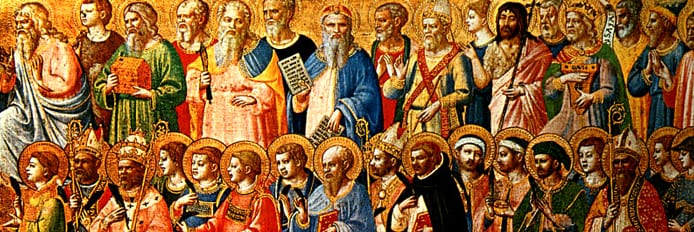
–Jeremy Myers

 Sunday Brunch