“The Pharisees . . . sent their disciples to him, with the Herodians, saying, ‘Teacher, we know that you are a truthful man and that you teach the way of God in accordance with the truth. And you are not concerned with anyone’s opinion, for you do not regard a person’s status. Tell us, then, what is your opinion: Is it lawful to pay the census tax to Caesar or not?’” (Matthew 22.15-17)
A number of years ago a well-known sports figure was on a stage in a convention center in Florida. Alongside him were three other sports players who also were finalists for the Player of the Year Award. After introductions of the players had been made, the Master of Ceremonies opened the floor for questions.
There in the front, sitting in a wheelchair, was a high school football player, paralyzed from the neck down as a result of making a tackle during a football game just a few months earlier, but excited now to see some of his sports heroes on the stage in front of him. Spending the last four months in various hospitals, he had been released on the same day as the awards ceremony, just in time to go to the big event, wheeled into the room by his parents.
His question was addressed to one particular player. In a clearly audible voice, the young man in the wheelchair said to the player, “Hey, can I get some of that ice,” his question referring to two shiny necklaces that hung around the player’s neck, the diamonds on the necklaces worth about $75,000. Hearing the question and seeing the young man who asked it sitting in his wheelchair, the player jumped up, pulled the necklaces off his neck, and brought them to the injured youth.
After the player put the necklaces around the youth’s neck, his mother began to cry while his dad wondered about getting a safe for the expensive jewelry. Meanwhile, the player returned to his seat on the stage as the awards ceremony continued, answering a few other questions, while keeping his eye on the young man across the room.
When the ceremony ended, the player jumped up and said to one of the coordinators of the event, “Where’s that kid at? I’ve got to get my stuff back.” Spotting the youth with his parents in the crowd, the player walked over to them, asking the young man to give back the necklaces, afterwards taking his address so that, as he said, he could send him something else.
It became clear, in that moment, that the player had only been playing to the crowd the whole while, never having any intention of giving his high-priced jewelry to the young man in the wheelchair. In his actions that day, the player provided proof of a word with which we’re all familiar.
The word “hypocrite” comes from a Greek word, hypokitai, which means an actor who assumes a character on stage, the word clearly implying two different personas, one that plays on the stage, the other that exists off the stage. Hypocrite, as we have come to understand it, expresses the divide between the two personas, the greater the divide between the fake and the real, the greater the hypocrisy.
In the narrative from the sacred texts that we hear today, the Teacher from Galilee uses the same word to describe the Pharisees and the Herodians, two groups that continually antagonize him, always hoping to diminish his popularity among the people, looking for any opportunity to catch him in a trap laid by their devious minds.
Telling us that their intention in this instance again was to entrap the Teacher in speech, the Scriptures set the stage for us, with the Pharisees seemingly heaping praise upon the Galilean, saying to him, “Teacher, we know that you are a truthful man and that you teach the way of God in accordance with the truth. And you are not concerned with anyone’s opinion, for you do not regard a person’s status.”
Of course, the false praise that falls from their lips is ironic because, in fact, the Teacher is everything they have said, their flattery falling flat in the face of the Rabbi’s genuineness. Anyone who has listened to the Galilean’s words and has watched his actions knows that the Pharisees, in their play to flatter him, have described him as he truly is–a sincere person, a person without duplicity, the opposite of their own two-facedness.
With any hypocrite, the effort to unmask him or her is not difficult, the hypocrite’s actions, calculated and contrived as they are, displaying the disparity between the true self and the false self, a side-by-side contrast that leaves little doubt as to the disingenuousness at play, the on-stage person nothing like the off-stage person.
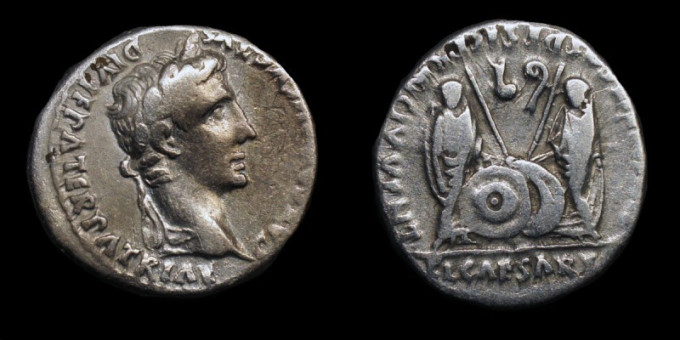
In this story, that contrast is concretized when the Pharisees pull from their pockets a denarius, the coin of Rome, offering it to the Galilean without second thought, never seeing that their possession of it violates their principles, since, after all, the coin contains a graven image of Caesar, carrying the inscription, Tiberius Caesar, August son of the divine Augustus, high priest.
For the true follower of Mosaic law, which prohibits graven images anywhere, but especially within the Temple, considered holy ground to every Jew and the place where this particular story takes place, a Roman coin would never be carried in a pocket or passed from hand to hand. Refusal to carry this coin would serve as proof that God calls the Jews to be a people set apart, or as the Hebrew scriptures say, “a holy people.”
Yet, these same Jewish leaders now provide just such a coin to Jesus, the prophet from Galilee, hoping to ensnare him with their deception, the fact of having the Roman coin stripping away their false front and revealing their true selves, “malicious persons,” as the Galilean describes them, their wicked intentions and double standards now on full display.
Stool pigeons seeking to lure the Rabbi into their snare, the Pharisees fail the test of sincerity, a test that Rabbi Jesus never fails, his real self always front and center, never someone who plays to the crowd, but who stays true to himself, a challenge to any who would seek to follow his way in a world full of actors.
Within the school of social psychology, there is a branch of study known as “Self-Presentation,” or “Impression Management,” both terms referring to our everyday efforts to convey certain images of ourselves that help us achieve our goals, these images flexible and adaptable, depending on the setting in which we find ourselves.
Again, as is evident, the terms come from the theatre, as does “hypocrite,” and they carry the same tensions and dangers, our self-presentation at risk of being deceptive or inauthentic as we move from one stage to another, interacting differently with different people, inconsistent in our words and in our actions.
While everyone practices self-presentation, the consistency varies, with some people’s self-presentation being more in line with who they really are, and with other people’s impression management lacking that same self-congruence. Studies show that, in fact, people’s self presentations overlap with their inner beliefs about 50 percent of the time. The other half of the time we’re simply playing to the crowd.
Seeing the situation for what it is, the follower of the Galilean finds him or herself facing the daily challenge of becoming authentic people who strive to conform to the divine image imprinted on our spirits, as the Galilean did, or, failing the challenge, becoming inauthentic people who strive to conform to the image of Caesar placed before us by our culture.
The choice between the two images never goes away, the entrapments also always there, as certain as the trick question posed by the duplicitous Pharisees in their plot to have the Galilean compromise his inner beliefs for outer approval. That we, unlike the Galilean, often make the wrong choice, turning our image into the image of Caesar rather than into the image of God, is clear and certain, the evidence against us mounting.
Already years ago, purviewing the hypocrisy of so-called disciples of the Galilean Teacher, the renowned Jesuit theologian Karl Rahner was forced to conclude, “The number one cause of atheism is Christians. Those who proclaim God with their mouths and deny him with their lifestyles” he said, “are what an unbelieving world finds simply unbelievable.”
The answer to this travesty, it would seem, is for us to consider the question posed by Rabbi Jesus as he held the coin of Caesar, asking the hypocrites before him, “Whose image is this,” challenging them to answer for him whose image they wished to imitate by their lives, the sacred one or the secular one, the holy one or the unholy one. With their answer, which was “Caesar’s,” they revealed their duplicity.
For us, the choice remains the same, to live an authentic life that springs from the divine image imprinted on our souls, living his way in this world, or to live an inauthentic life, one that reveres the image of Caesar, requiring that we play to the crowd, selling our birthright for social conformity and for spectator approval.
So long as we ask ourselves the question of whose image we wish to imitate, questioning in this way who we are becoming and where we are going, we stand a chance in this crazy world of remaining true to the teachings and the ways of the Galilean Teacher, who, although he suffered greatly for his non-conformity to the ways of the culture around him, also showed what living out the divine image looks like. He was the real thing to the end, even as he hung on the cross, nails hammered into his hands and feet by Roman soldiers, condemned to death by religious hypocrites.
Somewhere, there is the story told that the Queen of Sheba, learning of the wisdom of Solomon and traveling to meet him, brought with her nice gifts and hard questions. Among the tests she put before Solomon was a particularly difficult one. It seems she had brought with her artificial flowers so perfectly formed that no human eye could detect them from real flowers.
Placing these fake flowers in a vase on Solomon’s table next to real flowers already there, she awaited his entry into the throne room. As he sat at the table, the Queen of Sheba said to the King, “Solomon, you are the wisest man in the world. So tell me, without touching these flowers with your fingers, which are the real ones and which are the fake ones.”
According to the story, Solomon studied the flowers for a long time but said nothing. Finally, after a while, he spoke to his servants, “Open the windows and let the honey bees come in.” The servants did as he had said, the bees flying into the room and, within moments, alighting on the real flowers. Pointing to the flowers where the bees were, King Solomon, smiling, said to her, “Those are the real ones.” The Queen of Sheba, also smiling, saw in that moment that he was indeed a wise man.
As the bees did, so others around us do, figuring out for themselves soon enough whether we are the real thing or if we are just make-believe. One sniff of us and they will decide if we pass the smell test or if we fail it. They know, as bees do, that the real flower always smells divine.
–Jeremy Myers

 Sunday Brunch