“Jesus said to them, ‘Did you never read in the Scriptures: The stone that the builders rejected has become the cornerstone. Therefore, I say to you, the kingdom of God will be taken away from you and given to a people that will produce its fruit.” (Matthew 21.42)
A few decades past, a national newsmagazine carried a story about the dilemma in which many foster children find themselves, especially when their so-called temporary placements go on for many years, or when caseworkers claim to want to reunite children with birth parents, even though their parents’ whereabouts are unknown. As can be expected in such situations, the children feel an immense sense of rejection, corroding their sense of self-worth.
A children’s advocate cited in the news report recalls the story of an 11-year-old boy named Kevin who always had lived in foster care. At age 8, Kevin was suicidal and was admitted to a hospital. While there, the boy climbed into a trash can and asked to be thrown away. Already at eight years of age, he had experienced all the rejection he could endure.
Rejection is never pretty, bringing with it a high cost to the person being rejected, who, experiencing it, is flooded with feelings of unworthiness, unwelcomeness, and unwantedness. It is an assault upon the sacredness of self, inflicting a deep wound that bores into the heart, causing hurt, harm, and havoc.
As the gospel text shows us today, the Galilean Teacher, sent by the Most High God to offer a path back to the Divine way, is rejected by the religious leaders in Jerusalem, who consider his message a threat to their way of thinking and who plot a devious means to his destruction and death. The pain of this brutal rejection is expressed poignantly in a story the Teacher tells his persecutors, a story that draws a direct parallel to the circumstances in which he now finds himself.
Unlike many of the other stories that the Galilean tells, this story is told in each of the three synoptic gospels, indicating its importance to the writers of these texts, as well as its continued importance to the people hearing the texts in the early Christian communities. Looked at closely, the story could be said to be the whole of the gospel in short form.
“A landowner planted a vineyard,” the Teacher says, beginning his story with an image that often appeared in the Hebrew Scriptures, a vineyard serving as a symbol for this world as the place of human activity, the owner a reference to the Maker of the universe who provides a place for his creatures, designing it for fruitfulness, understood as a life of benefit to God and to others.
Unfortunately, as the story tells, the tenants working the vineyard–humanity in general and the people of Judea in particular–do not want to turn over the produce to the servants dispatched by the landowner to collect it–these seen as early messengers for the Divine One–opting to beat, stone, and kill the servants. The landowner, far too forgiving, again sends another set of servants–these seen as representing the prophets of old–to obtain the produce, but they, one by one, also are assaulted and assassinated.
Unwisely thinking the workers surely will respect his son more than they did his servants, the landowner now sends this beloved son–representing the Sage of Galilee–to the vineyard, but he is treated no better than the servants that preceded him, with the workers scheming to kill him in an attempt to steal his inheritance.
Learning of the malfeasance and malignancy in the heart of these workers, the owner decides to remove these heartless tenants from the vineyard, giving it to new tenants who, hopefully, will show greater respect to the owner and to his desires.
The Galilean Teacher ends his story with a question he addresses to his persecutors–the Pharisees–and to his detractors–the chief priests–“Did you never read in the Scriptures: ‘The stone that the builders rejected has become the cornerstone.’ Therefore,” he pointedly says to them, “the kingdom of God will be taken away from you and given to a people that will produce its fruit.”
Once we understand the immediate circumstances in which the Rabbi tells this story, we better understand the significance of the story. The Teacher has entered Jerusalem, the tension between him and the religious leaders increasing and escalating dramatically when the Teacher cleanses the Temple of the moneychangers. Along the way, he curses a fig tree that bore no fruit, an action also indicating a judgment on the people whose lives do not reflect the generosity of God.
Now, confronted by the Pharisees, the Galilean proceeds to tell three stories to them, each of which presents a similar message of their rejection of God, this story of the wicked tenants being the second of the stories, preceded by the story of the two sons sent to the vineyard, followed by the story of the wedding guests invited to the banquet.
At the center of each story, we find the Teacher making the same case, pointing to the Pharisees’ obdurance of heart, accusing them of rejecting the ways of the Most High God, while others, seemingly less religious, have accepted God and his ways, changing the course of their lives.
As we reflect on these stories of rejection told by the Teacher to the Pharisees, there is no small irony in knowing that the Galilean, sent by God to urge his children to make a change of heart and a change of ways, finds acceptance among those rejected and cast away by society–such as the sick, the sinful, and the stone broke–while, at the same time, finds rejection among the religious elites and the insiders of society. The friend of the rejected and the despised becomes rejected and despised, his corpse upon the cross, beaten and spat upon, becoming the final act of rejection.
The lesson left to the rest of us now living in these times, where the vineyard is the same, the owner is the same, and the heart of the workers is much the same, is not to do the same, not to reject God, not to repudiate his way. We have become the other tenants in the story to whom the owner has leased his vineyard in the hope that we, unlike the previous tenants who have rejected the same opportunity, do not squander our time, but will have something to share with the owner when our labors are done.
If we are serious-minded and singular of heart, then our sacred journey through this world will be, not one of manifold rejection–of God, of goodness, of generosity to others–but will be one of manifold reverence–of God, of his way, of others who share this space with us. In training our hearts to revere rather than to reject, we become the tenants that the vineyard owner wants and welcomes, tenants who choose reverence and not rejection.
We learn in this story that, while rejection is a repudiation of someone, its opposite is reverence, which is a respecting of someone. Reverence, rooted in the Latin word reverentia, means to stand in awe of someone, admiring, imitating, respecting that other person who walks before us. A good example of reverence is found in the Talmud, a collection of teachings by the old rabbis, where we are instructed, “All men should rise when a sage passes.”
Yet, as we know by the example of the life of the Rabbi Jesus, our reverence is not to be reserved only for the wise person, but is to be extended to the poor person, to the hungry person, to the sick person, to the forgotten person, and especially to the person rejected by society because he or she has no status, no social standing, nothing outstanding.
In respecting the rejected among us, we imitate the Galilean, who rejected the kings of this world and who chose to revere the King of the heavens instead, where the last is first, where the meek inherit the land, and where the hungry are satisfied.
And in doing so, in following the example of the Galilean Teacher, will we also become the stone rejected by the builders? In all likelihood, yes, because the kings of this world do not abdicate their thrones easily and the Evil One does not relinquish his hold upon the world without a fight to the death.
But, for the followers of the Galilean Teacher called Jesus, the choice is always reverence of others over rejection of others, even at the cost of our becoming outcasts, rejected by the powers of this world, as Jesus was, seen as losers in the sight of many, as the Crucified One was.
The well-known newscaster, David Brinkley, once told a story of the time he and a few others were playing poker in the White House with President Truman. The Prime Minister of England, Winston Churchill, was on a state visit. The year was 1946, just a short while after the end of World War II. As the men played the card game, it became clear that the Prime Minister of England was not a good card player. He continued to lose while the other men won.
Brinkley says that at one point Churchill excused himself so that he could go to the bathroom. As they waited at the table, President Truman said in a loud voice to the rest of them, “This man saved the free world. Lose”, his words and his tone indicating that Churchill was a man to be respected for his mastery on the world stage, not to be rejected for his paltry playing skills at the poker table.
So, Brinkley said, the rest of the night, they were folding with flushes and three of a kind, in this way showing respect to the man, even if the cards in their hands would have shown Churchill to be the one losing.
Hearing that story, we could say that these men, in choosing to lose to Churchill, although they easily could have beat him, became winners, their humility greater than their need to win, their respect for him greater than their repudiation of his skills at the card table, their desire for good fruit greater than their desire for spoiled fruit. The Galilean Teacher, in all likelihood, would have liked the story.
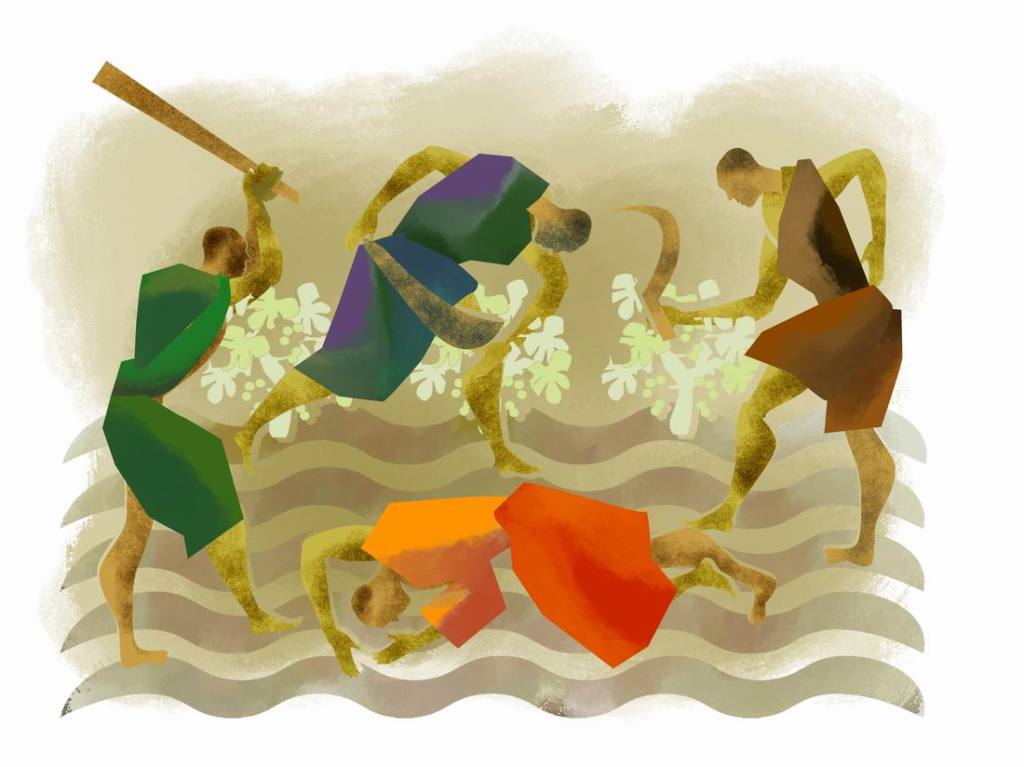
–Jeremy Myers

 Sunday Brunch