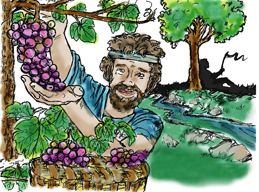
“A man had two sons. He came to the first and said, ‘Son, go out and work in the vineyard today.’ He said in reply, ‘I will not,’ but afterwards changed his mind and went. The man came to the other son and gave the same order. He said in reply, ‘Yes, sir,’ but did not go. Which of the two did his father’s will?”
(Matthew 21.28-30)
Some years ago, a newspaper carried the story about an incident that occurred in Miami, Florida. Wanting to improve the image of the city, a commission decided to set up a beautification committee, appointing 25 people to the committee.
But soon word got around about the committee and it seemed lots of people wanted to work on the committee. Multiple requests were received until finally 131 people were appointed to serve on the beautification committee. Then the committee had its first meeting to get organized so that they could begin their work.
Surprisingly, or not so surprisingly, nineteen people showed up for the meeting. Nineteen out of 131. The only conclusion that could be drawn from that number was that people wanted to belong to the committee, but they didn’t want to do the work. For them, it was enough just to say they were on the committee.
That incident, although reported in the newspapers, was neither singular nor significant when put alongside the many other similar incidences of people pretending to be one thing, the whole while being something else. Shallow and superficial people are nothing new, not in this world, not at work, not even in other-worldly circles.
Hence, the story that Rabbi Jesus tells the Pharisees on one occasion, a pointed story of image versus reality, clearly directed at these religious leaders of the day for their grandiosity dressed up in the garb of religiosity. The story he tells is one of contrasts, using the example of two sons of a vineyard owner.
As he told the story, one day the vineyard owner goes to one of his sons, asking him to work in the vineyard that day, receiving back a quick answer from his son, “I will not.” However, a bit later, the son changes his mind and goes anyway, doing as his father has asked him to do in the first place.
Meanwhile, the same father goes to another son, asking him if he will work in the vineyard, receiving from this son a different answer than the one received from the first. “Yes, I will,” this son answers, a happy answer, but hollow, because the son never goes, instead staying at home, doing nothing for the dad, choosing to play video games in his room.
The Galilean Teacher concludes the story by asking the Pharisees a simple question, “Which of the two did his father’s will?” Since the implied answer doesn’t seem to be a setup, they point to the first son, since he was the one who went to work in the vineyard for the day, although telling his dad he wouldn’t.
With that answer from them, the Galilean offers a damning indictment of the Pharisees, speaking to them these words, “I say to you, tax collectors and prostitutes are entering the kingdom of God before you,” explaining to them that sinners, like the first son, changed their mind because of the preaching of John, but the religious leaders, like the second son, said all the right things, but changed nothing about their behavior.
That story, told by the Galilean after he has entered Jerusalem, and soon after he had kicked out the moneychangers from the Temple, has continued to be a call to his followers to practice what they preach, to talk less and to do more, not to be–as people like to say in Texas of wannabe cowboys–“All hat, no cattle.”
As the story makes clear, saying yes to God, but doing nothing, does not make a person good any more than the second son who said yes, but stayed at home for the day, got the work done for his dad. The caution for anyone wanting to follow the Galilean is to avoid becoming like the Pharisees, men claiming moral rectitude, dressing the part, but not measuring up, not living it out.
Whitewashed tombs, the Galilean once called such men, easy on the eye on the outside, hard to stomach on the inside, a soul-withering charge that continues to the current day as a judgment on those who profess one thing, but who do another thing. Hypocrites, the Galilean also liked to say of such people, hypocrisy condemned by the Teacher more than just about anything else in his teachings.
“No one knows a bird until he has seen it in flight,” the naturalist Henry Beston once wrote, an assessment of featherless humans as well as full-plumed birds found in these words, which may explain the comment made by Thomas Linacre, the physician to Henry XIII, when he had completed reading the gospels for the first time towards the end of his life and who drew the conclusion, “Either this is not the Gospel or we are not Christian,” nearly as damning a critique as Gandhi’s, who once admitted, “If it weren’t for Christians, I’d be a Christian.” Apparently, neither man could find much to credit to Christians, although much to criticize about them.
What the Galilean Teacher wants from his followers is moral integrity, or as he says, “the way of righteousness,” meaning a person walks the walk and doesn’t just talk the talk. Integrity is a word not often heard today, probably because there are fewer examples of it to laud, many more examples available of people who profess one way to live, all the while practicing another way to live. The way of righteousness, sad to say, has few who walk upon it.
Exceptions stand out, reminding us that integrity is possible, even if not commonplace. After his presidency ended, Jimmy Carter has continued to find ways to serve others, so much is service a part of who he is, one of his favorite groups to work with being Habitat for Humanity, an organization that builds homes for poor people. Grabbing a hammer in hand and wrapping a nail bag around his waist, Carter has climbed atop many a roof to help build a house for those who have no home.
Once, when working in the Philippines on a house for Habitat for Humanity, the day a typically humid and hot one for that region, Carter began to sweat as he mixed some of the cement that was being used, sweat falling off his head and hands, mixing right in with the mortar.
The homeowner, later asked what he liked most about the house when it was completed, answered that one day he had watched as the sweat poured off the body of the former president, dropping into the concrete mixture, becoming a part of it. The homeowner said that as he watched that happen he knew the walls of his house were blessed because they contained the sweat of this righteous man.
Reclaiming that story, it would not be too far afield to say–and the Galilean surely would concur–that if we never work up a sweat doing a day’s work in the vineyard, then we scarcely can lay claim to our status as a follower of the One who said that, if we are to be like him, we must serve the poor, feed the hungry, clothe the naked, and heal the sick.
If our brow never has beads of sweat on it and if our hands never have cakes of dirt on them, then we have not gone to work in the vineyard. We may have said yes with our mouth, but we have said no with our hands. Simply calling ourselves disciples of Jesus means nothing unless our words are backed up with our deeds. Saying yes to the vineyard owner while doing no work in the hot sun means we’re blowbags, not besties.
Some years ago, the country singer Keni Thomas put out a song called “Not Me,” each verse containing an experience where there is the opportunity to say yes or to say no. For example, the first verse talks about volunteers that are needed to coach a kids’ baseball team, with no one raising their hand, coaches in the group saying “not me, not me, no way with this job of mine, I could never find the time, not me, not me.”
Finally, one man is picked because he is the only dad there. “The world becomes a better place,” Thomas sings, “when someone stands and leads the way, steps forward when they’d rather say not me,” moving us to the second verse where a judge tells the oldest child in a family that she is now the legal guardian of her two younger brothers.
“I’m sorry that you lost your folks,” the judge says, “but there’s no next of kin,” the song continuing with the words, “she knew how hard it would be but she softly said, I’ll raise them, while a voice inside her screamed, not me, not me, I can’t believe what’s happening, this isn’t how it’s supposed to be, not me, not me.”
Thomas sings once again the refrain, “The world becomes a better place when someone stands, and leads the way, steps forward when they’d rather say not me.” The third verse presents a similar situation of an army captain who has led a squadron of soldiers.
Some might say it is only a song, but then they’d also miss the point that the Galilean Teacher was making when he told the Pharisees the story of two sons, both of whom were asked to work in their dad’s vineyard, only one of whom went to the vineyard that day, although he had told his dad minutes before, “Not me, not me.”
As the song makes clear and as the Teacher made clear, “The world becomes a better place when someone stands, and leads the way, steps forward, when they’d rather say not me.”
–Jeremy Myers

 Sunday Brunch