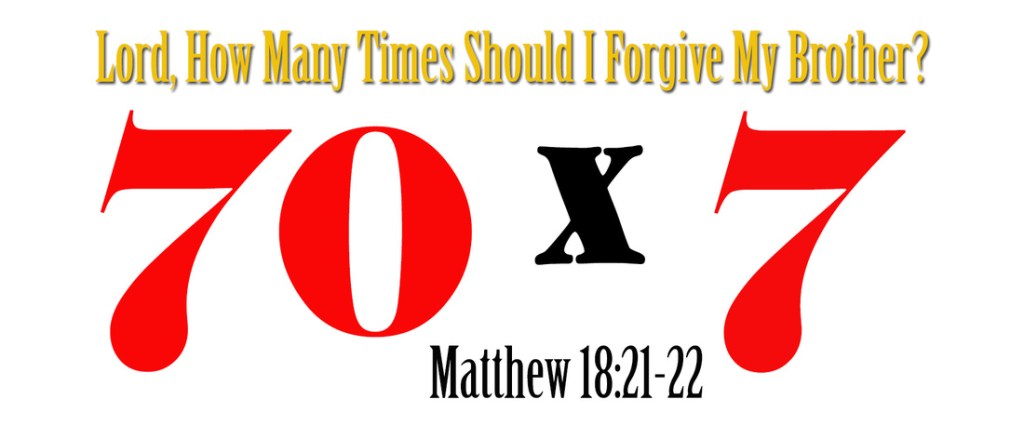
Peter approached Jesus and asked him, “Lord, if my brother sins against me, how often must I forgive? As many as seven times?” Jesus answered, “I say to you, not seven times, but seventy-seven times.” (Matthew 18.21)
In Chaim Potok’s brilliant book, The Chosen, he tells the story of two Jewish boys in Brooklyn, both baseball players, who meet one day as they play on opposing sides. Danny, who belongs to the orthodox Hasidic branch of Judaism, is at the pitcher’s mound, with Reuven at bat. Danny throws a straight line drive that hits Reuven in the head, smashing his glasses, sending a splinter of glass into his eye. Reuven is rushed to the hospital and Danny goes to see him the next day. Potok has Reuven narrate the conversation for the reader.
“Hello,” Danny Saunders said softly. “I’m sorry if I woke you. The nurse told me it was all right to wait here.” I looked at him in amazement. He was the last person in the world I had expected to visit me in the hospital. “Before you tell me how much you hate me,” he said quietly, “let me tell you that I’m sorry about what happened.”
I stared at him and didn’t know what to say. . . “I don’t hate you,” I managed to say, because I thought it was time for me to say something even if what I said was a lie. He smiled sadly, “Can I sit down? I’ve been standing here about fifteen minutes waiting for you to wake up.” I sort of nodded or did something with my head and he took it as a sign of approval and sat down on the edge of the bed to my right.
“What do they say about the scar tissue?” he asked. I was astonished all over again. “How did you find out about that?” “I called your father last night. He told me.” “They don’t know anything about it yet. I might be blind in that eye.” He nodded slowly and was silent. “How does it feel to know you’ve made someone blind in one eye?” I asked him. I had recovered from my surprise at his presence and was feeling the anger beginning to come back.
He looked at me, his sculptured face expressionless. “What do you want me to say?” His voice wasn’t angry, it was sad. “You want me to say I’m miserable? Okay, I’m miserable.” “That’s all? Only miserable? How do you sleep nights?” He looked down at his hands. “I didn’t come here to fight with you,” he said softly. “If you want to do nothing but fight, I’m going to go home.”
“For my part,” I told him, “you can go to hell, and take your whole snooty bunch of Hasidim along with you!” He looked at me and sat still. He didn’t seem angry, just sad. His silence made me all the angrier, and finally I said, “What the hell are you sitting there for? I thought you said you were going home!”
“I came to talk to you,” he said quietly. “Well, I don’t want to listen,” I told him, “Why don’t you go home? Go home and be sorry over my eye!” He stood up slowly. I could barely see his face because of the sunlight behind him. His shoulders seemed bowed. “I am sorry,” he said quietly. “I’ll just bet you are,” I told him.
He started to say something, stopped, then turned and walked slowly away up the aisle. I lay back on the pillow, trembling a little and frightened over my own anger and hate. “He a friend of yours?” I heard Mr. Savo ask me. I turned to him. He was lying with his head on his pillow. “No, I said.”
As the story moves on, Reuven’s father, on learning of the visit by Danny, tells Reuven that it is important to listen to someone who asks to be heard. Danny, undeterred by Reuven’s anger, returns the next day in another effort to seek forgiveness. This time Reuven offers his forgiveness and their friendship becomes the motor that drives the rest of the story.
Potok, as he often does, puts before us in that conversation an experience relatable to every reader, an occasion where someone has wronged us in some serious way, sometimes asking our forgiveness, as Danny does, sometimes not, but either way we are left to deal with the trifecta of feelings that are front and center anytime we are wronged–resentment, revenge, restitution.
Obviously, Simon Peter has stood in our shoes, as the scriptures make clear, when he asks the Teacher from Galilee the question we all have asked, “If my brother sins against me, how often must I forgive? As many as seven times?” We may want to recall that the Teacher had just instructed his disciples on reconciling with others, beginning his teaching with the same words that Simon now uses, “If a brother sins against you.”
Sure enough, Simon, the one who always speaks what is on his mind, wants clarification, or, as his question suggests, he wants a number. “How many?” he asks, making forgiveness a mathematical problem. Offering seven as a good number, since seven had a revered tradition in Judaism, and knowing full well that scholars of the law taught that three was the limit, Simon had to feel smug, realizing his suggestion was safe, even generous.
Shocking Simon, as well as the others who were keyed to the conversation, the Teacher answers with a much higher number, seventy-seven times, an exponential number that, if understood rightly, would mean a limitless number of times, an answer that removes forgiveness from human calculation and puts it in divine figures.
Telling a story, as he often does to assert a point, the Teacher offers the example of the servant who “owed a huge amount” of money to a king, but cannot pay it, which forces the king to put the servant up for sale, as well as his household. Kneeling before the king, the servant begs for mercy, and the king, “moved with compassion,” agrees to forgive the man his debt.
But the story does not end there with that solid example of mercy, instead moving to a second part where the same servant confronts another servant who happens to owe him “a much smaller amount,” demanding it while choking the man in a rage. This servant, like the servant now assaulting him, falls to his knees, asking for patience, assuring him that he will repay the debt.
Yet, the loan shark refuses to listen to the cries of the servant, instead putting the man in debtor’s prison. Others, seeing the situation, become bothered and bring the story to the king, who, learning of the servant’s ingratitude, lambasts him with these words, “You wicked servant! I forgave you your entire debt because you begged me to. Should you not have had pity on your fellow servant, as I had pity on you?”
Not waiting for a response, since the man’s actions were answer enough, the king has the servant imprisoned, as he had done to his fellow servant, the Teacher ending this story with the warning, “So will my heavenly Father do to you, unless each of you forgives your brother from your heart.” We can suppose Simon is stunned into silence by the story, his mind unable to comprehend the computations put before him by the Teacher.
Forgiveness, the Teacher makes clear to Simon, can’t be limited by the chintziness of the human heart, calculating, controlling and constraining as it normally and naturally is, but must be expansive, excessive, exponential, abnormal and unnatural as it seems. For the follower of the Teacher, it’s AP math, not simple addition. Or, as someone once said, “The follower of the Galilean is to be an island of mercy in a sea of indifference.”
At closer glance, it is clear that forgiveness is at the heart of the teaching of the Galilean and, as such, is at the heart of discipleship, our practicing or not practicing it proving or disproving our willingness to follow, the more we do it bringing us closer to the one whom we follow, the less we do it taking us further from the one whom we follow.
Augustine of Hippo, in preaching to his community on the necessity of forgiveness if they were to be disciples, pointed out that he was aware that some of them passed over the phrase in the Lord’s Prayer that says, “And forgive us our debts as we forgive our debtors,” knowing it would be a lie for them to say it aloud, preferring to harbor hatred in their heart rather than mercy, their failure to forgive putting them far from the Teacher.
As the Galilean makes clear, it was God who first forgave, a lesson we cannot forget, the sending of his Son into this world the clearest and fullest expression of his forgiveness of humanity for its failure to live up to its inherent goodness, this extension of the olive branch repairing the fractured relationship between Creator and creatures, forgiving us for the mess that we had made of ourselves and of the world.
As he had first walked in the Garden with the man and the woman, before the serpent had shut off our hearts, so now after eons of separation, Divinity walked again with men and women, opening their hearts anew, telling us that being together is better than being apart, calling us to become the community that was in the beginning.
Because we have been forgiven by the Most High God for our many trespasses, the bridge rebuilt between heaven and earth, we are instructed to do the same, forgiving those who have trespassed against us, rebuilding the bridge that has been destroyed by transgressions. We are to bring close to us into a restored community the one who owes us, just as God has brought us close to him, restoring the primordial community of Paradise. The bridge to Paradise must be rebuilt, not burned.
For whatever reason, we easily forget the forgiveness that first was given to us by God, perhaps because it requires us to acknowledge we also have done wrongs that call for God’s forgiveness. We can more easily forgive others who have wronged us when we realize the innumerable times that God has had to forgive us for the wrongs we have done to him by our selfishness, our spitefulness, and our utter sinfulness.
But because our hearts are easily hardened, the path to forgiveness is long for most of us who prefer to hang onto our grievances, plotting our get-evens, not wanting to meet our brother or our sister who has wronged us, more content to count the many ways we have been wronged rather than the many times we are commanded to forgive.
Yet, if we are to become better than we are and if the world is to become better than it is, we must take the steps to the other that will bring us together again. Until and unless we do, we remain as we are, alienated and apart, and the world remains as it is, debased and desolate. Without a constant injection of forgiveness into this world, Paradise seems long in the distance and our steps towards it are labored.
Many years ago, the British playwright John Drinkwater wrote a play that he called Abraham Lincoln. There is a scene in the play where a woman from the North, strongly anti-South, is ecstatic to hear the news of the latest victory of the Union forces over the Confederacy. She excitedly says to Mr. Lincoln, “They lost 2700 men and we lost 800. How splendid!”
The President is taken aback by the woman’s statement and he begins to say to her, “Thirty-five hundred human lives lost,” when the woman interjects and says to him, “Oh, you mustn’t talk like that, Mr. President. There were only 800 that mattered.” Lincoln’s shoulders droop, his eyes fill with tears, and he says to her, “Madam, the world is larger than your heart.”
We could say the woman did not understand the mathematics of forgiveness as taught by the Galilean Rabbi called Jesus. We can hope our heart, if not our math, can count much higher.
–Jeremy Myers

 Sunday Brunch