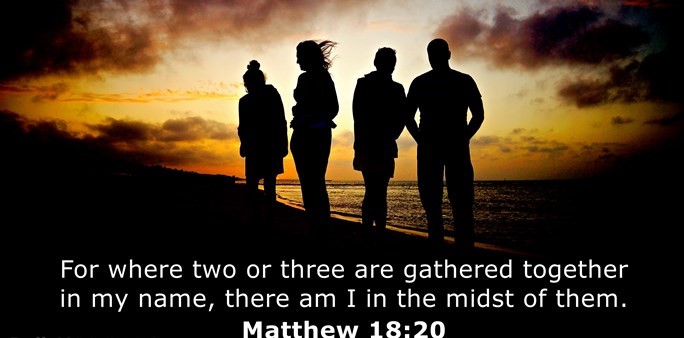
“Again, amen, I say to you, if two of you agree on earth about anything for which they are to pray, it shall be granted to them by my heavenly Father. For where two or three are gathered together in my name, there am I in the midst of them.” (Matthew 18.15-20)
In Erich Maria Remarque’s classic work, All Quiet on the Western Front, he tells the story of a 19-year-old German soldier named Paul Baumer who is fighting in the trenches of World War I. One day, as Paul huddles in a crater made by a bomb blast, a French soldier jumps into the hole. On instinct, Paul stabs the French soldier with his bayonet.
Checking the soldier’s pockets, he learns that his name is Duval, that he is a husband and father, and that he works as a printer. Paul watches as the man slowly and painfully dies. He contemplates what he has done, staring at the corpse of the Frenchman and asking the man for his forgiveness.
Paul speaks to him these words, “Comrade, I did not want to kill you. If you jumped in here again, I would not do it, if you would be sensible, too. But you were only an idea to me before, an abstraction that lived in my mind and called for its appropriate response.”
He continues speaking to the corpse, “It was that abstraction that I stabbed. But now, for the first time, I see you are a man like me. I thought of your hand grenades, of your bayonet, of your rifle. Now, I see your face and our fellowship. Forgive me, comrade. We always see it too late.”
Paul asks the dead man, “Why do they never tell us that you are poor devils like us, that your mothers are just as anxious as ours, and that we have the same fear of death, and the same dying and the same agony? Forgive me, comrade. How could you be my enemy? If we threw away these rifles and these uniforms, you could be my brother.”
Remorseful and repentant, he ends his moving soliloquy with these words, “Take twenty years of my life, comrade, and stand up. Take more, for I do not know what I can even attempt to do with it now.” Of course, there is only silence from the man he has stabbed, his still body resting against Paul’s own shoulder. Anyone looking at the pair–outside of the trench–could have easily mistaken them for brothers, except for the war, except for the opposing ideas.
The German soldier sees too late that the right time for reconciliation was before he had stabbed the Frenchman, not after he had inflicted the wound. There is a profound lesson in Paul’s words, a warning to the reader to make every effort to make peace with a perceived adversary before the bayonets are drawn. Once a life has been taken, reconciliation is no longer an option. It is too late when Paul pours out his words of regret to his enemy that he now sees was–in truth–his comrade.
As we consider the words that the Galilean Rabbi called Jesus speaks to us today, as told to us by the writer Matthew, we see that he also urges his followers to seek reconciliation with all others above all else. Using a hypothetical that is only too real, he lays out a stair-step series of if’s, “If a brother sins against you,” “If he does not listen,” “If he refuses to listen to them,” each situation followed by a possible resolution to the escalating conflict. As we listen to the scenario, it becomes clear that the Rabbi wants peace in a community, not conflict.
It makes sense. His mission, from the start, has been one of reconciliation, his life on earth initiating a reconciliation between God and humanity, so long at odds because of humanity’s waywardness, leading then to a reconciliation between the internecine factions of a fractured humanity–male and female, Jew and pagan, powerful and powerless, clean and unclean, insider and outsider.
At each turn in the road, the Galilean reached out to the other, the one seen as an enemy, welcoming him or her back into the community, embracing each of them–leper, prostitute, pagan–within the divine arms of love. He saw the other, not as a foe to fight or an alien to alienate, but as a child of the Most High God, each molded by his hands, each brought to life by his breath, each placed on earth with a divine mandate.
Entering into this world, a world filled with opponents, competitors, and heretics, a world hellbent in seeing people at each other’s throats, the Galilean Teacher envisioned a world filled with comrades, companions, and colleagues. The Teacher’s world–if believed in and sought after–is a world more optimistic and less judgmental, a world more peaceful and less warlike, a world more other-centered and less self-centered.
For this reason, the Galilean always urged his followers to open their eyes, to rid themselves of blindness, to see before it is too late that we all share the same divine imprint upon our faces, his spirit found in the sparkle in all of our eyes, his love planted in our hearts, overflowing into a love of all others whom we meet on the road of life.
In the early 1990’s, as the war in Bosnia was waged, a reporter stationed in war-torn Sarajevo witnessed a little girl shot by a sniper’s bullet. The reporter rushed to the man who was holding the child in his arms, helped them into the car, and hurried to the hospital. As the reporter sped through the rubble-filled streets, the man in the backseat, holding the bleeding child, urged him to go faster. “Hurry, my child is still alive.”
A moment or two later he would say, “Hurry, my child is still breathing.” As they neared the hospital, the man cried out, “Oh, no, no, my child is getting cold.” When the car pulled into the hospital parking lot, the little girl was dead. The man in the back seat sadly said to the reporter, “This is a terrible task for me. I must now go tell the father his child is dead. He will be heartbroken.”
The reporter was surprised, looking at the grieving man with the dead child in his arms, finally saying to him, “But I thought she was your child.” The man looked back at him and said, “No, but aren’t they all our children?” Aren’t they all our children? With those five words, the man articulated the vision of the Galilean Teacher, who also asked the same question, “Aren’t they all God’s children?” “Are they all our brothers?” “Aren’t they all our sisters?”
Now, as we look at our own divisive times, when the world seems so divided by differences and when conflict is the currency of the realm, the Teacher’s message seems like a pipe dream, like a fantasy that belongs in children’s storybooks, the word “reconciliation” inaudible because of the screams, shouts, and shrills that fill the air. The calls for community, camaraderie, and common purpose are muffled and muzzled and muted by the calls for distance, disunity, and disdain.
Yet, if we are truly aligned with the Galilean Teacher’s life and lessons, then we must walk into the streets, reminding the world by our ways and our words that the Most High God wants a world at peace, not a world at odds, yearns for a people living together, not a people fighting against each other, weeps for the family he remembers, not this family he longer recognizes.
To ensure that we understand God’s vision for the world, his dream for the well-being of all his children, the Galilean instructs his followers that–in his words–”where two or three are gathered together in my name, there am I in the midst of them,” words that clearly state his spirit is present in places where people live in harmony, his spirit absent in places where not even two or three people can get along.
Hearing the Teacher’s words, we are left to ask ourselves how in the world we got to this place where we are, where two or three people can’t be in the same room together anymore, where the same street is filled with people standing on opposite sides. Serious-minded souls surely ask the question, searching for some sensibleness in the insanity.
An answer, perhaps, can be found in the Russian writer and dissident Alekandr Solzhenitsyn, who once suggested, “If only there were evil people somewhere insidiously committing evil deeds, and it were necessary only to separate them from the rest of us and destroy them. But the line dividing good and evil cuts through the heart of every human being. And who,” he asked, “is willing to destroy a piece of his own heart?”
The evil, then, is not out there in the other, on the other side of the street, but it is within each of us, within our hearts, the same evil that penetrated the peacefulness of a Garden, a place where once upon a time there was community, this perverse presence entering the picture, burrowing into our hearts, turning us into captives of its evil intent, planting a wedge between the first man and first woman as they bickered and blamed each other about the first bite from a forbidden fruit.
From that early time until these late times, that evil presence has hovered over the world, like a dense, impenetrable fog, infiltrating our hearts, provoking men and women to do as the first of our kind did, fighting, clawing, killing, until any trace of Paradise is obliterated and every effort at community is destroyed. In a world sold a bill of goods on selfishness, self-interest, and self-importance, no one profits, except evil.
Our task, then, as followers of the Galilean Rabbi, is to preach the good news of reconciliation, finding ways to bring two or three into a community of love, teaching the world it is possible for people to be at peace, showing those enthralled by the enticements of evil that the pathway to life is walked on with companions, while the pathway to death is walked on with enemies.
Some years ago, a Vietnamese woodcutter was walking home after a long day of work in the dense woodlands of that country. As he found his way through the entanglements of the jungle, he came across the remains of a soldier, left to die in the underbrush of the forest. Looking more closely, he realized it was an American soldier from that war fought years before.
Carefully gathering the bones, showing respect for life and for the dignity of all human life that was so much a part of his Buddhist faith, the man buried the remains in the ground of that far away land. Some years passed and the same woodcutter would lead Americans to the spot in the forest so that the remains could be dug up and returned to the United States. A Vietnamese poet, learning of that incident, sought to explain the experience, writing these words:
Was your plane on fire, or did you die of bullet wounds, or fall down exhausted? Just so, you died in the forest alone. Only the two of us, a woodcutter and his wife, dug this grave for you, burned incense sticks, prayed for you to rest in peace. How could we know there would be such a meeting between you and me, once separated by an ocean, by the color of our sky, by language?
But destiny bound our lives together. And today, by destiny’s grace, you are finally going home.I believe your American sky is as blue as the sky above this country where you rested for twenty years. Is it too late to love each other? Between us now, the ocean seems so small. How close our two continents are at this moment. I wish a tranquil heaven for your soul, gemmed with twinkling stars and shining moon. May your soul rest forever in the soil of your home.
Hearing those beautiful words, we can ask, “Was it too late for reconciliation?” Perhaps not, we can pray.
–Jeremy Myers

 Sunday Brunch