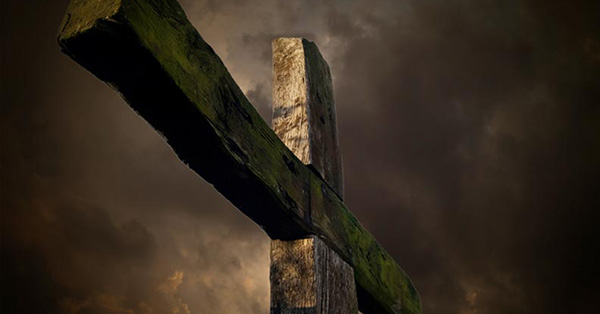
“Peter took Jesus aside and began to rebuke him,’God forbid, Lord! No such thing shall ever happen to you.’ He turned and said to Peter, ‘Get behind me, Satan! You are an obstacle to me. You are thinking not as God does, but as human beings do.’ Then Jesus said to his disciples, ‘Whoever wishes to come after me must deny himself, take up his cross, and follow me.’” (Matthew 16.22-24)
Anybody who has had the good fortune–or misfortune–of studying geometry is familiar with the name Euclid, who is known as the father of geometry. But before he gained that imminent title, he was a young teacher who was employed as a royal tutor to Ptolemy I of Alexandria. As Euclid attempted to teach Ptolemy his principles of geometry, the king is said to have complained to his teacher that surely there had to be a shorter path to learning geometry. Euclid answered the king, “Sire, there is no royal road to geometry.”
Three hundred years later, a similar conversation takes place, this time between a Galilean Teacher and one of his pupils, Simon Peter. And, as with Ptolemy, Simon complains to the Teacher that there had to be an easier way than the one that the Teacher proposed. The Teacher, much the same as Euclid, answers–in so many words–that there is no royal road to Jerusalem, but only the way of the cross.
As we take a few moments to look closer at the conversation between Simon the student and Jesus the Teacher, we notice that the Galilean Rabbi does not make any effort to soften his response to Simon, but, in a stern voice, reprimands him for thinking there is an easier way to achieve the Teacher’s goal, rather than going to Jerusalem, where it is near to certain that he will end up on a cross.
Some have called this conversation a grand reversal because, just a short while before, the Teacher had applauded Simon on his insight, calling him blessed or graced for seeing what others could not see, that he–the Teacher–was the Anointed One, long promised, long prayed for. But now the Teacher calls Simon, not blessed, but Satan, which had to be as shocking a name-calling to Simon as it is to us.
Perhaps it is somewhat helpful if we remember that Satan in the Biblical tradition is not necessarily the same Satan we imagine–someone horned and pitch-forked–but instead means an adversary, someone who takes an opposing stance, the opposition in this instance, as we watch Peter “rebuke” Jesus for wanting to go to Jerusalem, when a much safer place to stay would have been there in Galilee.
Equally interesting, whereas earlier the Galilean had told Simon that he would be a rock, someone strong and sturdy enough to carry his mission into the world, where he will bind on earth what is bound in heaven, now he tells Simon that he is a stumbling block, someone who is getting in the way of his mission to go to Jerusalem, where he will suffer at the hands of the top religious leaders of the people.
No one wants to be called a stumbling block, not then, not now, not if we are followers of the Galilean Teacher. The Greek word translated as “stumbling block” is scandalon, from which we get our word “scandal,” which means an action that is wrong. The Rabbi, doubtlessly using a sharp voice as he speaks this sharp word, corrects his student, telling him that he is dead wrong, a scandalon, someone who is blocking his way, causing him to stumble, a hindrance, causing him to have to circumvent Simon’s efforts to stop him.
Both shocking and unsettling, this “grand reversal” that Simon experiences reminds us that following the Teacher is not a straight and smooth road, but is a journey with twists and turns, even for the diligent disciple. The lesson is both clear and certain–one minute we appear as blessed, the next minute we appear as bedeviled.
The American preacher and writer, Fred Craddock, tells of the time he preached a sermon that one of the people in the pew didn’t like. The man came out of the church and told Craddock, “Bad choice.” Craddock answered, “Well, those were the words of Jesus.” The man answered, “Well, what people expect of the church nowadays is not a lot of talk about cross-bearing and loving enemies, they want to come to church to feel better, be a part of a group that will help them be successful.” He added, “We get together to mutually enjoy each other, so knock off the ‘ought’ and ‘must’ and should.’”
That man, dare we say, was a stumbling block, attempting to do as Peter did, rebuking Craddock for preaching the hard truths, whatever the cost, instead insisting that Craddock water down the message, until it is a thin bouillon, nearly tasteless, in place of serving a thick stew, highly seasoned. He wanted something palatable, not distasteful, easy on the stomach, not stomach turning.
Truth be told, such stumbling blocks are not few and far between. Over a decade ago, the Gallup Organization, which has polled the religious beliefs and practices of Americans for over half a century, offered this conclusion, “While religion is highly popular in America, it is to a large extent superficial: It does not change people’s lives to the degree one would expect from their level of professed faith.”
If Gallup is correct, the implication being that churches have become saunas to refresh us, instead of sanctuaries that challenge us, then the crosses on the steeples become a gross example of false advertising, suggesting they need to come down, implying a more appropriate symbol be put in their place, such as a smiley face, which promises satisfaction, not sacrifice.
Of course, the sacred text does not want us to point fingers at Simon or at others, always the easiest game in town to play, but urges us to look within our own hearts, always the toughest thing in the world to do. But if we are courageous enough to look deep into ourselves, the question we want to answer is, “Are we the scandalon, the stumbling block, the snare that stops the Teacher’s mission in its tracks?”
In other words, do we choose the path of least resistance, the easy way out, the four-lane paved highway? Or do we instead take the one-lane dirt road, bumpy and rocky, muddy and slippery? Do we ignore the poor, mistreat the alien, and harass the downtrodden? Or, do we choose to love the enemy, forgive the one who has wronged us, and walk the extra mile for the other, whatever the cost?
As an assist to our finding an answer as we search our souls, we only have to remember that the road to Jerusalem is never easy, or as the Jesuit preacher Walter Burghardt liked to say, when speaking of following the way of the Teacher, “If you’re not hurting at all, it’s a pretty good sign that you’re not working at it.”
Some years ago, a group of seminarians were being taught the art of preaching. Typical for such a class, each student took a turn at delivering a practice sermon at a church in the area. One of the students had returned to class that week explaining that a number of the members of the church where he had preached expressed anger because of his sermon. One man, he said, had even walked out before the sermon was over.
Wanting to be helpful, classmates bounced ideas around, looking at what the student-preacher might have done wrong. Had he been too vocal in his arguments? Had he spent enough time getting to know the people? Had he spoken in too strong a tone of voice? Everyone offered some answer as to where and how he had got it wrong.
The old professor, with years of experience and tons of similar experiments, listened patiently to the discussion, waiting until the class had listed any number of possibilities. Then he said to the students, “Did it ever occur to any of you that perhaps what he did wasn’t wrong, that it was right?”
He continued, “I’m bothered by the assumption that many of you seem to have that there is some way to talk about Jesus without getting hurt for doing so. Let me assure you,” he said, “none of you is smarter than Jesus. Jesus got into trouble for his preaching. So will you.”
Those wise words apply to any of us who would walk behind the Galilean Teacher, professing to be his follower, wanting to share his message of love with a world that feeds on hate, each of us preachers of his word, practitioners of his way. The professor is right. None of us is smarter than Jesus. If he got into trouble for his preaching, so will we.
So, the question before is, do we walk with him all the way to Jerusalem, because it is the hard thing to do, or do we try to block his path, because it is the easy thing to do? Do we love as he loved, thereby continuing his message, or do we love only those that love us, thereby hindering his message? As Simon learned on the road to Jerusalem with the Teacher, we can be either adversaries or we can be companions.
–Jeremy Myers

 Sunday Brunch