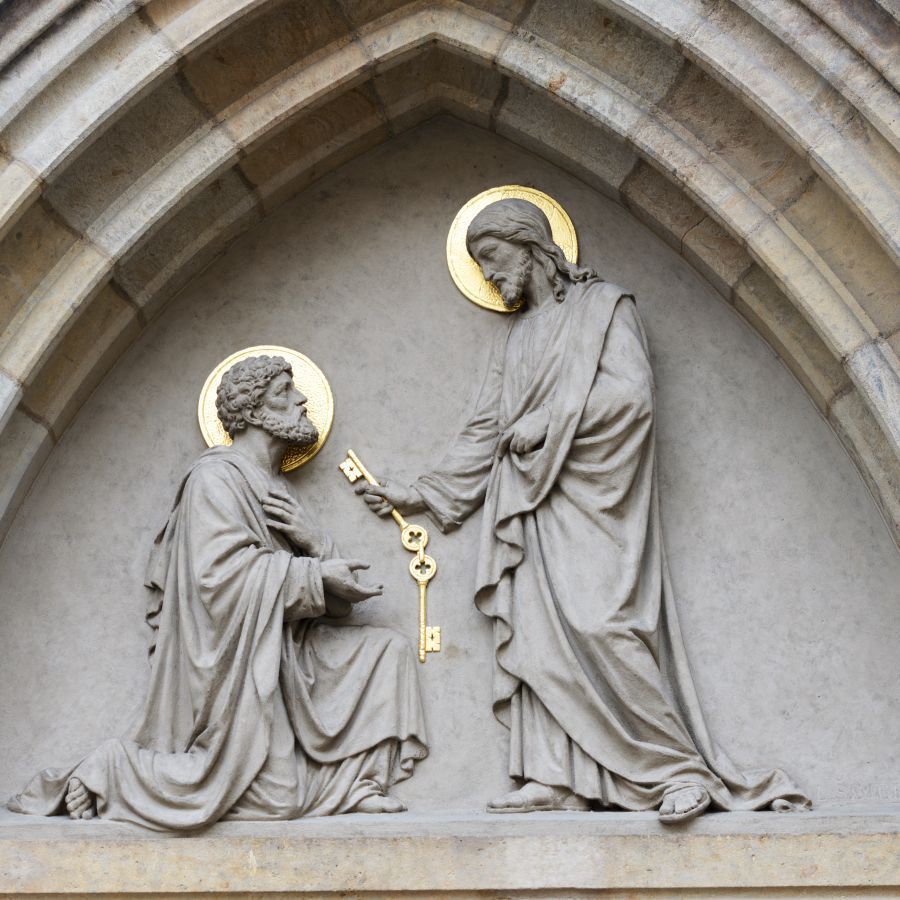
“Jesus went into the region of Caesarea Philippi and he asked his disciples, ‘Who do people say that the Son of Man is?’ They replied, ‘Some say John the Baptist, others Elijah, still others Jeremiah or one of the prophets.’ He said to them, ‘But who do you say that I am?’” (Matthew 16.13-20)
The Alaskan writer Heather Lende tells a story in one of her books about the time she was at a get-together in her little town where a meal was served to the townspeople when she witnessed a “solemn, blonde-haired little girl–Sally Chapell” walk up to the one of the community’s firemen, stand in front of him, and say to him, “I know you, you’re Fireman Al.” The tall, big man answered her, “Yes, I am.”
Then Sally said to him, “You help people.” Again, he answered her, “I do my best.” Lende says she watched as the little girl asked Fireman Al if he would fix her shoe, because the strap on her Mary Janes had come unbuckled. And as Lende describes the moment, “Al pulled her up onto his lap and fastened it.”
That story illustrates well the importance of knowing who someone is, as little Sally did, using this knowledge to get help with the torn strap on her shoes. “I know you,” Sally says. Today, the Sacred Scriptures has the Galilean Teacher ask his closest followers if they know who he is. Actually, the Teacher asks them two questions.
The first question, a general one, is, “Who do people say that I am,” an interesting question, since we typically don’t think of Jesus as being overly concerned about who people say he is. But, there is a reason for the question. We listen as his followers give him several answers, each of which is complementary, placing the Rabbi on a Mount Rushmore of Hebrew great figures, including John the Baptist, Elijah, Jeremiah, “or one of the prophets.”
Really, no one could complain about being put in the company of these revered religious leaders, each of whom gave voice to the heartbreak of the Most High God. But the Rabbi offers no comment on their answer, neither nodding in approval nor frowning in disapproval, instead moving to the second question, showing us that the first question was really a platform for the one he now puts to them, “But who do you say that I am.”
If we listen closely, we realize that the conjunction “but” renders the prior question of lesser importance, moving the response from popular opinion to personal conviction, thus suggesting that the popular response means less to him than the personal response. The heat is on, the disciples realizing the Teacher isn’t content with knowing who others say he is, always a safe place to hide, but wanting to know who they–his most trusted followers– say he is, a less safe place for them to hide.
Surprised by the question, or not prepared to provide an answer, although they doubtlessly had pondered it before this moment, the disciples say nothing, an awkward moment, as is anytime a question hangs in the air, at least until Peter, always the risk-taker in the group–whatever the situation–answers the question in his typically gutsy and spunky way.
“You are the Anointed One, the Son of the Living God,” he says, his answer shaking the Eleven from their brain freeze because “the Anointed One” had a revered and extended history in Judaism, pointing to a person who was set apart from others, anointed with oil as a symbol of specialness, and commissioned to a particular role assigned to him by none other than the Most High God himself.
As a result, in the minds of most Judeans, the Anointed One was the name to be given to the long-awaited Messiah, still to come, the holy one who would rescue the Jews from Roman occupation, the one who would restore the dynasty of David in Jerusalem. It was, simply stated, a name full of expectation, a name steeped in gravitas.
As we see, Peter’s answer brings a response from Jesus, who praises Peter for his insight, calling him “blessed,” meaning someone who is favored by the Divine One, his insight a sign of Divine grace at work in his soul, revealing to him knowledge known only by God. And because Peter has been gifted by God in this way, he also is charged with a special duty.
So, the Rabbi places on Peter the responsibility of leading the other disciples to that same insight, overseeing the formation of an assembly or a community that will remember the Rabbi by telling his story and by living the way he lived, while also directing Peter that he must be strong as a rock, not easily shaken or smashed, but providing a solid foundation on which this new assembly of believers might grow into the likeness of the Teacher.
Those two questions frame the story as we have it, a progression, as we have seen, from the popular to the personal. But, perhaps more importantly, there is something left unsaid, a third question, unasked by the Rabbi, a question that, by necessity, follows from the first and the second questions, which we must ask now, not so much of Peter, for he is gone, but of ourselves, for we are here.
That unasked question is this, “Who do you say you are.” It is the quintessential question that every human being must answer sometime, “Who do you say you are,” the response we give to it going to the core of our self-identity, the way we see ourselves, and the way others will come to see us. The answer we give becomes our place in the world, our statement of self, our proclamation of personhood, the innermost part of ourselves continually expressing itself outwardly into the world.
While the question of who we say we are is important for everyone who lives upon the earth, providing us with a place and purpose in the world, it is of primary importance for those who would identify themselves as followers of the Galilean Rabbi, as Peter and the eleven did, whose journey of self-identification as disciples, as we know, was neither quick nor straight, but rather was slow and difficult.
As for them, so for us, people living here and now, who stand where Peter and the Eleven stood, with the same unasked question before us that awaits the answer from us, a response that will determine what our next step will be. “Who do you say you are?” If we answer, as Peter implies in his answer to the Rabbi, that we are his followers, that we wish to be identified as his continued presence in the world today, then that next step we take will always be in imitation of the Teacher, thereby ruling out other roads, directing us in one direction.
Clearly, we do not ask ourselves the question only one time, as if who we say we are is answered like a math problem, answered and then we move on to the next problem, but it is a question that we will have to ask ourselves every day, because every hour requires an answer from us, every minute placing before us an opportunity to live as the Teacher lived.
Unfortunately, we live in a time where the question–”Who do you say you are”–too often gets a head answer, not a heart answer, resulting in a majority of those polled in our country saying they are Christian, while at the same time continuing to carry divisiveness, bigotry, and greed in their heart, none of which is part of the Christian identity. Jesus does not want an answer from the head, he wants an answer from the heart.
The reason is simple. Our true identity is found in our heart, not in our head, and so who we decide we will be is expressed in how we actually live, which means–for the true follower of Jesus–choosing reconciliation over division, sharing over greed, and embracing others over excluding others. When the answer comes from the heart, as it must for the follower of the Teacher, it flows like blood throughout our whole being, shines like light throughout our day, moves like breath throughout our whole life.
Some twenty years ago, a principal of a high school received a strange phone call, stranger than usual, this call coming from an inmate at a nearby prison. The man had run afoul of the law years before, but building up a small fortune before his luck ran out. Calling the principal, he had a deal to offer her.
As he explained, he was ready to make a sizable donation to the school–with one condition. He wanted her to give his adult son–a high school dropout–a diploma. As the principal listened to the inmate on the phone, it became clear that the man did not expect his son to do the work to earn the diploma, only to receive it.
Confused by the offer, the principal asked why the man wanted his son–now grown and working–to have a high school diploma. The inmate answered her, “Because education is important,” his answer showing he had no clue as to what a diploma meant in terms of putting in the hours and doing the work. A diploma to display was enough for the inmate, who failed to see that–without earning the credits–the diploma was just a piece of paper, nothing more.
It is the same for fraudulent followers of the Teacher, who wish others to see them as his disciples, a baptismal certificate proof enough, with no long days of work put in, no late nights of study suffered through, a yellowed piece of paper the only document necessary to prove to others in the world, “This is who I say I am.”
For authenticity’s sake, we have to answer the unasked question in a more believable way, a way that resonates more closely with the way of the Teacher, with a life that reflects more clearly the life of the Teacher, with no certificate needed because our way of life is proof enough of who we are, not a faded memory from long ago, but a life lived in the here and now with an outpouring of love.
Some years ago, a woman was riding home from her job, taking the city bus as she often did, it being a late Fall day, the first hint of winter already in the Boulder, Colorado air. It seemed, as she sat in the bus that evening, that many of the passengers on that particular bus were headed to the homeless shelter at the north end of town, the cold already making it impossible to spend the night on the cold concrete of the city sidewalks.
At one stop, the bus driver was hesitant to let a woman on, the driver telling the woman that the company had a policy of “no shoes, no service.” The woman explained that she had fallen asleep in the park and, while she was asleep, someone stole her shoes. Eventually, the driver relented, relaxing the company policy, allowing the woman to climb onto the bus in her stocking feet.
The woman without shoes sat down next to the other woman, the two of them making small talk as the bus got on its way. After a bit, a young girl across the aisle from them said to the shoeless woman, “I’d like to give you my shoes. I don’t have far to walk.” The woman answered kindly, “Oh, I can’t take your shoes.”
But the girl’s mother insisted that they didn’t have far to walk, assuring the shoeless woman that giving the shoes was her daughter’s idea. So the woman took the shoes, put them on, and–finding they fit–smiled and thanked the young girl for giving them to her. Now, she had something to protect her feet from the cold of the concrete in that Colorado town.
In that moment, that young girl answered who she was, knowing the answer required more than lip service, instead requiring real service, which can only come from a heart that sees all others as members of the human family, a heart that sees sharing what we have with those who don’t have is the only decent thing to do, a heart that sees breaking down barriers between “us and them” is the only way to save this world from its descent into hell.
That unasked question–”Who do you say you are?”–remains now for each of us who would follow the Rabbi to answer, a question that the Teacher did not ask because, in all likelihood, he understood–better than anyone–that it cannot be answered by words, but can be answered only by love.
–Jeremy Myers

 Sunday Brunch