I spent a good part of my childhood at my grandma’s snack bar, a long, rectangular tabletop that my uncle had designed for her when he built her house in 1954, this bar separating the kitchen from the dining area. Instead of the table, my grandma and I always ate at her snack bar, where two high bar stools stood on opposite sides, her stool the green one on the west side, and my own bar stool, a similar one, on the east side. There was a third one–a yellow one–that was pushed against the north wall of the kitchen, used only if another person showed up.
We faced each other every day as we ate our meals. I’m sure we chatted while we ate, although I don’t remember the conversations. Being young, I probably asked her lots of questions, which, being kind, she answered. But even if we did not say a lot while we ate, I learned as much about my grandma while at that snack bar as I did from conversations we may have had away from it. The food expert Ken Albala likes to tell his students that “food choices express who you are.” So, even without saying a word, Grandma was expressing to me who she was as we ate the food she had prepared.
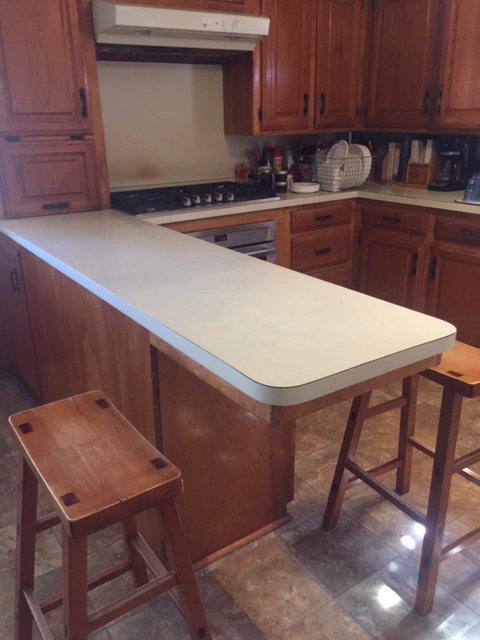
By the time I was commissioned to keep my grandmother company–a short while after my grandfather had died–she was getting old, and, having spent innumerable years cooking big meals in her farmhouse kitchen for her large family, she was tired of kitchen duty. Besides, as she always said, it was difficult to cook for just one or two people, which I am sure is true, her sense of food proportions long tuned to a family of twelve children.
When I think of Grandma–as I often do–my memories go first to the snack bar, picturing again the two of us–an old grandma and her young grandson–eating “butter bread” and drinking a cup of coffee. Looking back, I guess the more proper term would be “buttered bread,” but she always called it butter bread, a thick layer of butter spread across the surface of the thick slice of homemade bread.
It was our staple–butter bread–most often made from white flour, but also from whole wheat flour, which made for a darker loaf of bread, my preference, if given a choice, even now. She baked bread every week, a practice she brought with her from the farmhouse, and I still can give a rundown of the process, beginning with moving one of the bar stools to the center of the kitchen, pouring ingredients into the big pan she used, with the best part coming, in my opinion, when she kneaded the bread, her arms pumping into the dough with determination and with endurance.
When she had a hankering for it, she would make a coffee cake, beginning the process in much the same way, but raisins getting tossed into the dough, and a sugar and egg icing smeared across the cake when it came out of the oven, unlike the plain milk she used as a coating over the homemade bread, always using a dishrag to lather the top of the hot loaf, a whiff of steam dancing off the surface.
For years, butter bread and milk coffee was what we most often had for supper each evening, substituting coffee cake from time to time, only switching to hot tea when winter came because she liked it during the cold months, doctored with sugar and milk, the same way she liked her coffee.
Because Grandma canned peach preserves, I’m sure we occasionally spooned some atop the bread, but when preserves were brought out, she much preferred tomato preserves, which also were homemade, and which–I swear–I’ve never seen on a grocery shelf anywhere, nor–for that matter–have I heard anyone else speak of them, although I’m sure somebody else knows what I’m talking about.
If the peach trees had borne fruit the summer before, we would have canned peaches to add to the menu, a nice treat when she opened a jar of them, the peaches always sliced in half the way she liked, never smaller slices as you might find in the canned goods aisle of a grocery store today. Although my recollection is not perfect, I believe we also had canned apricots, although less often, since apricot blooms rarely survived the late April freezes, infamous in these parts.
Not being obsessed with variety, as later generations would be, Grandma rarely varied the meal, keeping continuity with her farmhouse practice where, my mom often told, they had fried chicken every day during the summer–because the supply was there in the chicken coop–and everyone also completely satisfied with the meal, as I was with our simple routine. When Grandma wanted a change, she would fix us tapioca, something I very much liked, but something I’ve never found anybody can fix as well as she did.
As you might expect, the other meals were similarly basic, breakfast consisting of bread and coffee, sometimes a hot cereal such as cream of wheat, fried eggs and bacon saved for Sundays, and lunch usually being some kind of soup, her favorites being pea soup and beef hash, two soups I still favor. She could and would fix a larger meal, but, as a rule, she also kept these simple.
Aside from the homemade bread and coffee cake that she baked, Grandma also would bake peach cobblers, but only if fresh peaches off the tree in the orchard were available, although her favorite pie always was mince meat, something we enjoyed especially during the winter months when mince meat was available at the store, considered a holiday specialty item more than an everyday item. From time to time, she’d make a lemon pie or, at other times, a custard pie.
She also had a simple, but good sugar cookie recipe, although I never saw her read a recipe in my life. Everything came from memory and nothing was measured. I still can see her ginger snaps, also made from scratch, which she liked to dip into her hot coffee before eating. To this day, if I see a bag of ginger snap cookies on the grocery shelf, I’ll buy it, not only for the good taste, but for the good memories.
The only cake I remember her baking was a chocolate cake, always with the same icing, a recipe that has been passed down the generations, the icing cooked over the stove and hardening when put on the cake. However, it is neither quick nor all-too-easy to make, especially for the microwave cooks of today.
Once in a while, Grandma would bake apples, which few people today remember or recognize. Some years back, when I wanted to surprise Mama, I baked her a pan of apples, but I had to look up a recipe, because my memory of how the task was done was not good. Somewhat of a surprise for a first attempt, I found they turned out very tasteful, almost as good as Grandma’s, but maybe a little crunchier.
The big cooking projects, as I remember, were the times when Grandma would make cottage cheese from scratch, using milk from the cow, not from the refrigerator, although–technically–both come from a cow. Having looked up recipes for cottage cheese, I’m sure hers was much the same, my memories stuck on the big bowl of skimmed milk that sat atop her freezer for a couple days, covered with cheesecloth.
I remember how Grandma then would cook the milk until it separated into curds and whey, straining it with a dishcloth that she had folded across a bowl. These curds, now collected in the dishrag, she would wrap up and hang from the clothes line outside until they had drained, then brought back into the house, cooled and sprinkled with cinnamon, and served on the snack bar. While the final product was surely delicious, the process was highly meticulous. Again, I’ve never found cottage cheese in the store to taste close to what Grandma could make.
Another item that required meticulous work–and odiferous, for sure–was when she decided to make pon haus, a German favorite, supposedly made popular by the Pennsylvania Dutch, but obviously known in the Old Country, a food item that showed that nothing was wasted when a hog was butchered in the fall. Typically, as I recall, the head of the butchered hog was placed in water in a deep pot atop the stove and brought to a boil, the meat falling off the bone when tender.
Once the meat was done, the broth was drained off, small chunks of meat remaining in the broth. Then whole wheat flour, combined with a mixture of spices, was added to the broth until it had thickened. The thick mixture was poured into pans, where it could solidify, forming loaves, which could be sliced into pieces. These pieces were then fried in a skillet and lathered with maple syrup when served for breakfast.
Perhaps overly sensitive, I never took to pon haus, the sight of the skull boiling in the water too much for my sensibilities, although it has continued to be a family favorite, my mother considering it one of her favorites throughout her life, grateful that her brother knew how to make pon haus, still today the custodian of the family recipe. I have not asked to borrow it, although some of my cousins have, apparently having less sensitive noses and generally fewer sensibilities than I have.
I’m left to wonder where Grandma’s meat grinder went after her death, a cast-iron hand apparatus that could be screwed underneath the snack bar where, once secured, chunks of meat could be tossed into and ground up to be put into the pon haus. A heavy kitchen tool, it had seen many years of use and had moved from the farm with her. My special job was to attach it to the snack bar, an important task, also one requiring every bit of muscle in my little arm.
Another food item enjoyed by my grandma, but not by me, was something she called “knobbles,” although, if my spelling is correct, has a much stronger “k” than the more ordinary word, “knobble,” connoting a round protrusion of some sort. “K-nobbles,” as Grandma made them, consisted of toasting big chunks of home-made bread, especially the heels, and then soaking them in warm milk. I don’t recollect anything being added to the porridge-like dish, but perhaps some sugar was.
When it came to store-bought items, Grandma also kept it simple, as you might expect, but she had a handful of favorites that she allowed herself from time to time. She liked sardines and taught me to like them, something we could eat during Lent without fear of breaking the Lenten regulations. She liked prunes, having had wild plum bushes growing on the old farm each summer, as well as a plum tree or two in her orchard in town, the place she moved when she and Grandpa left the farm.
From time to time, she bought herself licorice, a candy I could never agree to calling candy, its rather bitter taste and tough black twirls not appealing to my taste buds. She also enjoyed the hard, multi-colored candy that showed up on store shelves before Christmas, truly candy in my opinion, and much more to my taste.
Occasionally, Grandma would buy herself a small jar of dried beef, which she ate sparingly because she said it cost too much. I haven’t seen any in stores in years, but I know Hormel makes a product similar to what she liked. When she bought it, I enjoyed eating it, but I was just as intrigued by the small jars in which it was packaged, which made for a perfect little drinking glass for a small boy, such as myself. She also allowed herself an orange crush soda pop once in a while.
When someone gave it to her as a Christmas gift or one of her sons bought it for her, she kept a bottle of Mogen David Concord Wine in her laundry hamper in the utility room, taking a sip now and then. Why she put it in the laundry hamper, I do not know. She permitted me a taste now and again from her glass, but I thought it tasted just like grape juice, which, I guess, it is. She was a German Catholic, so didn’t have the same scruples toward alcohol use as did American Protestants.
I’d like to think Mogen David wine is still sold somewhere, but probably not in most stores, considered too cheap for profit. However, surely there are a few people who drink it. As Larry Gatlin and the Gatlin Brothers sang in one of their songs, “Do they have Mogen David in Heaven, Sweet Jesus? If they don’t who the hell wants to go?”
One other food item that deserves mentioning before we leave Grandma’s kitchen was bacon grease, which is–as its name implies–grease from bacon. Grandma kept a special can in the bottom drawer of her cabinet, retrieving it after she had fried bacon, pouring the grease into the can, putting a lid on it, and saving it for the many cooking tasks that called for bacon grease.
Our modern minds, more health conscious and more accustomed to turkey bacon, would not consider bacon grease anything worth keeping, much less using in something baked or cooked, but Grandma came from a different time. In her defense–if necessary–she lived to be 86-years-old, so I know bacon grease didn’t bring her to an early death.
Professor Albala, the food expert previously mentioned, likes to say that eating is the activity that tells the most about a person. Reflecting on the things that Grandma chose to eat, I have come to see that he is right, finding that the foods she liked tell me who she was in a way other things did not.
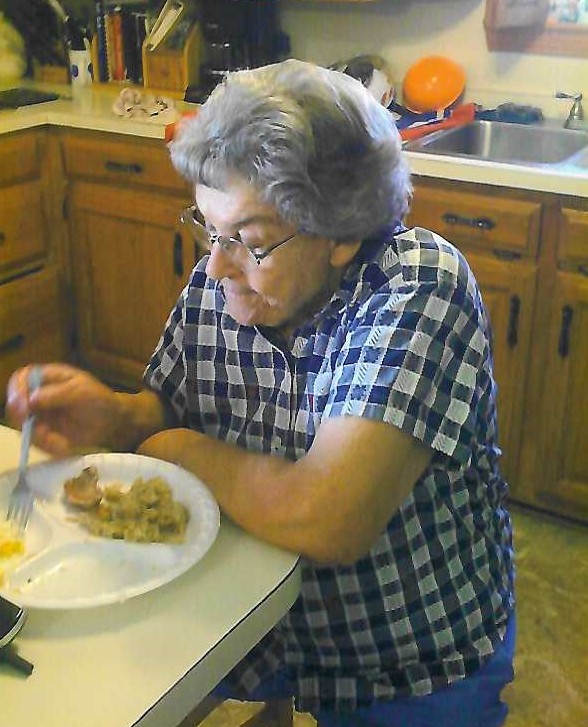
In telling her story, I like to remind others that Grandma was raised on the prairies of Nebraska, where food was grown in the garden behind the sod house, a person’s livelihood dependent on it, where nothing was wasted because there was not any surplus, and where people prayed grace before eating because food was never taken for granted.
With her eating habits formed on that Nebraska prairie, they came to define her, someone with simple tastes, someone without need for variety, and someone with a firm belief that food should never be wasted. Sitting and eating across the snack bar from her for many years, I came to know her in a special way, a knowledge I cherish, a love I will remember always.
–Jeremy Myers

 Sunday Brunch