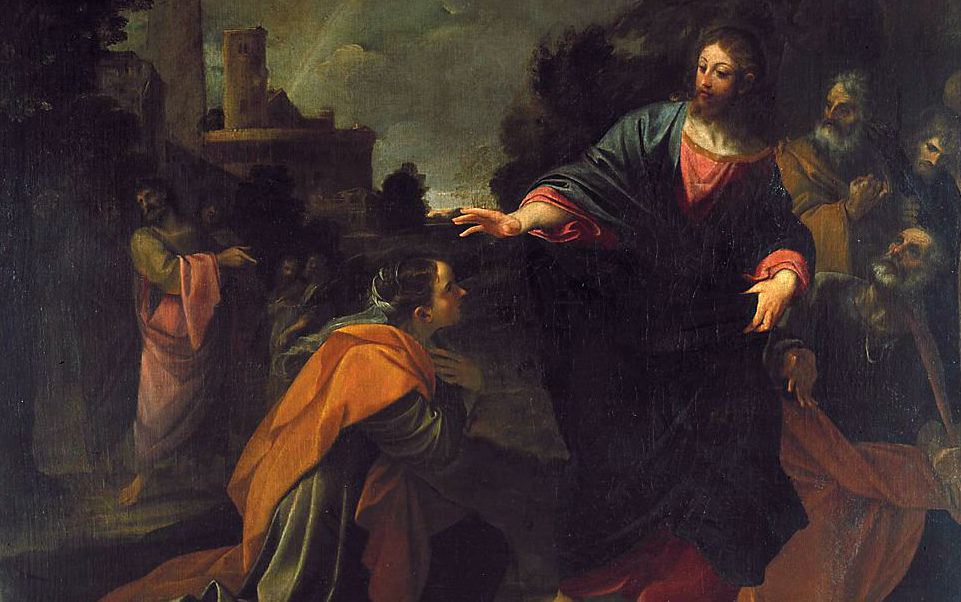
“At that time, Jesus withdrew to the region of Tyre and Sidon. And behold, a Canaanite woman of that district came and called out, “Have pity on me, Lord, Son of David! My daughter is tormented by a demon.” Jesus’ disciples came and asked him, ‘Send her away, for she keeps calling out after us.’” (Matt 15.21-28)
John Grisham, the popular and prolific American writer, often sets his stories in the soil of Mississippi, a place he knows well, since he’s lived there since he was a four-year-old boy. For Grisham, everything is explained by geography, a point he makes clear in his collection of short stories called Ford County,
Grisham ends the collection with a story about a young man named Adrian Keene, from the wealthy Keene family, who returns home to Clanton, Mississippi to die. The year is 1989 and, like so many other young men of that time, Adrian has contracted AIDS, after leaving Mississippi for New York City and then San Francisco.
Adrian has seen too many of his friends die already and he doesn’t want to put any of those still alive through the torture of his dying, so he goes back home. But his family–a prideful and powerful old family–doesn’t want him in their mansion, so his Aunt Leona, the matriarch of the family, convinces a black woman, Miss Emporia to take Adrian into her little house in “Lowtown,” the black section of Clanton, a house she rents from the Keene family, which Leona promises will be hers if she cares for the young man during his last days.
Miss Emporia is seventy-five years old, but she agrees to do it because the possibility of owning her own home is enough to make her do it. As the story progresses, she becomes very fond of Adrian, while at the same time experiencing ridicule and isolation from the people of Clanton, including from the preacher who tells her to take a leave of absence from church, all because of her kindness to Adrian.
After Adrian dies in his bed one night, Emporia finds a letter he has written for her, giving her the details of the funeral arrangements, telling her, “Mr. Walker has agreed, reluctantly, to bury me in the black section of the cemetery, as far away from my family’s plot as possible. When my ashes are buried, I’d be honored if you would offer a silent word or two. And feel free to stop by my little spot occasionally and leave some flowers. Again, nothing fancy.”
Adrian ends the letter with these words, “Thank you so much for your kindness. You’ve made my last days bearable, even enjoyable at times. You’re a wonderful human being. Love, Adrian.” Grisham ends the story with these words, “Emporia sat on the edge of the bed for a long time, wiping her eyes and even patting his knee. Then she collected herself and went to the kitchen, where she threw the letter in the trash [as he had told her to do] and picked up the phone.”
As we all know, Ford County isn’t only in Mississippi, but can be found just about anywhere on the face of the earth, anywhere, really, where people are divided by skin color, where other people are shunned because of their sexual orientation, and where people from the good part of town would never dream of entering “Lowtown,” except maybe at night for a pint of whisky or a chance at sin, as they do in Grisham’s Ford County.
Geography also is at the front and center of the story that the evangelist Matthew tells us today, a story with its fair share of suffering, separation, and narrow-mindedness. As we have heard, the evangelist says that the Galilean preacher called the Carpenter’s Son left Galilee for the region of Tyre and Sidon. This is no minor detail, but, like Grisham’s Ford County, is central to the story he wants to tell.
Biblical scholars tell us Tyre was about 37 miles from the Galilean border, while Sidon was more like 75 miles away, the long distance making it clear to us that this was no day trip for the Galilean, who had to walk on foot. If he went the full distance, this trip becomes the longest that he made during his missionary years. In going to these towns, the Galilean left the Jewish territories and crossed the border into a region where only Gentiles–or non-Jews–lived, something avoided at all costs, a part of the world where nothing good can happen, at least in the minds of the Judeans.
There, it is a Canaanite woman who approaches Jesus, the Canaanites having a long history of bad blood with the Jews, ever since the Hebrew slaves entered Canaan, despoiled the Canaanites of their land and took possession of it for themselves. Again, geography adds complexity to the story, helping us to understand two things in the story. First, the reason why Jesus doesn’t respond to the Canaanite woman when she shouts at him, a breach of propriety for a Jew, since it was improper for a Jewish man to address any woman other than his wife, much less a foreign enemy such as a Canaanite.
Secondly, we begin to understand why the disciples come off as so cold-hearted and callous, saying to Jesus, “Send her away. She keeps calling out after us.” They want nothing to do with her, failing the test, as she does, on gender, nationality, and geography. Why should they be put out for someone who is unlike them in every way?
But, as we see, the story takes a turn when the woman breaks through all the barriers–gender, race, and geography– kneeling before the Rabbi, begging him to heal her sick daughter, and reminding him that she is no more an outsider than the household pet is an outsider to the family living in the home.
Jesus’ response is immediate, himself ignoring custom and rules and borders, saying to her, “O woman, great is your faith! Let it be done for you as you wish,” the evangelist adding, “And the woman’s daughter was healed from that hour.” With this praise of her, she becomes only one of three people who is praised by the Rabbi in the Scriptures for their faith, each one of them, by the way, an outsider.
The story seems to suggest that our ways of dividing the world–geographically, societally, racially–are all contrary to the ways of the Most High God, who sees us holistically as his children, not as segmented groups divided by human constructs that keep us apart, that do not bring us together into the family that he calls us to be. Or, as the gifted musician Pablo Casals once said, “Love of country is a wonderful thing, but why should love stop at the border?”, his question suggesting that the geography of the heart is as divided as the geography of the land.
Recently, the writer Paul Sutherland tells of an experience he had when traveling with his family to a beach in Nicaragua. During the long drive in their van, Sutherland, not seeing an uncovered drainage hole on a narrow street in a small village, drove over it, the front tire becoming lodged in it. Some locals, seeing the situation, came over to push the van, but it wouldn’t budge.
Then a farmer drove by on his tractor, stopped in the middle of the street, seeing the situation. Without saying a word, he went into a nearby shop and came back with a length of blue rope. He tied one end of the rope to the van and the other end to a chain on his tractor, in this way pulling the van out of the drainage hole.
“Thank you,” Sutherland said to the farmer, offering the man some money. But the native farmer refused, saying “Somos personas.” Sutherland persisted, telling the man that the money could be used for his family. Again, the farmer refused, repeating again the same words, “Somos personas.”
When Sutherland and his family got back in the van to start on their way, his daughter asked, “Dad, do you know what he was saying?” Sutherland answered that he did not. She said to him, “Dad, he was saying ‘We are people.’ Dad, he was saying we are the same, we are all people. We are here to help one another. We are people. Somos personas.”
It is much the same thing that the Canaanite woman was saying to Jesus, when she implored his help with her daughter, telling him that geography didn’t matter. “Somos personas.” We’re all people. The Galilean Rabbi agreed, praising the woman, and teaching us that these social, geographical, and religious divides we use everyday do us no good, but only alienate us from one another, blinding us to our shared humanity.
It is time, the Rabbi seems to be saying, for Ford County to get over its many prejudices.
–Jeremy Myers

 Sunday Brunch