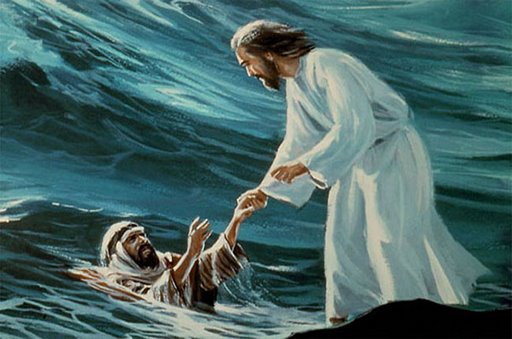
“When the disciples saw him walking on the sea they were terrified. ‘It is a ghost,’ they said, and they cried out in fear. At once Jesus spoke to them, ‘Take courage, it is I. Do not be afraid.’” (Matthew 14.26-27)
When Franklin D. Roosevelt was 39 years old, he lost his ability to walk due to polio, his wheelchair now his primary means of getting around. Yet, he kept his wheelchair out of the public eye, not wanting to let his disability define him. As a result, most Americans, not to mention people around the globe, did not know the President of the United States could not walk. Secret Service agents would block the view of him using a wheelchair and most reporters respected the White House’s request for the president not to be photographed in it.
Yet, there was one group for whom FDR dropped the ruse–these were military amputees. Hospitals were filled with men depressed and disillusioned about their fate and their future, having lost their ability to walk following amputation of their legs because of war injuries. As often as he could, FDR would visit these hospital wards. The severely wounded GIs recognized the visitor immediately, his face being the most famous in the world.
Yet, it was not his face that held their attention. As he entered the ward–this leader who had downed both Hitler and Hirohito–he came down the aisles in his wheelchair, in full view, with no attempt to hide his handicap. Some who saw it said he made his wheelchair look like a royal chariot as he briskly wheeled himself from bed to bed, encouraging the GIs, not only with his words, but with his presence, seated as he was in his wheelchair, the most powerful person in the world.
Today, the Sunday scripture selections offer us a similar example of encouragement, as we listen to the evangelist tell us of a late night rescue of a band of disheartened and distressed disciples, threatened and tossed about in their little fishing boat, as they find themselves caught in the middle of the Sea of Galilee, the fury of the winds and waters seeking to sink them to the bottom of the deep and the dark.
Then, as their hope wanes as the waves flood the fishing boat, they see a figure–a ghost, they think at first–coming towards them, seemingly walking on the water, the waves carrying him closer to them, until they see that it is not a figment of their imagination, but is a face they know, that of their beloved Teacher, Jesus, come to rescue them from the clutches of the chaotic sea.
The story is told by three of the evangelists–Matthew, Mark, and John–the repetition a reminder of its importance, not only to the early community of believers, who had their own struggles on the sea, but to later believers, who also found themselves facing the peril of the sea, which is never just a body of water in the Bible, but is seen always as a symbol of chaos.
For many of us, that time and that situation is now, as we face the chaos of a world-wide pandemic, food and financial insecurity, and inner doubt about our future. We find ourselves drowning under the waves of loss of health, loss of work, loss of home, and loss of family. Our boat, once secure and safe, now feels shattered and sinking, as we hold onto the side, our grip slipping, our voices sobbing in the darkness for help from someone, from somewhere.
The point of the scriptural story that is told to us today is that help comes.The Galilean Teacher did not abandon his disciples when the storm on the sea tossed them like pancakes on the griddle, and he will not abandon us when the storms of life come at us, full of sound and fury, bringing with them chaos and confusion that promise destruction and destitution.
We want to remember that, when the Galilean is within reach of the disciples, the first words he speaks to them are words of encouragement. He says, “Take courage. It is I. Do not be afraid.” As we have seen before, our English translation of the Greek is not perfect. When the Teacher says, “Take courage,” the Greek word really means, “Have courage.” “Be of good cheer.”
Apparently a favorite phrase of the Galilean Teacher, who uses it at least on seven different occasions in the scriptures, we find in it not a rebuke or a reprimand, as people might think, but instead a call to have good cheer, to have comfort, to have confidence, even as we face the disconcerting and discomforting and dispiriting situations that chaos always creates in our lives.
The British, well-known for coolness in any circumstance, created a slogan that continued to be used throughout the dark and dreadful days of World War II. First printed on a poster at the start of the war, the words in bold print read, “Keep Calm and Carry On.” The intent of the poster and the phrase was to raise morale among the British people in the face of what appeared to be the apocalypse, with the threat of invasion an everyday occurrence and the bombing of buildings an every night event.
In much the same way as the slogan was meant to encourage the British people during wartime, the Galilean Rabbi is encouraging us as we fight the many inner and outer wars in our own world, saying to us in these times, “Cheer up! Don’t be afraid. I’m here.” He enters the chaos with us, into the storm, as he always entered the chaos wherever he found it, bringing with him healing of our hurts, drying of our tears, and mending of our hearts. He fights against the forces that would have us sink into the deep.
That message is as old as the oldest message of the sacred texts. Already at the dawn of creation, when there was nothing but chaos, the earth without form, with darkness over the abyss, and a mighty wind sweeping over the waters, it was the Lord God who stepped into the chaos, commanding light to shine in the darkness, parting the waters, and calming the winds, bringing forth a whole new world out of the chaos and the confusion.
Now the Galilean Rabbi makes the same promise, when he says, “It is I,” promising us that he will not allow chaos to regain control over the earth, but will hold it at bay, delivering us from the storm winds, and bringing us safely to the other shore. As Augustine, the saintly scholar of old once said, “The ship which carries the disciples is tossed and shaken by the tempests and the contrary wind rests not and strives to hinder them from arriving at rest, but greater is he who makes intercession for us.”
Thirty years ago, a newlywed couple set out to sea in a sailboat for a short honeymoon trip. The boat hit a reef off the coast of Florida and sank, leaving time only to make one mayday call shortly before midnight, leaving the couple to float in their life jackets in the dark, leaving them strapped together onto a small air-filled boat fender.
Hours passed and night wore on, but Richard, the husband, hung onto hope, promising his wife, Evelyn, that help would come and, if not, when morning came, he could get both of them to shore.” As Evelyn held tight to her wedding ring, her fingers shriveled from the water, her back and neck aching, the chill of the water causing cramps, she pleaded with Richard, “Cut me loose and go to shore. I’m slipping off. I can’t hold on.” Richard refused, saying to her, “You can let go, but I’m not letting go of you.”
With the light of dawn finally coming, they heard a coast guard helicopter pass over, the rescue crew circling back a second time, spotting the couple in the water, about two miles southeast of Great Abaco Island. After seeing a doctor, they were released, but finding sleep impossible, they stayed up to see the first light of a new day. As Richard said. “It was something just to see that again, to thank God.”
“You can let go, but I’m not letting go of you.” If the words sound familiar, they should. Those are pretty much the same words that the Galilean Teacher said to his disciples when they thought they were doomed. Those are the same words that the Galilean Teacher says to us, as we find ourselves in the deep seas, holding on for dear life, losing hope with each passing hour. “I’m not letting go of you,” he says. Not now. Not ever. Or, said another way, “Take courage. It is I. Do not be afraid.”
–Jeremy Myers

 Sunday Brunch