“The slaves of the householder came to him and said, ‘Master, did you not sow good seed in your field? Where have the weeds come from?’ He answered, ‘An enemy has done this.’ His slaves said to him, ‘Do you want us to go and pull them up?’ He replied, ‘No, if you pull up the weeds you might uproot the wheat along with them. Let them grow together until harvest.” (Mt 13.24-30)
A woman tells of the time a few years ago when she bought a crabapple tree that was supposed to make red flowers. After planting it, leaves started to fall off. Discouraged, she heard her husband say, “Give it a little time.” The next Spring, the tree did better, but still it had no blooms. The woman said to her husband, “That does it! I’m getting rid of it!”
But her husband calmly answered her, “Maybe this isn’t the flowering kind. Some of them never bloom, you know.” The woman replied, “But the tag said, “Flowering Crabapple. Red!” Another year passed and Spring came. And again there were no red flowers. One day her husband took her outside and showed her some tiny clusters of red balls hidden among the new leaves.
The woman asked, “Are these blossoms?” He answered, “Yes, they’re blossoms.” The woman watched the little tree turn brilliant with red color as the days passed, reminding her that impatience does not make a tree bloom.
While patience may be a virtue, it is one we do not practice well, especially when it comes to other people. We easily lose patience when others do not meet our expectations, or disappoint us, or refuse to abide by our timetable. Like the woman in the story, we are quick to write them off, deciding that they’re never going to amount to anything, or accepting that they’re not worth our time or effort.
For those of us who are quick to judge the tree that doesn’t bloom when or how we want, we may want to listen to the story that the Teacher from Galilee tells his listeners today. It is a story specifically told for impatient people, those of us quick to judge others for their failure to grow or thrive, shaking our heads because they seem to always lag behind everybody else. Listen up! The Galilean has something to say to us.
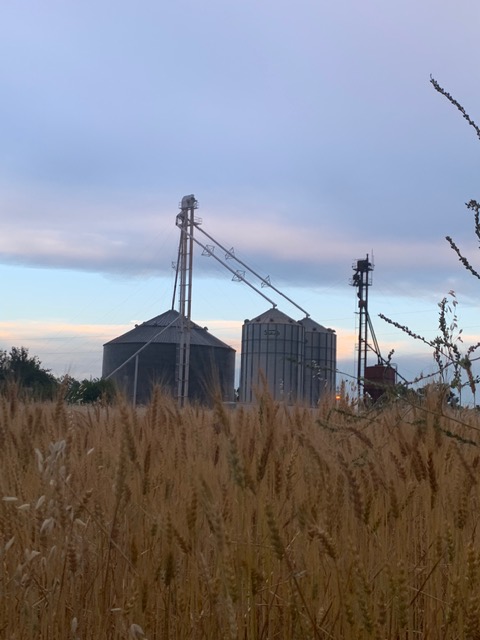
The story he tells is simple. A farmer plants seed wheat, but when it begins to pop through the ground, his workers see that weeds also are sprouting among the tender wheat stalks. The workers hurry to the man to inform him that weeds are in the wheat field. They ask, “Do you want us to go and pull them up?” The farmer answers, “No. If you pull up the weeds you might uproot the wheat along with them. Let them grow together until harvest.”
Scholars of the sacred texts have decided that the Teacher was responding to the Pharisees when he told this story, pointing to them as the impatient workers who want to rid the wheat field of the weeds, in this instance sinners being the weeds. Using this story as a way of expressing an important truth, the Teacher wants them–and us–to understand that it isn’t up to us to decide that the weeds have to go. That decision belongs to the owner of the field, which clearly is God.
Whereas we, like the Pharisees, are quick to judge others, condemning them as inferior or lesser persons, God, like the farmer, has greater patience with sinners, insisting that there will be time to separate the weeds from the wheat, but that time is when the harvest comes, not now, and not by us.
God sees the big picture, unlike us, who choose instead to stay within our narrow and limited view of others, our disappointment of them quickly morphing into disapproval. And because he sees the big picture, he is more patient, more tolerant, more understanding of others who can’t seem to get it together, who continue on paths that bring trouble to themselves and others.
And that big picture always includes the possibility of people changing their ways, becoming better persons as they age, getting away from the bad stuff that hampered their growth. God sees deeper and farther than we do, reading hearts while we read only externals, delaying judgment until the end, while we rush to judge.
Back in the days when railroads were the means of transportation, a train was traveling through the hot and dirty plains of the MIdwest, the passenger car full of tired people. When evening came, with the passengers wanting to get some sleep, a small baby who was being held in the arms of a man, began to cry. As the minutes passed, the baby became more restless, crying more often.
Unable to take the noise anymore, a big brawny man spoke for the rest of the group, saying in an impatient voice, “Why don’t you take that baby to its mother?” The man with the child waited a moment and then said, “I’m sorry about the crying. But I’m doing my best. The baby’s mother is in her casket in the baggage car ahead.”
There was an awkward silence throughout the car. Then the big man who had asked the question got out of his seat, moved to the man with the motherless child, apologizing for his impatience and unkind words. He took the tiny baby in his own arms, telling the tired dad to get some rest, taking care of the little baby throughout the night.
That story is a good reminder of the Galilean’s expectation that his followers use a wider lens when we find ourselves impatient with others, jumping to conclusions about them, judging them harshly for their actions, or always assuming we have all the information we need to decide these people are weeds that don’t belong in a wheat field.
Rather than remove them from our line of vision or silence them by various means, such as rebuking them for their ways, ridiculing them for their waywardness, or reducing them to a category, the Teacher asks us to forego false assumptions and harsh judgments, adopting a patient attitude towards them, assuming they are doing the best they can, their circumstances unknown to us because of our limited or biased perspective.
Without a doubt, adopting a more patient attitude towards others whom we find annoying, frustrating, or worthless will not be easy, but it will be necessary if we want to live out the teachings of the Galilean, who welcomed the unwelcomed, embraced the unlovable, and accepted the unaccepted. If we are to become his living presence in the world, then we must patiently wait for the blooms to appear, accepting that others are not bound to our timetable, understanding that growing is not linear, but looped.
The mountaineer, Greg Mortenson, learned an invaluable lesson in patience when he was trying to build a school for poor children in Pakistan. Frustrated with the slow pace of the local workers, he became irritable and condescending. Finally, the local village leader sat down with Mortenson and said to him, “If you want to thrive in Baltistan, you must respect our ways.”
He continued, “The first time you share tea with a Balti, you are a stranger. The second time you take tea, you are an honored guest. The third time you share a cup of tea you become family, and for our family, we are prepared to do anything, even die.” Then the man placed his hand on Mortenson’s and said, “You must make time to share three cups of tea.”
Perhaps that is the same lesson that the Galilean would have us learn today. Before we rush to judge others, we might want to sit down and have three cups of tea with them.
—Jeremy Myers

 Sunday Brunch