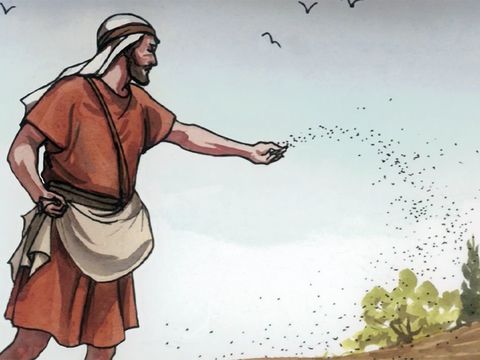
“A sower went out to sow. And as he sowed, some seed fell on the path, and birds came and ate it up. Some fell on rocky ground, where it had little soil. It sprang up at once because the soil was not deep, and when the sun rose it was scorched, and it withered for lack of roots. Some seed fell among thorns, and the thorns grew up and choked it. But some seeds fell on rich soil, and produced fruit.” (Matthew 13.4-8)
If memory serves me well, I remember reading once about a man in Cologne, Germany who collects dirt. This is what he does, sending out little plastic bags to various places around the globe, asking people to fill the bag with dirt, then returning it to him, where he exhibits all of it in a dirt museum, an entire collection of the many kinds of dirt.
The man is a researcher whose special interest happens to be dirt, admitting that he is fascinated by the stuff, explaining that it isn’t as mundane as people think. Recognizing its religious importance as a symbol of our beginning and our end, he also points out that particles of dirt are responsible for the stars, sunsets, and blue skies.
Of course, he’s not the first person to be interested in dirt, only someone particularly interested in collecting different samples of dirt. The ancients also understood that all dirt is not the same, with Pharoah’s Egypt becoming the envy of the world because of its rich wheat fields made from the sediment of the Nile as it overflowed. Ancient Greece, on the other hand, couldn’t boast of good dirt, with less than one-third of its land useful for cultivation.
So, it is no surprise, really, to hear the Galilean Teacher talk about dirt today, when he uses this everyday example as a way to express a spiritual teaching. In the passage selected for today’s study, he speaks of four types of soil, the first being hard-packed dirt, the second being rocky ground, the third being overgrown dirt, and the fourth being, as he says, rich soil.
And what is his interest in these varieties of dirt? Essentially, the Rabbi is telling us that each of us is potentially one of those types of dirt, our lives on a sliding scale from non-arable to arable, with arable capable of producing, in his words, fruit a hundred or sixty or thirtyfold. Where we are on the scale depends on us, the decision in our hands to be receptive to the seed that is planted in us, or the opposite, to be unresponsive to the seed.
Here, it is important for us to see that the emphasis in the story is not on the seed. The seed is the same. It is the dirt that is different. The image of the seed that the Rabbi uses is a reference to God’s spirit that is planted within our hearts, his life that awaits awakening in us, a spark of the divine encased in a handful of dust.
Again, the imagery is as old as the first page of the Hebrew Scriptures, when the Lord God formed the man and the woman from the dirt of the earth and breathed life into them from his own breath. The Galilean Rabbi is repolishing this same rich image, inviting us to see our growth as children of God now in terms of seed planted in the ground.
The challenge the Galilean Rabbi puts before us is to become dirt that is receptive to the seed, dirt that embraces the seed, dirt that feeds the seed so that it grows into something good and beautiful and strong. This is the spiritual journey of every person, allowing the seed or spirit of God to grow ever bigger in us, until that day and time when the Spirit of God fills our hearts, consumes our being, and makes us one with God.
While the types of dirt that the Galilean Rabbi uses as examples are often understood as different types of people, from the hardened soul unreceptive to God’s spirit to the soft soul that embraces the spirit of God within it, the truth is that we are, at one time or another, each of these different types of dirt, depending on the day of the week and the hour of the day.
SImply stated, we are not completely one type or another type, but rather each of them, with our hearts sometimes hard as stone, our hearts other times open to others, some days our spirits full of gratitude, other days our spirits full of grievance. That reality is a gentle reminder to us that spiritual growth is a mixed bag, our good intentions compromised by our weakness, our better angels always in a cat-and-dog fight with our lesser angels.
That we have good days and bad days–days when we feel we are growing towards God because of our generosity, only to be followed by days when we feel for certain our hearts are shriveling up because of our selfishness–this toss-up is part of the human situation, not meant to be debilitating, but meant to be challenging, testing our limits of love, pushing us beyond our boundaries of bigotry, calling us to become more of a good person now than we were an hour ago.
Again, what type of soil our inner spirit becomes is for us to decide. And our soil quality finally is determined by countless little decisions made along the way, a choice for good or for evil made in the blink of an eye, adding up over the course of years to dirt that grows goodness or dirt that won’t grow a darn thing. In time, our spirits become either a fertile field or a barren desert.
That is not to say we can’t change the quality of our soil, just as any poor soil can be enriched by various means. Yes, it will require hard work, serious intent, and a lot of divine assistance, but our comfort is found in knowing that every saint started out as a sinner. The seed stays within us, awaiting our efforts to make the dirt of our humanity something fertile and fruitful and faithful.
With right decisions and with right-mindedness, we can become holy ground, a place where the divine presence is felt by all who approach us and where divine goodness is shared with all who step near us. This is the fruitfulness that the Galilean calls a hundred or sixty or thirtyfold, meaning our love for others has become a bountiful harvest.
Admittedly, for many of us, we feel that even on our best days, we are mud dressed up in nice clothes. But the point we want to remember is that the Most High God never wanted us to be just mud. When he planted his spirit within us, he envisioned a world bursting forth with life and with love, a paradise where the wolf shall dwell with the lamb, where the leopard will lie down with the goat.
Perhaps the American writer Kurt Vonnegut comes close in one of his poems to capturing that primordial vision that remains always a future possibility when he writes these lyrical words, “God made mud. God got lonesome. So God said to some of the mud, ‘Sit up!’ See all I’ve made,’ said God, ‘the hills, the sea, the sky, the stars.’ And I was some of the mud that got to sit up and look around. Lucky me, lucky mud. I, mud, sat up and saw what a nice job God had done.”
Today, the Galilean Teacher reminds us that we are lucky mud, called by God to sit up, to allow his spirit to move within us, to be a part of the nice job that God has done. The seed is already within the mud. Now we have to let it grow slowly and steadily within us, until only goodness and gentleness bloom upon the earth.
–Jeremy Myers

 Sunday Brunch