“He breathed on them and said to them, ‘Receive the Holy Spirit.'” (John 20.22)
Some years back, a spiritual writer imagined the resurrection of the Galilean Teacher in this beautiful way. “Jesus [takes] that first uncertain breath, his chest barely rising and falling, his breathing gradually growing in strength and regularity, until the Spirit breathes onto him, calling his voice forth again.” She writes, “This is the resurrection as I imagine it. No trumpets, no great beams of light, simply God breathing unto God in one unbroken line of praise. Alleluia!”
That beautiful image serves us well as we study the sacred scriptures for this Feast of Pentecost, that moment in time when a blast of wind blew down a side street in Jerusalem into a crowded room where the disciples had huddled, shattering their self-imposed safe room, hurling them onto Main Street in Jerusalem, where, their old cowardice now gone, they find their new voices, proclaiming that the Galilean Teacher had been raised from the tomb.
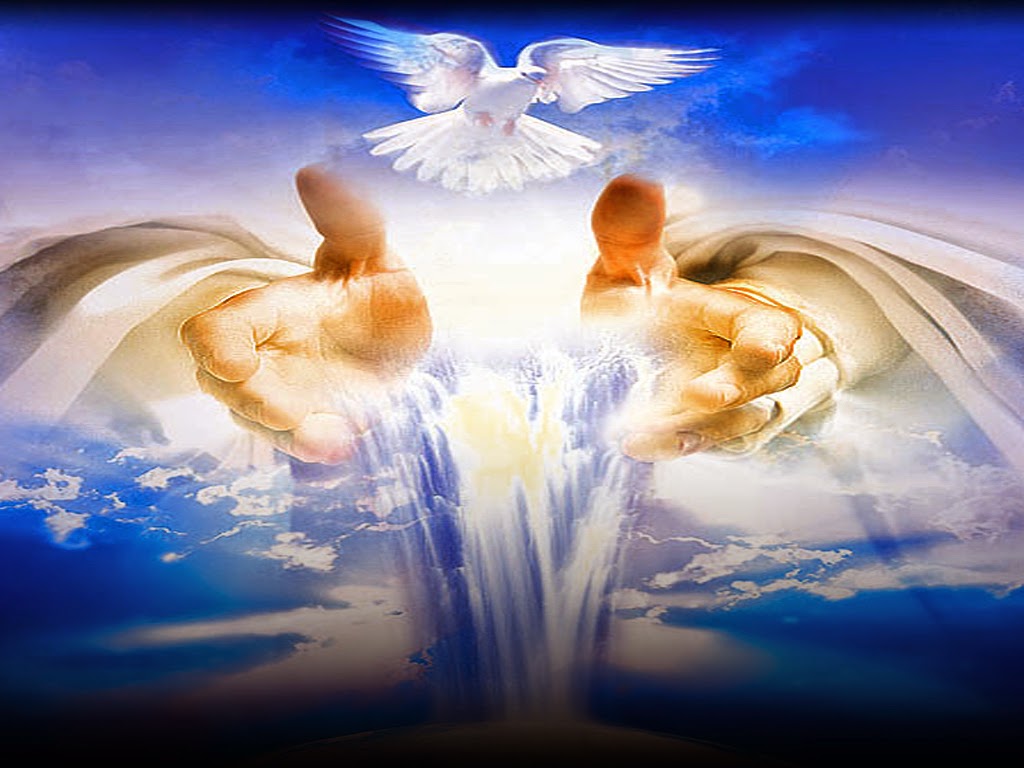
Describing the same event in a slightly different way, but with the same import, the evangelist John presents the imparting of the Holy Spirit as coming, not from a blast of wind, but from the breath of the Risen Lord, as he stands before his shaken and scared disciples in their lock-down on the evening of the Resurrection, offering them words of peace in the midst of their turmoil, then inviting them to share in his new life. “He breathed on them,” the evangelist says, and he said to them, “Receive the Holy Spirit.”
Clearly, the evangelist intends us to understand this event as a restart on the creation of the world, recalling the ancient story of the vast emptiness being brought to life in primordial times by the breath of God who breathed upon the surface of the earth as he spoke the words, “Let there be,” with life in all its forms springing from the surface of the abyss, galloping, blossoming, filling the air with the sounds of plants and trees and creatures suddenly breathing in divine love and breathing out divine love.
That full-throated and full-throttled creation, with life erupting on the earth even as a mighty wind swept over the waters, was meant to work its way through all times until the Creator, in the fullness of time, could reclaim it as complete and as good, all creatures coming to rest on the seventh day, alongside the Most High God whose breath was to breathe down through the ages, in a continuous exhalation of love.
But, as we all know, that Divine imperative that life would not end was interrupted when a sinister snake suddenly wrapped its scaly body around the world, placing it in a death grip, strangling the life from it, slowly destroying all things that had been singing Alleluias, silencing the song, while overshadowing the world in a cloak of darkness, and ever so gradually stealing the breath of life until all things would die.
That was the sad situation of the world when the Word became flesh and dwelt among us, breathing new life into dead corpses, healing broken bones, and allowing the world, for the first time in eons, to take a deep breath and breathe unpolluted air again.
And while the serpent, coming out swinging and swearing as usual, attempted to return everything to chaos once again, plotting with evil and crooked men to steal the breath from the Galilean Teacher, it failed miserably, because the God of life showed he held a royal flush in his hand, breathing life back into the Galilean, his resurrection the jump start on the recreation of the world, again destined to become the garden the Most High God designed it to be at the start, so long as creatures great and small walked in the world in the same way as the Teacher.
Offering us a snapshot of that same resurgence of life, the evangelist first shows the disciples hidden in a dark room, as if in a tomb, hardly able to breathe, out of fear for their lives, the air around them clammy and close, when, in the same way the stone suddenly was rolled away from the tomb, the door to the room opened, and the Resurrected Lord stood among them again, filling the room, not only with light, but with air, rescuing them from their fears, resuscitating their shallow breathing, and reassuring them that the head of the serpent had been crushed. “Peace be with you,” he said to them, “and when he had said this, he breathed on them and said to them, ‘Receive the Holy Spirit.’”
Many years ago, the brilliant Jesuit poet, Gerard Manley Hopkins, penned a poem he called, “Easter Communion,” in which these beautiful words appear, “You striped in secret with breath-taking whips . . . Breathe Easter now,” his verse expressing in poetry the promise of the Easter event. Now, we all breathe Easter, all of us, once bowed down and broken, beat and brow-beaten, bloodied and bludgeoned, our breathing faint and fading, but no more, because we breathe Easter now.
What the poet spoke in beautiful images, the priest said in beautiful prose, when Archbishop Oscar Romero spoke to the people of El Salvador on Pentecost Sunday in 1978, and announced to them, “It will always be Pentecost in the church.” He said, “It will always be Pentecost in the church,” by which he meant the Holy Spirit, who was breathed into the first disciples, still breathes in all of us who continue to believe and to inhale the grace and the goodness of the Resurrected Lord, refusing to stay behind locked doors, instead entering the streets of the world, singing alleluias at the top of our lungs, as all creation did at the dawn of the world.
The only question for us, as we ponder again the power of the Most High, who blew into Jerusalem as a strong driving wind on the first Pentecost, in very much the same way as the mighty wind swept over the waves on the first day, the question is whether we allow ourselves to breathe Easter now, or whether we stay behind locked doors, fearful and fretting, all the air sucked out of the room.
If we choose to breathe Easter now, then we take a deep breath, we let go of our suffocating fears, and we go into the big world, imitating the way of the Galilean Teacher, forming our daily lives according to his wise teachings, accepting that the wind will shake us up, as it always does, and it will blow us where we do not want to go, as if often does. When we breathe the pure and sacred air of Easter into our lungs, our old lives are broken into jagged pieces, and our new lives take a brand new shape from the broken pieces. We are resurrected.
The respected and learned writer, Rabbi Lawrence Kushner, once offered the idea that God’s name is unpronounceable to the Jewish believer because the name of God is the sound of breathing. He went on to say that when the High Priest would go into the holiest of rooms in the Temple, he would simply breathe.
Perhaps that is, in the end, what the Christian believer is asked to do as well, with the Spirit of the Resurrected Lord always swirling around us, continuously whipping up the wind with its wings, we should simply breathe, in that way pronouncing God’s name into the world with our every breath, filling the world around us with alleluias.
–Jeremy Myers

 Sunday Brunch