“Go, therefore, and make disciples of all nations.” (Matthew 28.19)
One of the first rules that would-be scuba divers learn is always to follow the bubbles. Adherence to that simple rule means the difference between life and death. When in deep water, it is easy for a diver to become disoriented, one reason being the diffusion of sunlight by water, which makes it difficult to determine if the light is coming from above or below, another reason being that there is no sense of gravity, since the diver is virtually weightless in water.
So, the safest way for the scuba diver to determine where to find the surface is to follow the bubbles that float from his scuba gear. While his perceptions might be wrong and while his guesses might be wrong, the bubbles are never wrong, always floating up. The safe and the smart diver knows to follow those bubbles.
That adage seems an appropriate rule, not only for the would-be diver, but also for the would-be follower of the Risen Lord. As the diver follows the bubbles to find the right way, the disciple follows the way of the Lord Jesus to go where he or she should go. And in both instances, a failure to follow rightly carries consequences.
At its root, the word disciple means one who follows. To follow is an action verb. Sometimes called dynamic verbs, these verbs explain what the subject of the sentence is doing or has done. While this was an important school lesson we learned, it is an even more important life lesson we remember on this Feast of the Ascension of the Lord Jesus.
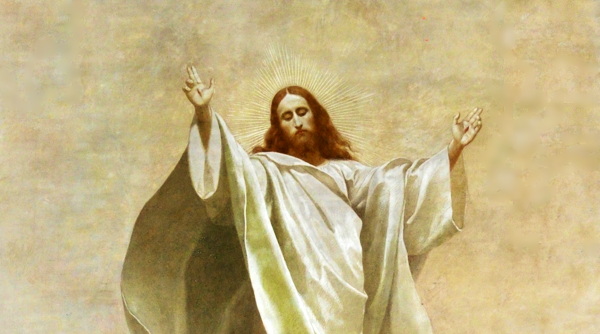
The Christian scriptures are bare bones in their description of this momentous event, with the writer of the Acts of the Apostles stating it in the simplest terms, “He was lifted up, and a cloud took him from their sight.” Perhaps the writers of the sacred texts found it less important to describe the event and more important to tell us what the Risen Lord expected from his followers after his ascension.
And what did the Resurrected Lord expect them to do? The evangelist Matthew tells us he said to them right before his ascension, “Go, therefore, and make disciples of all nations.” There, in those few words, we find the action implied in following the Risen Lord. If we are to follow him, then we are to go into the world, inviting people to follow his way as we follow his way, in the process many others also becoming his disciples.
The action implied in following Jesus as his disciple is reinforced by the angelic figures who appear after the Risen Lord was lifted up and was taken from their sight. Luke describes it for us in this way, “Suddenly two men dressed in white garments stood beside them. They said, ‘Men of Galilee, why are you standing there looking at the sky?’”
The implication here is that the disciples have action to complete if they are to call themselves followers of the Risen Lord, that action beginning with his command to go and make disciples in the world at large. Standing and staring into the sky is not the action that the Resurrected Lord asks of those who follow him. Rather, he wants them to go.
A story told by the old rabbis brings home the same point. As the story goes, once a student came to his teacher with this complaint. “Rabbi, there is something I do not understand. It took God six long, endless days to create the world. Look at it! It’s terrible, cruel, and corrupt.” The teacher looked at his disciple and answered him angrily, “Can you do better?” The student was silent for a moment. Then he answered, “I think I could–yes!” The teacher then said, “Yes? Then what are you waiting for? Get busy. Go to work! Now!”
That old rabbi used the same word that the Galilean Rabbi used when telling his followers what he wanted of them. “Go,” he said to them, using that singular word to inform them that following him was an action verb, not a descriptive adjective. The proof that we are followers is not that we attach to ourselves the word “Christian,” but that we actually go and do the work that the Teacher asked us to do, the hard work of going into the world, inviting others to live the way of the Teacher as we live it, showing others by our example that the way of the Teacher is a better way to live in the world.
Social scientists point out that when people in this country are asked the question, “Are you a Christian?” the majority of those asked will answer “Yes.” That answer, more the rule than the exception, bespeaks our understanding of Christian as limited to our family history, our social category, or our self-identification, but it does not necessarily reflect the broader way we live or the type of actions we take.
That reality is reflected in the example of the popular professor who was approached one day after class by a freshman who told him that a friend of his had been a student of the professor’s a few semesters earlier. The professor, with a slight smile, answered simply, “He may have sat in my classes, but I assure you he was not a student of mine.” It was a gentle reminder to the freshman that just sitting in a classroom does not make you a student. Much more action is required before one can honestly say one is a student, or a follower, of someone.
As one insightful spiritual writer once wrote, “Jesus’ challenge to people was not ‘Admire me,’ nor was it ‘Agree with me.’ His call was ‘Follow me.’” For us, that means if we are to follow him, then it requires that we live in the way that the Teacher lived, that we love in the way that the Teacher loved, that we die in the way that the Teacher died, our lives a continuous pouring out of ourselves to others so that they might live. We expend our lives in actions that benefit others, such as feeding the hungry, forgiving the sinner, forgetting no one, especially not the least, the last, or the lost among us.
We could expect someone such as Dorothy Day, the advocate for the poor, to understand this lesson better than most. When a group of students from Harvard University made a day trip to New York City to see Dorothy Day, she agreed to meet them at St. Joseph’s House, the soup kitchen where she lived.
Although Dorothy Day was 80 years old at the time and was suffering from a heart condition, the students found her standing behind a table in the kitchen, cutting celery and carrots for the evening meal. Only after she had finished her work did she sit down with the students to visit.
Day told them that she was fortunate, in her words, “to be of some use, still, to our guests,” the word she always used when referring to the street people who came to the kitchen for a hot meal. They were guests at the table.
Dorothy Day then went on to tell the students, “I may be old and near the end, but in my mind, I’m the same old Dorothy, trying to show the good Lord I’m working for him, to the best of my abilities.”
Her actions inspire us today as we recall the Ascension of the Resurrected Lord, reminding us that we should not “stand staring into the sky,” as the disciples did at first, but we are to “go into the world,” as the angels directed them, in that way becoming true disciples of the Lord, men and women who follow him by going into the world, as he did.
—Jeremy Myers

 Sunday Brunch