“In my Father’s house there are many dwelling places. If there were not, would I have told you that I am going to prepare a place for you? And if I go and prepare a place for you, I will come back again and take you to myself, so that where I am you also may be.” (John 14.2-3)
Some years ago, a business woman, on her way to work each morning, would drive by the same homeless man. Without fail, the man would be walking up and down the sidewalk, occasionally speaking to people. One day, curiosity getting the better of her, the woman stopped to talk to the man.
She learned that, like many other homeless people, he struggled with mental illness. She also learned that he walked back and forth on this same stretch of road every day because he was waiting for his mother. The man believed that his mother was coming back to get him, and so he waited for her every single day. In fact, for three years, he had been waiting, sure that she would return to get him and take him home.
The woman was so moved by the man’s story that she began stopping regularly to visit with him. When the weather turned cold, she and her husband invited him to stay with them. Although others helped her get food and clothing for the man, she felt like he still needed one more thing–a home. So she and her husband decided to ask him to let them give him a home with them.
“Do we really mean it,” she said, “when we say that he’s going to be in our lives for the rest of it if that’s where he wants to be?” And we said, ‘Yes, he is.’” And in that exceptional act of generosity, the man found a place, with people who were willing to take him in and give him what he needed the most–a home.
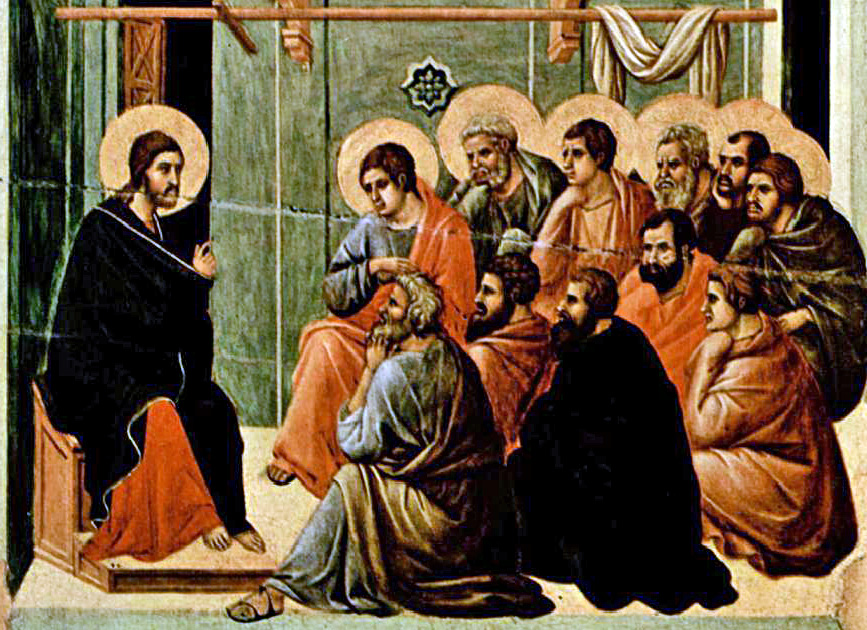
On the last night of his life, the Galilean Teacher promised his followers a place where they could find a home, a place with him, not here on earth, but in eternity with his heavenly Father. “In my Father’s house there are many dwelling places. I am going to prepare a place for you. I will come back again and take you to myself, so that where I am you also may be.”
It is this promise that the followers of the Teacher live for, dying in the hope that after our wandering the sidewalks of this world is done, we will be given a home, a place where we will find comfort and peace, satisfaction and happiness. And where is that place? It is with the Lord Jesus and with his Father, in their dwelling place.
As we listen closely to the Galilean Teacher’s words, the important truth underlying this promise is that “a place” is really “a person.” Eternity is not being in a place, some geographic location, so much as it is being with a person, specifically the Lord Jesus, “so that where I am you also may be,” as he says to his followers.
If we reflect for a moment on our own personal experience, we realize the greater truth in this promise, all of us coming to see eventually that home is never about a house, a structure on a street with a number painted on the sidewalk, but home is always about a person, that individual or individuals who are in a place, making us feel welcomed, regarded, loved. When we say we are going home, we may imply we are going to a place, but, in fact, we are going back to a person, or persons, the house meaningless without the people in it who make it a special place.
Without them, it never feels like home, instead emptier and lonelier, as anyone who has lost a loved one learns painfully well when going back into the place where they lived with those who loved them, now just a house, but not a home any longer. Home is where the people we love and who love us live; a house is a roof over our heads.
In his beautiful book entitled, “The Longing for Home,” the gifted writer Frederick Buechner speaks of home as our origin and as our destination. “What is the connection between the home we knew and the home we dream?” he asks. “I believe that what we long for most in the home we knew is the peace and charity that, if we were lucky, we first came to experience there, and I believe that it is that same peace and charity we dream of finding once again in the home that that the tide of time draws us toward.”
He concludes, “The first home foreshadows the final home, and the final home hallows and fulfills what was most precious in the first. That, at least, is my prayer for all of us.” It is a good prayer, and it is a prayer answered in the words of Jesus, Son of Joseph, the Rabbi whose home in Nazareth was the first step towards reaching that home that awaited him in heaven.
The promise that the Galilean Teacher makes to each of us is that he will bring us to that same home when our days are done on earth, and although he calls it his “Father’s house,” it is so much more than just a house, because in it we will find someone, not empty space, someone whose heart is full of love for us, whose arms open for us when we enter, whose eyes fill with tears of joy when they see us.
That is the home we are promised, if we would follow the way of the Teacher, heeding his words and his world view, loving one another, forgiving one another, giving to one another, expressing in these ways that we are brothers and sisters, not mortal enemies or wary strangers to one another on the sidewalks of a cold-hearted world.
Thomas, one of the followers of the Teacher, asked him, “Master, we do not know where you are going. How can we know the way?” And the Teacher said to him, “I am the way and the truth and life,” with those words reminding Thomas and the rest of us that the love, the peace, the happiness that we yearn will be found when we do as he did, when we live as he lived. Walking in his footsteps eventually leads us back home to him.
A number of years ago, tragedy struck when the lives of a young married couple were taken in a car accident, leaving five young children without parents, without a home, without a clear future. Soon after the funeral, the godparents of each of the children agreed that they would take the child for whom they were godparents, a sensible plan, although not perfect, not pain free for the children.
While thanking the godparents for their generosity, the maternal grandmother of the children, although aged, said that she would take the five children and raise them because she did not want them separated from one another. She said she would give them a home where they could grow up together, which she did, giving them not only a place, but a person who loved them enough to know that the loss of their siblings would be even more grief piled upon them as they suffered through the loss of their parents.
So, with more years behind her than ahead of her, the grandmother almost single-handedly raised the five children, showing them love, keeping them together as a family, making a home for them until they were old enough to stand on their own two feet. Her heart rightly told her that the children needed a home, not just a house.
We all yearn for that home, to be with that person who loves us, comforts us, and heals us, taking the emptiness in our heart and filling it with love, making us feel like we have–at last–a place to lay our heads peacefully, restfully, happily. That home, the Galilean Teacher tells us today, is with him. “I will come back again and take you to myself, so that where I am you also may be.” It is a promise that, we pray, with dying breath, he will not break.
–Jeremy Myers

 Sunday Brunch