“And it happened that while they were conversing and debating, Jesus himself drew near and walked with them, but their eyes were prevented from recognizing him.” (Lk 24.16)
We never walk alone. Survivors of traumatic experiences sometimes speak of sensing an unseen presence with them during their ordeal, a spirit that gives them comfort or support. The occurrence has been common enough that there is a name for it, usually referred to as “The Third Man Factor.”
In Larry McMultry’s epic western, Lonesome Dove, two-thirds of the way through the story the retired Texas Ranger, Pea Eye is forced to find his way through horrible conditions in Montana in an effort to get help for his friend, Gus, who remained behind, wounded and dying. Along the way, Pea Eye has just such an experience, calling it a ghost or a spirit that guides him on the way.
While Pea Eye is a fictional character, his experience is not fictional to the many others who have felt a similar spirit or unseen presence with them during arduous and brutal times when it seems uncertain that they will come out alive on the other end. High risk mountain climbers and Polar explorers all have spoken of the same phenomenon, with believers choosing to call the “third man” a guardian angel, while skeptics downplay it as simply a coping mechanism.
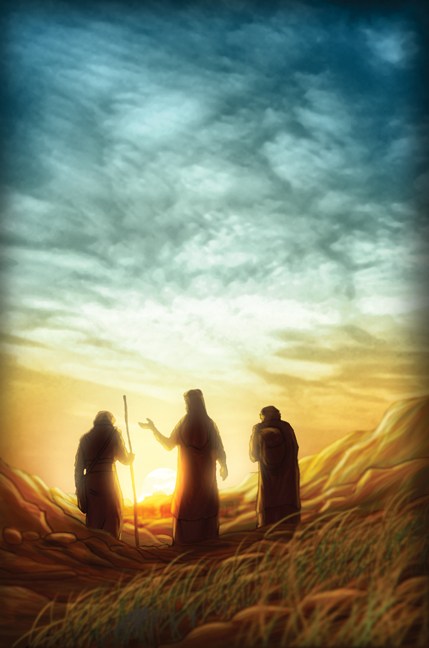
Clearly and compassionately, a message that comes out of the gospel selection for this Third Sunday of Easter is that the “Third Person” experience is very real, as real as the Resurrected Lord who walks alongside two disciples on their way to Emmaus, despondent and despairing because their hopes have been crushed by the crucifixion of their leader, the Galilean Teacher.
The evangelist Luke paints the picture in painful and poignant strokes as he tells the story of the two disciples, leaving Jerusalem, cutting their losses, walking away from life as they knew it, on their way to a small town seven miles from the city, their hearts broken and their steps faltering. Luke describes the moment when a third person “drew near and walked with them, but their eyes were prevented from recognizing him.”
That companion on the way asks the two why they are so dejected, so deep in thought, and as they explain and as he listens, the fellow traveler offers them comfort and consolation, casting in a new light the horrific events they had experienced, providing them with a bigger picture than they had been able to see. ”Stay with us,” they say to the stranger, “for it is nearly evening and the day is almost over.” Answering their pleas, he joins them at table, where, in the simple experience of breaking bread, the two disciples suddenly see who he is. “With their eyes opened, they recognized him.” It was the Resurrected Lord.
There are a number of lessons that the evangelist would have us take from this Easter story, all important, all helpful, but one of the most important is that “the Emmaus experience” happened, not just to those two disciples, but it can happen to all of us when we are on our own road to Emmaus, that is, any road in life that has us leaving a wreck behind us as we make our way out of town, unsure what tomorrow will bring or where the road will end.
“These are the times that try men’s souls,” Thomas Paine, the writer for the American Revolutionary War said, reminding us that the road to Emmaus is always a time of darkness, where we beg the third man, as did the two disciples, to “stay with us, for evening draws near and the day is almost over.” Shadows surround us and light abandons us, and we desperately need to know that we are not alone in our pain, in our confusion, and in our brokenness.
The Emmaus story, as the evangelist so beautifully describes it, tells us that our prayer in those dark times is answered, that the spirit of “the third man” stays with us, and that he offers us strength in our weakness, hope in our hopelessness, and a way through, even if not a way back. He shows us, as he showed them, that life, while it has changed, has not ended, and that tomorrow follows today.
Like the disciples, we also may not recognize that same spirit of the Resurrected Lord, although he is standing before our eyes, a challenge to us to open our eyes, as their eyes were opened, and to find his hidden presence alongside us as they did, even in something so simple as a walk shared, a word shared, or a table shared. When the weight and the worry and the wait are shared, we learn it is a lighter load that we carry, because we do not carry it alone. He stays with us.
Several years ago, sixty-one cloistered sisters from six Chilean monasteries spent a day visiting the inmates of the women’s prison in Santiago. The sisters made the request of prison officials, asking that they be allowed to see these women in their suffering, to stand beside them in their difficulties. The visit was allowed, the sisters spending the entire day meeting with the women. At the end of the day, they gathered for the Eucharist, where bread was broken, shared by them as had been the whole day.
As later reported, the incarcerated women were deeply moved by the visit from the sisters. “It was a blessing to have them here with us,” one after another of the women said, while the sisters spoke a similar sentiment, saying, “It was a grace to share with them, to really feel like a sister with them, to feel their sorrow, their joy, and to become one with them.”
“To become one with them.” There, in a prison, the Emmaus experience happened, just as it did outside Jerusalem, and if it can happen there, it can happen anywhere, because the spirit of the Resurrected Lord finds us wherever we are in our distress and despair, whatever the bars that we suffer behind. He walks with us, guiding us in our darkness, making sense of the senseless, and staying with us in the dead of night, until morning breaks again for us.
–Jeremy Myers

 Sunday Brunch