“Jesus did many other signs in the presence of his disciples that are not written in this book. But these are written that you may come to believe that Jesus is the Christ, the Son of God.” (John 20.31)
Contrary to popular opinion, Easter is not a day, but instead it is a decision. With all the extravaganza of Easter, including Easter eggs, Easter dresses, and the Easter Bunny, there is a tendency to believe that Easter is one day a year, when all the stops are pulled out, after which everything goes back to normal. A few candy eggs may hang around for a few days, but otherwise it’s back to business as usual, the Easter decorations put back in the box until next year.
That tendency grossly understates Easter, at least as it is understood in the sacred texts, where it more rightly is presented as a decision. And what, exactly, is that decision? Fundamentally, it is the decision to believe or not to believe. Was the Galilean Teacher raised from the dead, as Mary Magdela swore she saw, or was he still as dead as he was when he was put in the tomb days before?
As we look closely at the sequence of events that became the Easter experience, we see soon enough that each person that participates in that pregnant moment has to decide whether it is believable, or not believable, that the Nazorean, crucified on a cross, his body buried in a hollowed-out rock, now lives again. That decision, when it is made, determines the rest of life for them and for us.
Perhaps the Gospel of Mark, the earliest of the gospels to be written, stresses that Easter decision in clearer detail than the later gospels, although it is present in each of them. Mark writes that when the disciples “heard that Jesus was alive and had been seen by her [Mary], they did not believe” (16.11). The same decision not to believe is made when the two disciples “walking along their way” see the Resurrected Lord and “returned and told the others, but they did not believe them either” (16.13).
Mark writes that “later, as the eleven were at table, Jesus reappeared to them and rebuked them for their unbelief and hardness of heart because they had not believed those who saw him after he had been raised” (16.14). Mark, always the one to present the disciples as slow or hesitant believers, shows that they are the same to the final minutes before the Resurrected Jesus ascended to heaven.
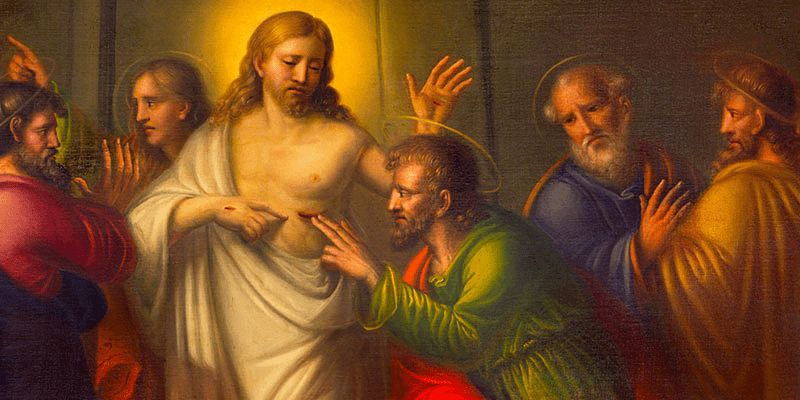
The evangelist, John, with a more lenient attitude towards the disciples as a whole, places the stigma of unbelief on one of them, Thomas the Twin, who comes to epitomize the seriousness of the Easter decision. His story is retold in the text selected for this Second Sunday of Easter, a story that has the apostles gathered in one place, behind locked doors, when the Resurrected Lord suddenly stands before them.
For some reason, Thomas is not with them, so when he is told later by them that Jesus is resurrected, he stubbornly says, “Unless I see the mark of the nails in his hands and put my finger into the nail marks and put my hand into his side, I will not believe” (Jn 20.25).
When that opportunity is given to him a week later, as the Resurrected Lord now stands before him, saying, “Do not be unbelieving, but believing,” Thomas comes to the moment of decision, answering the Teacher, “My Lord and my God!” He has decided to believe.
In a reprimand to Thomas for his refusal to believe the good news the prior week, the Resurrected Lord says, “Blessed are those who have not seen and have believed.” The evangelist John brings the Easter story to a conclusion by inviting others to believe. He writes, “Jesus did many other signs in the presence of his disciples that are not written in this book. But these are written that you may come to believe that Jesus is the Christ, the Son of God” (Jn 20.31).
And that is where we find ourselves today, where Thomas stood, on the precipice of the Easter decision, to believe or not to believe. If we decide that we will be believers, then, for us, Easter is not a single day on the calendar, but is an experience that enters into every single day. Our lives, as believers in the resurrection, are lived in such a way that Easter is not an isolated moment, but one never-ending moment that unfolds before us each day.
The Italian religious and writer Carlo Caretto, who spent ten years in the Sahara Desert, living a solitary life, where he came to a deeper understanding of the mysteries of God and the ways of the Son of God, wrote the following reflection in his book, Letters from the Desert, entitling the meditation, “Blessed Are You Who Believed.” He writes:
“When you forgive your enemy,
When you feed the hungry,
When you defend the weak,
You believe in the resurrection.
When you have the courage to marry,
When you welcome the newly-born child,
When you build your home,
You believe in the resurrection.
When you wake at peace in the morning,
When you sing to the rising sun,
When you go to work with joy,
You believe in the resurrection.”
Caretto writes, “Belief in the resurrection means filling life with faith,
It means believing in your brother,
It means fearlessness towards all.”
As we might expect from someone who has delved deep into the implications of the empty tomb, Carletto has provided us with clear examples of the Easter decision that believers make every day. And with each decision to believe, the Easter event stays alive and the Resurrected Lord still walks upon the earth, his spirit beating in the hearts of those who have decided to believe.
For the believer, then, Easter is the decision to believe that good prevails over evil, that the Maker of this world will judge the princes of this world in the end, and that goodness is more deeply rooted in the human heart than badness.
For the believer, Easter is the decision to believe that no life is without setbacks, but that the next step after the fall is always up, that stars are brightest on the darkest nights, and that the human spirit, fragile and breakable, is made to heal and to soar, even with scars.
For the believer, Easter is the decision to see the enemy, not as someone to destroy, but as a brother to be welcomed back into the family, to embrace the beggar, not as a stranger, but as a friend whose name we need to learn, to see the lost and the last, not as irredeemable or irreparable, but as fellow travelers on the road of life, awaiting our help and our hand.
For the believer, Easter is the decision to forgive the one who has hurt us, even if every bone in our body tells us not to, to show mercy to the one who deserves no mercy, even if our instincts are to do the opposite, to give the one who has failed us one too many times one more chance, even if it is unappreciated and unwanted.
For the believer, Easter is the decision to be the calm in the storm for the one who finds the winds of adversity too difficult to fight, to share our hope with the one who has no hope, to be the light for the person who sees nothing but darkness.
For the believer, Easter is the decision to ride the wave of life, trusting that someone will separate the sea for us, to reach for the heavens, believing that someone will uphold us, to hold our head high, knowing that someone loves us as we are.
For the believer, Easter is the decision to love, not to hate; to live, not to die; to outlast, not to give up.
“We are our decisions,” someone once said. Believers are people who have made the decision to live Easter, not for one day, but for every day.
–Jeremy Myers

 Sunday Brunch