“Those who had arrested Jesus led him away to Caiaphas the high priest, where the scribes and the elders were assembled. Peter was following him at a distance as far as the high priest’s courtyard, and going inside he sat down with the servants to see the outcome.”
(Matthew 26.57-58)
As we all know, “social distancing” has become a very familiar word to us in recent months, a scary word retrieved from our dusty dictionaries, turned into a national hygienic practice, now part of our everyday lives as we stand six feet away from everyone, avoiding contagion.
Of course, social distancing can refer to other things than just precautionary measures for health purposes. We practice social distancing when we avoid specific people because they’re not part of our crowd, or when we stay away from certain people because we don’t like them, or when we disassociate ourselves from someone because being seen with them isn’t good for our image. In any of these instances, we “unfriend” others, so to speak. One of the most famous cases of social distancing is in the Scriptures, specifically the texts that we hear today on Palm Sunday.
As a whole, the texts on this Sunday each year tell us of the final days of Jesus, the Galilean Teacher, who enters Jerusalem, hailed as a hero, and who leaves Jerusalem, cursed as a criminal, executed and crucified on a cross for claiming the Temple would be destroyed. The trumped up charges would be summed up on a board nailed atop his cross that read, “King of the Jews,” a stab at the Jews, made by the Roman soldiers in charge of the crucifixion, looking down their noses on them, as well as a jab at the Galilean Teacher, as he suffered alone on the cross, sweat and blood pooling on the ground beneath his feet, looking nothing like a king.
Buried within these gruesome texts for today is this line, “Peter was following him at a distance as far as the high priest’s courtyard.” The statement comes shortly after Jesus is arrested at “midnight in the garden of good and evil,” good because it was a place of prayer, evil because it became a place of betrayal. Hauled away, marched before a kangaroo court made up of the high priest and the scribes and elders, the man from Galilee doesn’t stand a chance, not really, the verdict already decided before the arrest, a quick solution made to a big problem that he posed for those with all the power.
In the Garden, all his “disciples left him and fled,” we are told, as soon as they smelled trouble brewing and as quickly as they could sneak away in the dark, a cowardly lot, to say the least, fearful for their own lives, somehow forgetting the months and days that they had walked the roadways of Galilee with their Teacher. The stench of treachery was everywhere in the air, that god awful night, first with Judas’ death-dealing kiss, then with one after the other, all of them cowards, running for the hills, leaving their friend alone on this battlefield, where good and evil fought to the death.
Perhaps feeling guilty, maybe shamed by his cowardice, Simon Peter creeps along in the shadows, staying at a safe distance, wanting to know what no good the religious leaders were up to with his friend, whom he assured just earlier in the evening that he would never, ever desert him, come hell or high water. The writer of the gospel says Peter was following “at a distance,” but the Greek word used here is better translated as “from afar.” Peter was following from afar. In other words, Peter didn’t want to get too close to Jesus for fear that he would suffer the same degradation, the same humiliation, the same execution that would befall his friend. It is the surest sign of social distancing found anywhere in the pages of Scripture, self-preservation in its most sordid form.
If the physical space were not enough to keep him safe, even as he stood from afar, Simon distanced himself even greater by his words, when a servant girl spotted him in the shadows and simply said to him, “You too were with Jesus the Galilean.” Simon, scared to death, hushed the poor girl, attempting to shut her up with these strong words, “I do not know what you are talking about!” It was a denial so chicken-hearted, so yellow-bellied, such a bare-faced lie, that it had to echo all the way to the high heavens, where it pierced the grieving heart of God, on this brutal night when the evil upon the earth was piled mountain-high.
To say the words one time was unfortunate, to say the words two times was unfathomable, but to say the words three times was unforgivable. And yet, when a second girl spotted Simon and said, “This man was with Jesus the Nazorean,” a second time he denied it, saying, “I do not know the man!” And when some others said a third time to Simon, “Surely you too are one of them, even your Galilean accent gives you away,” a third time he said, “I do not know the man,” tossing in a few curse words and a few profanities, just for effect. It was clear as day he wanted to be a mile away from Jesus.
In every way and with every word, Simon Peter distanced himself from Jesus of Nazareth, as far apart as he could get, while still looking around the corner to see what was going on, a finer example of a fair-weather friend not found anywhere in history, even on this dark night when fake friends and backstabbers were in no short supply, even in a world where disloyalty and distancing are everyday occurrences.
At least, unlike the others, in his favor Simon Peter had second thoughts and the first inkling of shame, hearing the crow of a nearby rooster, seeing the slow ascent of the sun, bringing to the light of day the dark deeds of the night, with nothing left for him to do except to stumble out of the courtyard wheezing, only to fall on his knees weeping. He emptied his stomach on the dirt-covered cobblestones, shame and self-loathing spewing out of his stomach, like food and drink would after a long night at the bar. Betraying your best friend, Simon learned, does not go down easily and does not stay down easily.
That betrayal, that decision to stand afar from Jesus, is what we are forced to recall today, painful and pathetic as it may be, that midnight when the jackals of hell were let loose, when an innocent man’s life was sold for thirty pieces of silver, and when unequivocal loyalty was sacrificed on the altar of personal safety. As the day dawned and as the street cleaners swept away the shattered glass and the broken bottles of the drunken night before, Simon Peter, now a shattered and a broken man himself, had no desire to show his face, his words of denial repeating through his head, replaying the lies he had spoken, replacing the last drop of happiness in his heart with a downpour of sadness into his soul.
So, truth be told, for what it’s worth, each one of us now stands in the same courtyard where Simon stood, in the same situation, and we are put to the same test as he was, a test of whether we are, in fact, followers of Jesus, called the carpenter’s son, or are we betrayers of Jesus, the Son of God, playing it safe, pulling back, putting no skin in the game. Do we say, “I do not know the man,” as Simon said, or do we say, “I know the man,” as a loyal follower would say?
The honest answer is revealed in the choices we make each minute of each day, when we decide either to follow the way of the Teacher or to follow our own way, to stand by him or to stand afar from him, to weather the storm or to run for safety? Sadly, as we saw, Simon failed the test, even after the Teacher had forewarned him it was coming. Simon distanced himself from Jesus in the critical hour of his Master’s greatest need, and his cowardice in that moment of choice has not been forgotten by history, even if it would be forgiven by the Resurrected Lord.
Some years ago, a slow-moving car was spotted on a busy highway, a bumper sticker with black lettering on white background visible on the polished rear bumper. As one after another of the speeding cars drew close behind the vehicle, waiting to make their way around it, the words on the bumper sticker could be read, the words easy enough to see up close, “Do you follow Jesus this closely?”
While drivers in the other cars might have smiled at the question at first glance, on second thought, they saw it was a serious question, although dressed up in humor. And it’s a good question. “Do you follow Jesus this closely?” Close enough to make you change your life? Close enough to make your life uncomfortable? Close enough to put your life on the line?
The honest-to-God follower of Jesus of Nazareth is that close to him, Katy bar the door. The make-believe follower, on the other hand, likes to tell themselves that they are close to him, but the lie is found in the safe distance they keep from him and from his ways, never risking the contagion of his love, a love so wide, so wonderful, so other-worldly that it will not only take your breath away, it will take your life.
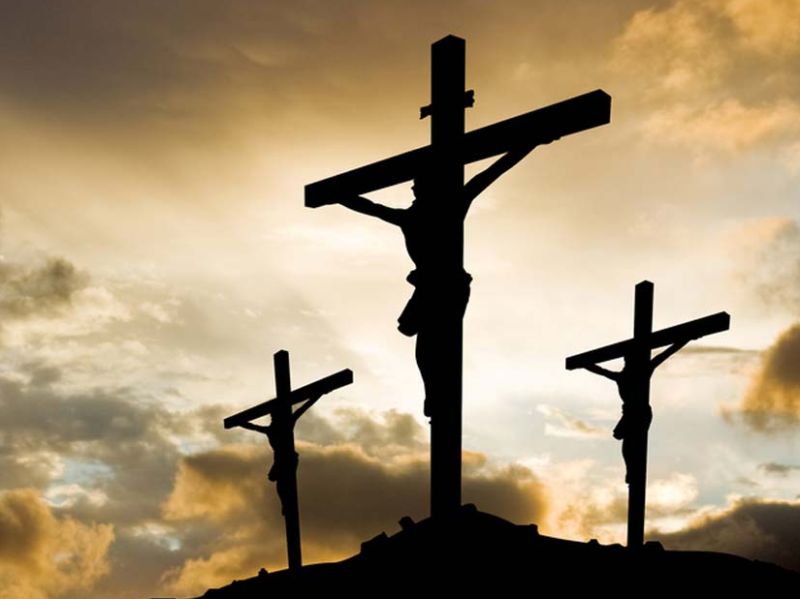
Today, as we hear one more time the tragic story of the Nazorean being crucified outside the city, his cross stuck between those of two criminals, his followers nowhere in sight, only serious questions such as these are allowed.
–Jeremy Myers

 Sunday Brunch