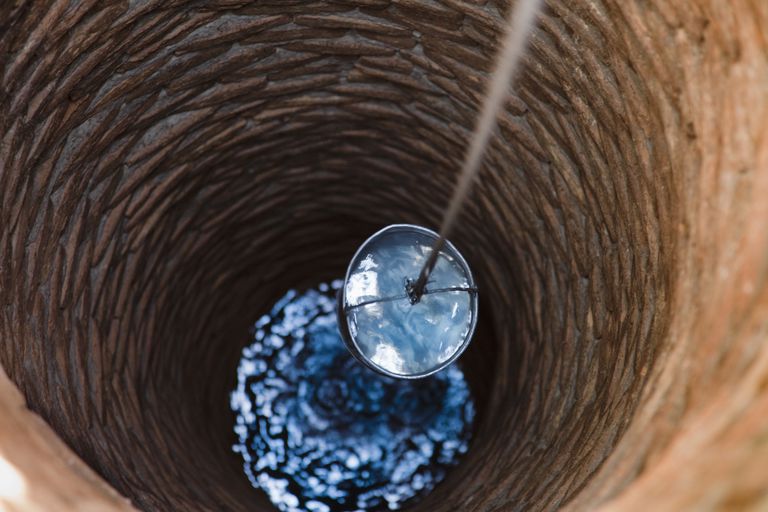
“Jacob’s well was there. Jesus, tired from his journey, sat down there at the well. It was about noon. A woman of Samaria came to draw water. Jesus said to her, “Give me a drink.” (John 4.6-7)
“I am haunted by waters.” When the writer Norman Mcclean first wrote those words in his epic book “A River Runs Through It,” he spoke not only for himself, but for all of us. He described well the human condition when he wrote, “Eventually, all things merge into one, and a river runs through it. The river was cut by the world’s great flood and runs over rocks from the basement of time. On some of the rocks are timeless raindrops. Under the rocks are the words, and some of the words are theirs. I am haunted by waters.”
Our primordial home is water. If we take evolution theory seriously, we probably crawled out of the water onto rock billions of years ago, although we would not have recognized our slippery selves, assuming there is a baby picture of us in some ancient family album. Even for the skeptics of science, there is no denying that we spend the months before our birth floating around in our mother’s womb, a water park of sorts, until the proverbial dike burst and we were pushed out into the world, again in a slippery and slimy form, but somewhat more recognizable to ourselves than when we had sea legs.
Because our first home was water and because our bodies are pretty much a water balloon, at least sixty percent water content, we need water for survival. We can survive without food for several weeks, but we cannot survive more than a week without water. Our inner thermostat is regulated by water, as perspiration and fevers clearly show. Our joints and organs depend on water in order to function. Take away water and our bodies begin to shut down, much the same as our potted plant when we forget to water it. We do well, then, to listen to our doctors when they tell us to drink 8 glasses of water every day.
For sure, water should never be taken for granted, even if the plastic stacks of bottled water on the supermarket shelves would have us believe we have an endless supply. Our ancestors never made that assumption, not only because they didn’t have bottled water, but because they understood that drinking water was a godsend, in the literal sense of the word. One of the first tasks of pioneers on the Great Plains, second only to getting a roof over their heads, was to dig a well. The ubiquitous windmill that stood beside every sod house was a visible reminder that there was no life on the prairie if there was no water.
It makes sense, then, that water should show up on every other page of Sacred Scripture, with a regularity that reflects its importance in our lives. The second verse of the first book of the Bible already speaks of water, “The earth was without form and void, and darkness was over the face of the deep. And the Spirit of God was hovering over the face of the waters.”
Later in the same book, when Hagar, the female slave of Sarah, was banished into the wilderness, along with her baby boy, Ishmael, because of her mistress’ jealousy, “the water in the skin was used up.” Hagar, at wit’s end and ready to throw in the towel, hears a voice tell her, “’Do not fear. Get up.’ Then God opened her eyes and she saw a well of water. She went and filled the skin with water, and then let the boy drink.”
Further on, in the Book of Exodus, as the Hebrew slaves trekked across the desert sands of Sinai, naturally they grew thirsty. So Moses their leader “lifted up his hand and struck the rock with his staff twice, and water came out abundantly, and the people drank, and their livestock.” That water from the rock was as important as the manna from the heavens, both of which, of course, came from the same divine source.
In the time of the prophets, Isaiah speaks for the Lord God when he says to the people of Israel, “I will pour water on the thirsty land, and streams on the dry ground.” In another place, he says, “They shall not hunger or thirst, neither scorching wind nor sun shall strike them, for he who has pity on them will lead them, and by springs of water will guide them.”
The Psalmist pays tribute to water often in his verses. “You visit the earth and water it. You greatly enrich it. The river of God is full of water. You provide their grain” (65.9). Or the more familiar verse, “He makes me lie down in green pastures. He leads me beside still waters” (23.2).
With such a rich history of references to water in the Hebrew Scripture, it is no surprise that the Christian Scriptures provide a similar supply of water associations. One of the surest such references appears in the text for the Third Sunday of Lent, where water serves both as a symbol of physical and spiritual need. The specific scene is a trip through Samaria that the Galilean Teacher undertakes, bringing him to the town of Sychar, “near the plot of land that Jacob had given to his son Joseph.” Next, we are told that “Jacob’s well was there.”
Soon enough, a woman comes to the well to draw water, an ordinary and daily task for women of those times, except that she comes at noon, whereas it was normally an early morning ritual. That change in routine alerts us to something different about this woman, indicating that she is an outsider in her own community. The man of Galilee asks her for a drink of water, a request that results in the woman telling the Galilean that he is the outsider and should not be asking a Samaritan for water–a double breach of propriety because she is a woman and because he is a Jew.
Then, a lengthy dialogue follows, in which the woman speaks of water in the physical sense, “You do not even have a bucket and the cistern is deep”, while the man of Nazareth speaks in the spiritual sense, “Whoever drinks the water I shall give will never thirst.” As the conversation continues, the two converge, with the woman finally asking the man called Yeshua, “Sir, give me this water, so that I may not be thirsty or have to keep coming here to draw water.”
Soon, the story presents a reversal, as we learn the woman has had five husbands, as well a live-in partner, providing an explanation for her outsider status in the community, and the Rabbi who comes from the region of Galilee becomes an insider, explained to us in this way, “When the Samaritans came to him, they invited him to stay with them, and he stayed there two days.”
In the same way, the one who asks for a drink of water from the woman at the well because he is thirsty becomes the one who provides spiritual drink to the woman who is the one who is truly thirsty. “The water I shall give will become in you,” he says to her, “a spring of water welling up to eternal life.”
This so called “discourse” in John’s gospel is one of several lengthy teachings of the Rabbi that the evangelist provides us, similar to the “being reborn” discourse with Nicodemus or the “Good Shepherd” discourse that also appears in the same pages. All the discourses present the Teacher as “the way, the truth, and the life” (14.6), a trinity of words that appears in the “Farewell Discourse” at the end of the gospel.
Here, at the well of Jacob, we find a fundamental truth about the human condition, presented in this dialogue about water, a conversation that moves from the need for physical water for our bodies to the necessity of living water to satisfy our spiritual thirst. What the Rabbi makes clear to the woman at the well–and to all of us who come to the well seeking this same living water–is that our spirits thirst with the same intensity that our bodies thirst. And if we deny the thirst of our spirits, then they will die as surely as our bodies die if they are denied water.
And where do we find that living water? The Galilean Teacher makes it clear that he is the source of this water that will satisfy our spiritual thirst. “If you knew who is saying to you, ‘Give me a drink,’ he said to the woman, “you would have asked him and he would have given you living water.” As he invites the woman at the well to drink of this living water, he now invites us to drop our bucket deep into the well of his heart so that we also can quench our spiritual thirst. He is Jacob’s well.
The problem, of course, is that too many of us too often refuse to recognize our spiritual thirst, instead trying to fill that inner desire with everything but the one thing that will satisfy that deep down need for meaning, for connection, for fullness of life. We try to slack our thirst by filling our closets, or by filling our stomachs, or by filling our egos, none of which brings lasting satisfaction, all of which bring no lasting solution. The Psalmist was right to say, “As the deer longs for streams of water, so my soul longs for you, O God. My soul thirsts for God, the living God” (42.1-2).
Like the child that swims in the waters of its mother’s womb, we are made to swim in the waters of our Creator’s love, and until and unless we allow our spirits to return to that well to draw living water from it, we will shrivel up, we will shrink, and we will become spiritually dead. On the other hand, if we “draw water from the wells of salvation,” in the words of Isaiah the prophet, then we will find, as did the woman at the well, that the only one that can quench the deepest thirst of our humanity stands before us, bucket in hand, asking us to drink from it fresh water for our souls.
The marine biologist and global environmentalist Rachel Carson once wrote these words, “For the sea lies all about us . . . In its mysterious past it encompasses all the dim origins of life and receives in the end, after, it may be, many transmutations, the dead husks of that same life. For all at last return to the sea–to Oceanus, the ocean river, like the ever flowing stream of time the beginning and the end.” That, in so many words, is the prayer of our spirits, that we may at last return to the sea, that our end may be our beginning, where the Alpha and the Omega are again one and the same.
–-Jeremy Myers

 Sunday Brunch