“At that time Jesus was led by the Spirit into the desert to be tempted by the devil.” (Matthew 4.1)
The desert inhabitant Michael Branch often writes about his home in the western Great Basin Desert, “a stark and extreme landscape,” he says, “one that shows no concern for our flourishing or even our survival.” He has lived in the desert for a decade or more, providing him first-hand experience of the tests and the temptations, the beauty and the beasts of desert life.
He acknowledges, “For the past decade, every assumption I ever made about nature has been challenged, every environmental value I held tested, and every elaborate self-image I constructed slowly eroded away by living amid fire, blizzard, and wind.” It is a return to the real, as we can see, where flights of fancy into the fake are exposed as frauds or foes.
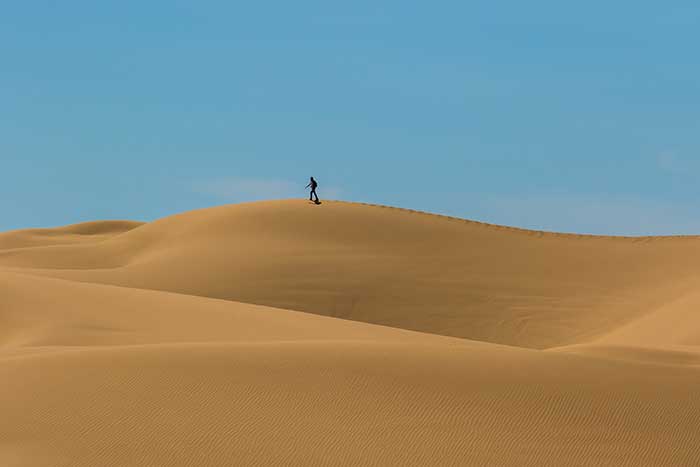
While most of us will never step foot in a desert, except maybe to cross it in the comfort of our air-conditioned car as we race to California, the calendar at this time of year invites us to live in the desert for these forty days of Lent, that liturgical season leading up to Easter, a spiritual boot camp of sorts, a time in which we are to step outside our dolled-up refinished selves, instead returning to our deep-down real selves.
Our example for making this pilgrimage into the wild, of course, is the Galilean Rabbi, Yeshua bar Yossef, who went into the desert before he began his mission and his ministry of infusing the world with limitless love, spending forty days in the emptiness of that landscape, seeking to find his real self. There, in the silence of the desert, he wanted to hear again the whisper of his heavenly Father, reminding him of who and what he was.
And what is that real self? It is the self that was in the mind of God when he formed us from his heart, a self that was brought to life by the breath of love, a self that was meant to breathe out that same life-giving love to others who walk in the world with us. The real self is mirrored in the first man and the first woman, unclothed, uncluttered, and uncontaminated, one with each other, one with all creatures, one with the Creator.
As in that primordial place, so now in this desert place, we also will find the Serpent wanting to wiggle its way into the gentle heart of the Galilean Teacher, tempting him, as it tempted those first beings, with an invitation to abandon the real self for the fake self, to relinquish the divine mission given to him, to settle for less. This sinister snake seeks to set up a war within the sacred man of Galilee, the Evil One always wanting to ruin anything good, offering now, not one bite of an apple, but bites of three forbidden fruits.
Keenly knowing the weakest chamber of the human heart, the Serpent puts before the humble preacher the threefold temptations of pride, of power, of position, hoping to ensnare him in this trap like a rodeo cowboy lassoing a steer. It is a replay of the original Fall, except this time the Tempter does not succeed, instead finding himself crushed in this unholy contest by the holy man of Galilee. “Get away, Satan!” the Rabbi speaks, banishing the Serpent back to the bone-dry hole out of which it crawled.
In choosing to become his real self, rather than a false self, Rabbi Yeshua proposes to us a way to live in the world, true to ourselves and true to the God who calls us to a life of love. Obviously, the temptations to become less than our real selves are always there, as the voice of Satan continues to holler into our hearts that we should exist only for ourselves, should exploit others for our ends, and should exchange selfless love for selfish hate. But if we are ever to become our real selves, the true person we are intended to be, we will have to become practiced in shouting, “Get away, Satan!”
In her children’s classic, “The Velveteen Rabbit,” Margery Williams tells the story of a stuffed rabbit sewed of velvet who is a Christmas gift for a small boy. As the stuffed rabbit is snubbed and shelved for more sophisticated toys, he learns lessons about love from the Skin Horse, who also sits on the same shelf, an old and wise teacher, telling the velveteen rabbit how to become real, warning him that it is not easy work, but it is work well worth the time.
“Does it hurt?” asked the Rabbit. “Sometimes,” said the Skin Horse, for he was always truthful. “When you are real, you don’t mind being hurt.” “Does it happen all at once, like being wound up,” he asked, “or bit by bit?” “It doesn’t happen all at once,” said the Skin Horse. “You become. It takes a long time. That’s why it doesn’t happen to people who break easily. Or have sharp edges, or who have to be carefully kept.”
He continues, “Generally, by the time you are real, most of your hair has been loved off and your eyes drop out and you get loose in your joints and very shabby. But these things don’t matter at all, because once you are real, you can’t be ugly except to people who don’t understand.” At the end of the story, because of the great love he has given to and received from the small boy as the child suffers from scarlet fever, the Velveteen Rabbit becomes real, hopping and moving into the woods with the other real rabbits.
These are the same lessons that the Galilean Teacher offers us with his example and with his words. Not only did he prevail over the Evil One in the desert during that forty-day contest, refusing to trade his real self for a false self, but he stayed true to his inner calling, loving the lost and the least, healing wounds inner and outer, feeding bodies and spirits, even as wickedness surrounded him and every wrong imaginable was done to him.
For the rest of us, less strong, less sure, we often find ourselves tempted to give up the good fight, tempted to accept wrong as the right way, tempted to become a shadow of our true self. Because we are weak in limb and in love, we are now urged to enter the desert, alone with ourselves, away from the pack, made to recall, to return, and to remember “our better angels,” the real selves first breathed into us with that life-giving kiss of divine love. These forty days are an invitation to revert to that truer self, to resync our hearts with the heart of God, to rediscover the love that is our source and our destiny.
So, as we enter the desert, it is not Satan that awaits us there so much as it is the voice of our Creator, so long as we do not allow ourselves to become distracted by the sinister smile of this snake in the grass with its snake-oil offers. And the words we will hear our Maker speak to us are, “I am going to take you into the desert again. I will win you back with words of love,” the same words that our Creator spoke through the ancient prophet, Hosea, many years before us (Hos 2.14).
There, in the desert, away from the noise of the world, removed from the allures of Satan, meant to hook us like the lures on the end of a fishing pole, there in the silence we can hear those words of love. As Mother Teresa once said, “Trees, flowers, and grass grow in silence. The stars, the moon, and the sun move in silence. What is essential is not what we say but what God tells us and what he tells others through us. In silence he listens to us. In silence he speaks to our souls. In silence, we are granted the privilege of listening to his voice.”
–Jeremy Myers

 Sunday Brunch