“Unless your righteousness surpasses that of the scribes and Pharisees, you will not enter the kingdom of heaven.” (Matthew 5.20)
When asked why he joined the Marines, a young man, who had left behind the comforts of family and farm, explained his reasons in this way. “I wanted to be tested,” he said. “All my life I’ve gotten by easy.” He continued, “Nobody ever demanded much of me at home or in school. I wanted to be somewhere that people believed in me enough to demand big things out of me. I wanted to show what I was made of.”
Although the Galilean Teacher knew nothing of the Marines, he knew a lot about what it would take to become one of his followers. Seeing that most people took the easy way out, he expected more from those men and women who would carry his way into the world. He demanded big things out of them, pushing them out of familiar comfort zones, urging them to go the extra mile.
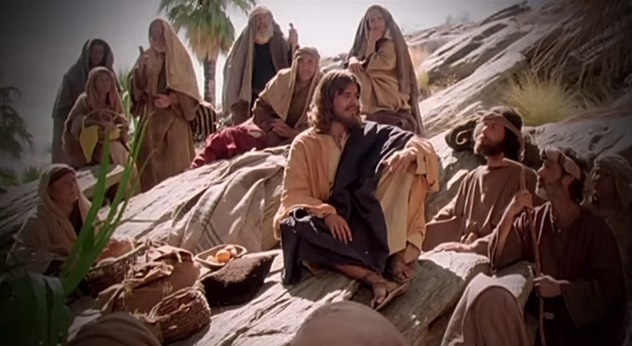
That message is made clear in the greatest sermon he ever preached, known today as the “Sermon on the Mount,” because he chose to address his listeners on a hill in the countryside of Galilee, where men and women sat on the grass, as he stood before them, like Moses of old, inviting them to a way of life very different from the one they knew.
Today, in the sacred texts put before us for our consideration, we hear some parts of that famous sermon, high expectations laid before any person who would become his disciple, no excuses allowed for slacking or shrugging off responsibilities, all expected to do more than the minimal, doing more than everybody else, in this way flooding the world with goodness.
As we listen to him, the Rabbi recalls familiar teachings from the ancient texts of the Mosaic Law, given to the great prophet on Mount Sinai, practiced through the centuries by the Jewish people, carved first on tablets of stone and then onto the hearts of the chosen people. “You have heard it said,” he tells them, offering them one, then another, still another of the old laws, such as “You shall not kill,” or “You shall not commit adultery,” or “You shall not take a false oath.”
Heads nodding in approval as he speaks these familiar words, he tells them that these laws are not enough anymore, not for him, not for his way of life, not for the transformation of the world that he wants to see. So he adds more, “But I say to you,” turning up the heat with additional expectations that go beyond the expected. “Whoever is angry with brother will be liable to judgment.” “Everyone who looks at a woman with lust has already committed adultery.” “Do not swear at all.”
As time moves on and as the Rabbi moves down the road that will take him to Jerusalem, he continues to preach this same sermon on great expectations, using ordinary examples to call forth extraordinary responses from his future followers. “If someone strikes you on the cheek, turn the other cheek.” “If someone asks you for your coat, give him your shirt as well.” “If someone asks you to walk one mile, walk two miles with him.”
Simply stated, this way of living in the world that he envisions requires more from us–more generosity, more kindness, more forgiveness. While others around us may be satisfied with a way of life that requires less of them–less tolerance, less gentleness, less goodness–it is not an option for those few followers who accept the challenge to become Christ to others.
Mother Teresa, the little nun who made big waves through a life of service to the poor in Calcutta, understood this message of great expectations, choosing not just to get by with the minimal requirements, choosing instead to give everything she had. She poured out the last drop of her life, in the same way as the Rabbi did, to help others who could not help themselves.
Among many memorable lines that Mother Teresa spoke in the many speeches that she gave, perhaps the one that comes closest to this understanding of “the more” that is expected of Christian believers were these words, “Give until it hurts, and then give some more.” That principle guided her own life and it becomes the standard for others who wish to imitate the way of the Galilean Teacher.
As we find ourselves in whatever corner of the world in which we live, we are to apply that same principle, realizing that the Rabbi of Galilee’s words always call us to do more for others, seeing that the Rabbi’s own life requires us to give more of ourselves to others. Using Mother Teresa’s measuring cup, when we feel we have given all we can give, then we should give some more. In that way, we come closer to being Christ for others.
Some years ago, the Wall Street Journal carried an article about the popularity of pew cushions in churches in this country. The report pointed out that half a century ago there were few, if any, pew cushions. Instead, people sat on hard benches. Today, the article pointed out, people coming to church want to be comfortable. They want soft seats. “Soft seats are more inviting,” one person said.
Another person said, “I love the Lord, but there is absolutely no reason to hurt for an hour while doing so.” As a result of this change in attitudes, church leaders consider soft pews an essential part of church life today. They want to satisfy their customers, offering comfort for the hour they are in church.
Perhaps a simple example of the shift in people’s attitudes, it also speaks to a greater move away from the challenges of living a Christian life–hard and difficult as they are–to a more comfortable religion that doesn’t pinch us or deprive us of too much. If we cannot sit on a hard bench for an hour, it is difficult to see how we can lay down our lives on a cross.
Obviously, not everybody can do it. Maybe that is the point that the Galilean Teacher wishes to impart to his followers. Not everybody is cut out for his way of life–only the few. It is also something the Marines understand, as shown in their long-standing motto: “Only the Few, the Proud, the Marines.”
–Jeremy Myers

 Sunday Brunch