Reading the newspaper the other day, I learned that my childhood friend, Nancy Drew, celebrates her 90th birthday later this year. Honestly, I didn’t know she was that old, still thinking of her as the plucky sixteen-year-old girl that I knew back in my younger days. Nor did I know there was such an age divide between us, or it wasn’t apparent when I knew her.
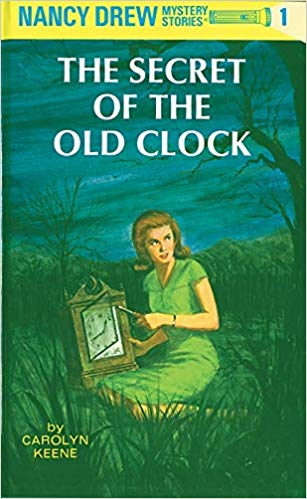
Like so many others in my generation, Nancy Drew was a part of our growing-up years, maybe not a friend down the street, but still a friend we came to know through the many books that had her as the central character. I met her in “The Secret of the Old Clock,” which was published three years before my mother was born. For me, it was love at first sight.
Written under the pseudonym Carolyn Keene, the books chronicled the life and adventures of the brave and brazen teenage sleuth, each book placing her in a situation that needed unraveling, like a cat with a roll of yarn, suspense building with each page, until ever-careful, ever-tenacious Nancy Drew provided us with the surprise ending, a smile on our face, believing good always wins in the end.
Among her fans, I learned from the newspaper, are notable people such as Oprah, and Hillary, and Sonia (Sotomayor), showing that the mystery books were a draw for lots of us, so popular that there are 533 Nancy Drew books published through 2019. As a young boy, I thought I had read all of her books. Embarrassingly, I now admit I didn’t make a dent in the voluminous stack.
As the record shows, the brainchild behind the series was one Edward Stratemeyer, who had created an earlier series, “The Hardy Boys,” a successful effort for sure, but who wanted something that showed off the smarts of a young girl, anticipating by years the women’s liberation movement of the 1960’s. Recruiting a young newspaper reporter, Mildred Wirt, Stratemeyer provided her with an outline for the first three books, which she then wrote. And the rest is history.
Interestingly, I learned about the Hardy Boys after I had met Nancy Drew, taking to the series with equal interest, but finding Frank and Joe not as interesting as Nancy, somewhat flatter in personality, even if equally skilled sleuths. Our little school library didn’t carry either series, so a trip to the local public library was the only means to get one of the books, not unusual for kids growing up in the pre-Kindle days.
Each week or two, my mom would take us to the city library seven miles away, where we could look for a book to read, taking it from the shelf to the check-out desk, writing our name on the library card, and holding it tightly in our hands as we went to the car, much the same as a mother would hold a newborn child. The care of the book was our sole responsibility, until we returned it a week or two later, hopefully in the same condition in which we had found it.
On the few occasions it occurred, a missing library book was cause for tribulation, sheltered as we were in our small world, still unaware that there were more serious offenses in the bigger world. As far as I know, eventually we always found the lost book, relief on our faces and on Mama’s face, making our return to the library a much happier trip. These trips to the public library were a regular event of our young lives, although I am not certain of the number of years we did it.
As with almost everyone else, my reading experience did not begin with Nancy Drew, but with Dick and Jane, a series of primers that also began in the 1930’s and continued until the 1970’s. Aside from criticisms of the stereotypes passed along in the books, they did the job, a great combination of word and pictures, a learning tool still used by language courses such as Rosetta Stone.
Learning to read, like learning to walk, is one step at a time. Living now in an age that presumes literacy, the ability to read was not always assumed, but was a cherished skill, available to only a few, elevating in status those capable of reading. Some years ago, this reality came home to me when an immigrant woman from Mexico asked me to read to her a letter that had been written to her from a relative. Although she could speak Spanish, she had not learned to read it, not uncommon, I have heard, in rural parts of that country.
Psychologists are quick to point out that literacy requires years of work before a person becomes proficient, another fact that we often fail to appreciate, also a reason that explains the popularity of media over reading for young people today. Reading, as the experts say, is an exercise in delayed gratification, requiring a person to learn new words along the way, also taking a good amount of time to get to the end of the story.
Television, as we know, doesn’t ask the same requirements of our minds, the vocabulary on TV generally geared towards a fourth grade reading level, as research has shown. Also, there is immediate gratification or, at most, a half hour wait for the end of the story. A steady stream of TV or video, it could be argued, is like allowing our brains to have a vacation. And, as we know, too much vacation makes us lazy and listless.
The Kindle, the first e-reader on the market, unknowingly does not help the situation by putting at the bottom of the screen the number of hours still needed to complete the book. When I look at the bottom of the screen, only to see that there are three or four hours of reading that remain in the book, when I already have expended that same amount of time in the pages before this point, I admit it requires stamina, a deep breath, and the long haul to stay at it.
Current research, I am told, shows that the average child spends less than five minutes a day reading outside of school. In fact, it is 4.6 minutes, which by anyone’s estimation, is not much time. We spend more time getting dressed, drinking a cup of coffee, or walking the dog. One out of five kids does no reading whatsoever outside the classroom.
At the same time, the average child spends 31 hours a week watching TV. If that number were not alarming enough, studies now show that there is an inverse relationship between the amount of time spent watching TV (or other electronic devices) and school achievement. The more time on electronics means less achievement in school.
According to the research, some of the consequences of heavy TV consumption by children include worse reading scores, less effort at school work, less ability to play well with friends, fewer friends, and fewer hobbies. As one analyst said, no one would knowingly allow any other person into the house if he or she caused that much damage, and yet the TV rests front and center in almost every living room, children propped before it, the harm accruing with each hour, each week, and each year.
Those numbers are worrisome, particularly when we consider that the best predictor of IQ, after genetics, is how much a person reads. The more a person reads, the higher the IQ. If parents want their children to succeed in school–and I am sure they do–then they only have to instill in them the habit of reading.
Here is where it gets more interesting. According to reading specialists, the single best predictor of how much a child reads is how much the child was read to as a baby. If we want our children to become readers, then we have to read to them when they are toddlers. Learning this fact, I admit some fascination, knowing that my siblings, almost to a person, are readers. Yet, I don’t remember our mother reading to any of us as babies.
If pressed, she would say, I believe, that the outdoors was the best teacher, offering unique experiences, firing imagination, a perfect puzzle solver, with reading a book coming behind in second place, doing much the same, but not even the best book rivaling the pages that nature put before us every single day. She liked to see us outside, thinking too much time indoors was not good for our minds or our bodies.
Given that my mom spent most of her daytime cooking and cleaning, washing clothes and working, her free minutes were few, this free time spent playing games with us, preparing a picnic for us, watching sporting events in which one or another of us participated. She read some childhood stories to us when we were older, if time allowed, or had one of the older children read to the younger children, centurions in Mama’s army.
On the other hand, she was a reader herself, especially after she had raised us, a habit from her own childhood, a practice most of her children would imitate. As a young girl, she would read whenever she had a free moment from family chores or farm work. There was no television when she was growing up, so there was no competitor. Her favorite reading perch was the roof of their farmhouse.
She took her book in hand, crawled through an open window on the east side of the upstairs, and lay on the wooden shingles of the roof, reading her book under the open sky and the bright sunlight. She said she would spend many hours reading books in this way, a love of reading that stayed with her throughout her life.
Not that she climbed onto the roof in her later life, but she maintained her interest in reading, enjoying a good book whenever her hectic day as a mother of many children allowed her a few minutes to relax and to read. Once, when I was in high school, I loaned her my copy of “Gone With the Wind,” Margaret Mitchell’s mammoth masterpiece, seven hundred and nineteen pages of small print. She became so caught up in the story line that she almost put aside everything else until she finished it. She said that her becoming caught up in a book was the reason she didn’t like to start one–she knew she couldn’t put it down once she had begun it.
Years later, we were amused when she showed the same fervor in reading the daily newspaper. While she had her favorite columnists, she also was the only person I knew who seemed to read every page of the newspaper, story by story. While reading, she habitually tore out articles that she thought we should read, never using scissors, ragged pieces of newsprint ready to give to us to read the next time she saw us.
Mama got more use out of a newspaper than anyone else I know, even more than the person who lines a birdcage with them. If she got behind, she’d stack up the newspapers until she had time to go through them, one by one, until she had read all of them. One of her greatest frustrations, it seemed, was to have to admit defeat and throw away the newspapers because she wasn’t going to have the time to make it through the heap. Even then, she would tear out articles by her favorite writers and save these stories until she could read them.
Last week, while I was reading the newspaper, I saw the headline, “Nancy Drew is Dead!” As the article explained, a new comic book series begins with the Hardy Boys standing over Nancy Drew’s grave, although real believers are hopeful that it is a cliffhanger and not a foregone conclusion. As one of her loyal readers, I cannot imagine a world without Nancy Drew, even if she is ninety years old and may want to retire from the public eye.
Either way, I always will appreciate Nancy Drew, carrying with me memories of her adventures, urging me to read on, gradually forming the habit of reading in me, a habit that has continued through the years, page after page, book after book, always looking for the next bestseller. Thank you, Nancy, my very old friend. Have a happy birthday!
–Jeremy Myers

 Sunday Brunch