When I was a little boy, my mom shampooed my hair at the kitchen sink. Part cattle driver and part homeroom teacher, she’d line my brothers and sisters and me into a single file alongside the kitchen cabinet, much like customers at the post office during the holiday rush. Then, with a smooth, swift, and steady reach of her arms, as sure as the player reaching for the prize in the claw machine at the circus, she picked us up–one by one–placing us on the cabinet top, positioning our heads over the sink, facing us towards her, and–once we were in place–she began the ritual of hair washing.
She used her left hand to hold our heads and her right hand to wash our hair, cradling us under the faucet, as a stream of warm water poured across our scalps. She instructed us to hold our little hands over our eyes so that the shampoo didn’t burn our eyeballs, massaging the soap through our hair with her fingers, lathering up our head until we looked like the whipped cream topping on a vanilla milkshake.
Needless to say, one or more of us would wiggle and squirm, which made the possibility of shampoo in our eyes a probability, resulting in an avalanche of tears and a chorus of cries, neither of which were encouraging to the ones still awaiting their turn, watchful and fearful that the same catastrophe might come their way.
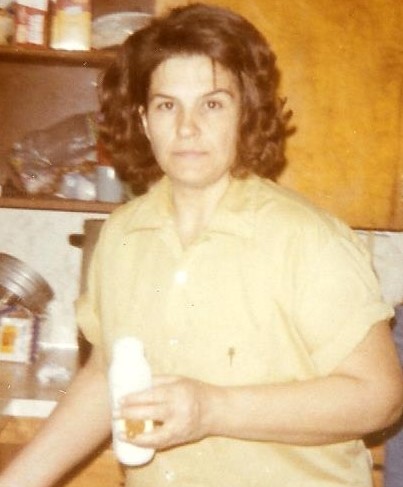
After rinsing out the shampoo from our hair, Mama would lift us from the counter, grab a nearby comb–if we had hair long enough to comb–and clear away the tangles, restoring our freedom so that we could run outside, our playground and our hair dryer at one and the same time. Never rushing, so far as I remember, always painstaking, she worked through the lineup with the same diligence as any assembly line worker.
Not asking the question because I didn’t know another way, I realized years later that Mama used the kitchen sink because it was much easier on her than using the bathtub. The height of the cabinet allowed her to remain standing while she worked on our scalps, whereas the low height of the bathtub would have required her to stoop or kneel, an uncomfortable position to maintain, considering the many heads of hair she washed in a single session. Whenever I see her kitchen sink, I think of it more as the place where I got my hair washed, and less of the place where the dishes got washed.

Her skill did not end at the kitchen sink when the shampooing ended. Resourceful and skillful, Mama also cut our hair, using a standard electric clipper for the boys, and a sharp scissors for the girls. Her specialty, I recollect, was the buzz cut for us small boys, as you’d find on any marine base, and trimming bangs for the girls, as you’d find on Sandra Bullock. Again, often these hair cuts would take place in the kitchen, with Mama commandeering the yellow high chair, normally reserved at meals for the baby in the family, but equally well-used as a barber chair for the older little children.
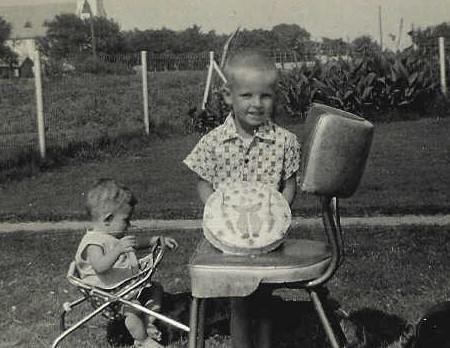
In the summer, nine out of ten times, Mama would move the high chair outside, sometimes onto the back porch, other times onto the grass–if we had not worn it bare–and would do her barbering under the open sky, with our hair dropping to the ground or blowing in the breeze, depending on whether or not it was a windy day, providing building material for a bird’s nest, which was always a fascinating thing for a small boy to discover some weeks later.
Sometimes, she’d drape a towel around our necks to catch the falling clumps of hair, especially if we were in the kitchen, and if we were outside, she’d see no need for it, especially if we were shirtless, as we almost always were in the summer months. A few minutes afterwards, running and playing, we shed any hair wisps off our backs, the wind doing the work for us.
My dad, as a rule, offered no opinion on my mama’s hair-cutting efforts or results, with one exception. He insisted that she not cut one of my younger sister’s hair short, but instead allow it to grow, trimming the edges, but not cutting the length. As a result, she always had the longest hair in the family, a hairstyle she held until late in middle school. I don’t remember any reason given for this one rule. Maybe it was simply because she had a thick head of hair that he thought looked nice.
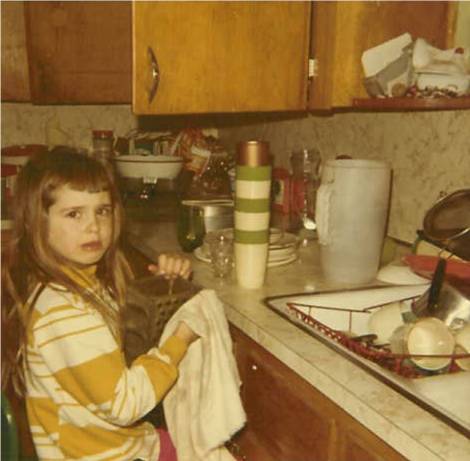
My sister never voiced any complaints about it, not to my knowledge, but she may have had some quiet reservations about it, especially having to be the one to carry the weight of that hair atop her head, and having to be the one to endure the torment of the prankster who pulled her hair, made possible only because of its length, a free pass granted to short-haired girls, but not to her.
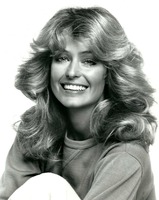
I don’t remember when I got my first haircut at a barber shop. Maybe around the time I entered high school, when hair cuts and hair styles became a bigger deal, longer hair now the fashion for males in the late 60’s and early 70’s, probably copying the style of the hippies of Southern California, the Farrah Fawcett look the fashion for females in the same time period. With longer hair and with blow-dried hair now covering our heads, my mama retired from her duties as the family barber, putting away the clippers and and allowing us to adopt the contemporary trends, a much fussier and time-consuming effort than the crew cuts of my younger days.
A few weeks ago, I made a trip to the hair stylist, a unisex shop where females regularly cut the hair of males, a big change from old-school male barbers, a change not only in gender, but also in cost. She used the same type of clippers that my mom used and she used up the same number of minutes that my mom did, but she charged $20 for the same haircut. This should not be construed so much as a complaint as an observation of the many changes my hair has seen over the years.
After cutting my hair, the stylist asked me if I wanted a shampoo. She was quick to say it was only a few dollars more, but I declined, her disappointment clearly outlined in her face, telling her it wasn’t necessary, which was true, but not telling her that I wanted to reserve the shampooing of my hair to memories of my mom, which also was true.
No one, even with the most skilled hands, could replace my mama’s hands as she lathered my head and washed my hair and rinsed off the shampoo. If I close my eyes, I think I still can feel her touch upon my scalp. I hope it is a memory I never lose. For her, it was not a duty, not a job, but instead was a sign of love, a sign of care. Those qualities are difficult to replicate in a shop.
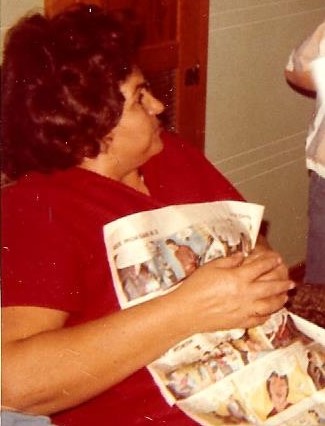
Pulling the dusty dictionary off the shelf, or pulling up Google on the computer, a person learns that the word “tonsorial” means anything that relates to hairdressing, a word that appears peculiarly unfamiliar, at least at first glance. What the dictionary doesn’t spell out for the reader is that the word is rooted in tonsor, another unfamiliar word to us, but very familiar to another age when a barber was called a tonsor. No, I never called Mama my tonsor. I just called her my mama. It would be many years later that I learned the word tonsor.
Backtracking, the reason that barbers were called tonsors was rooted in the practice of medieval monks cutting their hair in a distinctive way that was called a tonsure, from the Latin word tonsura, meaning clipping. The tonsure, as worn by monks until 1972 when a papal decree decided it was irrelevant, consisted of cutting all the hair on the head, except for a narrow strip of hair around the midsection of the head, the practice considered an act of humility, still meaningful then as now, since people of all ages put great pride in their hair.

We find the same association between a shaved head and the virtue of humility in the ancient religious texts. The Hebrew Scriptures regularly speak of a person shaving their hair as a sign of humility or penance. David, upon the death of his son with Bathsheba, shaved his head. The later Christian sacred texts borrowed and carried on the same practice, with Saul of Tarsus shaving his head as a sign of humility.
The opposite also is true. Long hair often is portrayed as a sign of pride. People with long hair generally end up in trouble in the Scriptures. Absalom, the oldest son of David, wears his hair long. When he instigates a revolt against his father and tries to escape from his father’s forces, his long hair becomes entangled in a low-hanging branch, hindering his escape and ensuring his death.
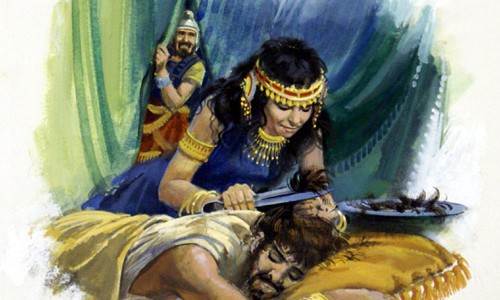
The same can be said of Samson, a long-haired hero in the Book of Judges in the Hebrew Scriptures, but whose strength is sapped when Delilah, his duplicitous girlfriend, cuts his locks one night while he sleeps. As the story goes, his strength returns when his hair grows back, and he pulls down the building in which he is chained between two pillars, and he and his enemies perish.
The Christian text has Paul insist that women cover their heads when they are in church, not permitting their long hair to be seen. I am old enough to remember when the rule was still practiced. My grandmother always wore a scarf into church, as did most of the other women of her time. Those who did not wear a scarf wore a hat. The mantilla still is considered proper church apparel for women in Spain, Mexico, or Russia.
There may be more cultural reasons for this edict than religious reasons. As we know, even today, women of the Muslim faith wear a headscarf called a hijab, the purpose of which is to conceal their hair and their faces, but this scarf is worn more for reasons of modesty rather than reasons of religion, although culture and religion are closely aligned in Muslim countries.
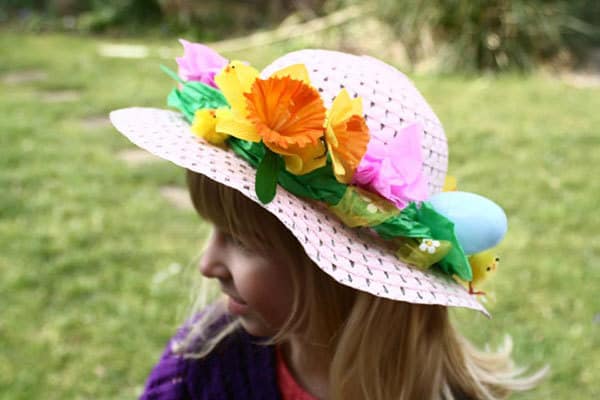
In our country, on any Sunday morning–generally speaking–women who attend church services do not wear head coverings, except perhaps on Easter Sunday morning, with the cultural tradition of a new Easter hat still holding sway in some parts. Instead, women are in church with their hair clearly visible, all types of hairstyles filling the church pews, depending on personal taste or current fashion.
A hairstylist told me that her busiest work day is Friday because it is the day when the silver-haired generation of ladies comes to the beauty shop to have their weekly hair appointment, wanting their hair to look spiffy and sprayed for Sunday services. That generation is fast fading, as any casual glance around church on Sunday morning shows.
A Sunday or two ago, I happened to notice a woman, some pews in front of me, who had gone with the simpler style, having pulled her hair into the ubiquitous scrunchie, securing the loose strands, more or less, with a Pebbles Flintstone look, although there was no bone twisting the hair together, so far as I could see. I smiled because it was clear that the relaxed, easy-care, no-bother look is now everywhere, something that in a previous age would have been the talk of the town, not just another day in the marketplace.
Although I think Mama would have wanted her girls’ hair to be brushed and tangle-free before they went to church, I also think she would be a fan of the no nonsense style elsewhere. When I walk through the hair care aisle at Walmart or elsewhere, I am amazed at all the hair products that are available, for men as well as for women, with male tonsorial pride at an all-time high, apparent by the multitude of male hair supplies on the shelves as well as the male hair replacement ads proliferating on television.
Obviously hair is never just hair. I have heard cancer patients speak of the loss of identity when the treatments resulted in total hair loss for them. I have seen many of them weep copious tears when they stare for the first time at their bald heads, where earlier long locks of hair had lay. Others, wanting to claim ownership of the procedure, make no effort to replace the loss with a wig or with a scarf, but wear their baldness with pride. Good for them, I say.
My bald spot is at the back of my head, so I never see it and so never am bothered by it. Over the years I have become less or little concerned about how my hair looks, the last real tonsorial effort being in my college years. Since then, one brush through my hair in the morning and I am good to go for the day. I probably lose less hair that way also, if our hair brushes can be trusted.
I read recently that a new study confirms that stress turns our hair white. I have heard of some people’s hair turning white after a traumatic experience. My hair turned white in my 30s. I do not claim stress for my premature graying, just a roll of the dice. Fortunately, it has never bothered me, no more than having to buy my first pair of reader glasses.
As my mom entered her final months, I had the honor of combing her hair for her on most mornings, moving her wheelchair to the mirror so she could watch me and advise me. As I moved the brush through her hair, I thought of the many times she had done the same for me when I was a baby or a little boy. And I said a prayer of thanksgiving to the God above that I could repay the kindness in a small way to the woman who had shown so much love as she shampooed and combed her little boy’s hair.

–Jeremy Myers

 Sunday Brunch