“And a voice came from the heavens, saying, ‘This is my beloved Son, with whom I am well pleased.’” (Matthew 3.17)
Fifty years ago, the gifted writer Chaim Potok wrote a book called, “The Promise,” a story that revolves around several young Jewish people, each of whom must make a choice about the direction he or she is going to take in life. Their choices are not easy, especially when the choice will determine the course of their whole life. Finally, it is personal integrity that determines the choice each one makes.
A character in the book makes this observation about making a choice. He says, “A choice tells the world what is most important to a human being. When a man has a choice to make he chooses what is most important to him, and that choice tells the world what kind of a man he is.”
Potok chose the title, “The Promise,” for his book because of the promise made between the Lord God and Moses, as recorded in the ancient Jewish texts, simply summarized in the statement by the Lord God, “I will be your God and you will be my people.” As we flip through the pages of the ancient Hebrew text, we will see that promise give power to the people in their perils, suffering at the hands of foreign enemies, weeping in exile along the streams of Babylon.
In a similar way, the prophets, spokesmen for the Lord God, will place the promise before the people when they have strayed from the path of righteousness, urging them to keep the promise they have made to the Lord God, not turning their back on his ways or his will. Often, the prophets will present this promise in terms of a marriage between a husband and a wife, the promise uniting them in a bond of mutual love and devotion.
As the Scriptures invite us today to observe the baptism of Jesus, the Teacher called Yeshua bar Jossef , or the carpenter’s son, we can see this occasion as the moment when Yeshua makes a radical life choice. For three decades, he has worked in his father’s carpentry shop, learning to shape wood into beautiful pieces of furniture, but now he is faced with a choice–to continue as the carpenter from Galilee, or to become the Teacher from Galilee.
That choice was clarified for him during a period of prayer and reflection in the desert, where he pondered the path he should choose, asking guidance from the Lord God whom he called Father, seeking to do his Father’s will, and not his own will. Finding his answer in the desert, attended to by angels during the difficult moments, he decides to leave the carpenter’s shop, now using his calloused hands to mold people’s souls, some as hardened as the hardest wood he had worked with in his shop.
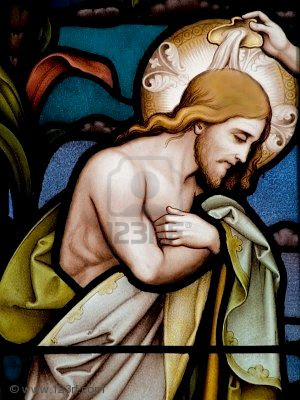
As he steps into the Jordan River, where John the Baptist washes away people’s pasts and invites them to a new future, a future filled with good choices, not bad choices, Yeshua allows the water to pour down his face and his beard, running down his body, making a promise in that moment that he will live the ways of the Lord God, not the ways of this world, whatever the personal cost to him.
The heavens hear the soft-spoken promise that flows from the lips of Yeshua, even as the water wraps around him. In that moment at the Jordan, his will is united with the will of his Father, and his way is the way of the Father. Seeing now the path before him, he promises to be the love of God in flesh and blood upon the sands of this world, to be the light of God in the darkness of the world.
We will see, as we watch the Galilean Rabbi walk the roadways of Galilee, that he is faithful to the promise, never compromising, always listening to the inner voice of the Father within his heart, guiding him step by step to Jerusalem, where he will be taunted, cursed, and crucified, where he will repeat one final time the promise he made in the Jordan, this time spoken in anguish and in pain, “Not my will, but your will be done.”
Of course, it is not enough that we look upon the baptism of Yeshua as spectators, honoring it as we would some decisive moment in the life of an ancient hero, while ignoring its summons to us to do the same. His baptism asks us to choose as he chose, to promise as he promised, forever after walking the way of righteousness, putting behind us the ways of the world.
For those who would call themselves followers of the Anointed One, our path alongside him begins with our own baptism, where water rushes down our bodies, as it did his, where we promise to live and to love as he did, and where we are anointed, called sons and daughters as he was called “my beloved son” by a voice from the high heavens.
That pivotal life moment of choice is sealed with promises, spoken by us if we are old enough to speak them, or spoken for us by our parents if we are still too young to speak them. These baptismal promises bind us to the living God in the same way that the promises made by the Lord God and Moses bound the people of Israel with their God. “I will be your God and you will be my people.”
In the early days of the Christian era, the radical choice that the neophytes made was symbolized in a real way. As they entered the pool of water, they turned their backs to the west, where darkness resided, and moved through the pool towards the east, where light shone. The movement from west to east symbolized the choice for good and against evil that the newly baptized were making, or as Moses of old told the Hebrews, “Choose life, or choose death.”
Once we have made our promises, our path is put before us, a path that would have us do good with our lives, loving all others, avoiding evil in every way, putting on Christ so closely it is as if we have a second skin over our person. For his part, God cannot promise that it will be an easy path, for no path of light in a world darkened by sin is an easy walk, but his promise is that he will stand beside us and strengthen us as we strive to shine a bit of light into the darkness.
In the 1983 movie, “Tender Mercies,” Robert Duvall plays the part of a washed-up, booze-drinking, country singer who wakes up one morning in a roadside motel after a night of too much drinking. Mac–Duvall’s character–resolves to give up alcohol and to start his life anew. Part way through the movie, he decides to be baptized, along with Sonny, the son of a woman he has married after he has changed his ways.
As they drive home after the baptism in the local church, Sonny says to Mac, “Well, we done it Mac, we was baptized.” Looking at himself in the rear-view mirror, Sonny says to Mac, “Everybody said I’d feel like a changed person. Do you feel like a changed person?” Mac answers, “Not yet.” Sonny replies, “You don’t look any different, Mac. Do you think I look any different?” Mac answers, “Not yet.”
Hearing Sonny speak those words, most all of us probably feel the same way. Even if our baptism is years behind us, we may think we aren’t all that much of a changed person, particularly on those days when we seem to make choices that do not look one bit Christ-like.
Still, we cannot and should not despair of ever becoming the likeness of Christ. For most of us, it will take a life-time of daily choices. An honest admission that we are not yet there reminds us that the road is long, but even a single step in the right direction brings us that much closer to fulfilling the promise we made at our baptism to become a beloved child of the living God.
–Jeremy Myers

 Sunday Brunch