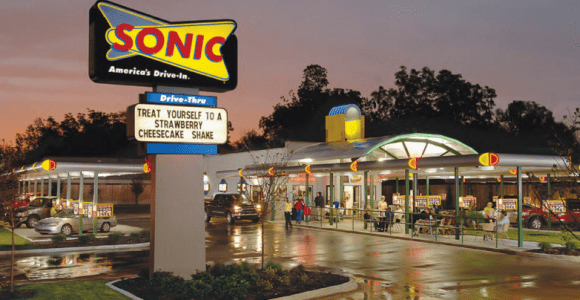
She’s the happiest girl in the whole USA. Maybe not the girl Donna Fargo made famous in her 1972 hit song by the same title, but the carhop at the Sonic Drive-In that I see on Sunday afternoons. As I pull next to the digital menu at Sonic, push the red button on the intercom, I see her dance out of the door of Sonic, a service tray in her hand, a smile on her face, as she moves towards a customer somewhere on the Sonic parking lot.
Although I have seen her in every weather condition, from the hottest day in July to the coldest day in January, she always has a smile on her face, one of those smiles that has set up house, with no intention of leaving, like a mother hen on a warm nest of speckled eggs. If it’s a hot summer day, she wears short sleeves. If it’s a cold winter day, she wears layers, a coat and a sweater, with a neck-muffler added to the ensemble if it is really cold. She likes to wear a comfy, well-worn pair of black tennis shoes. I am sure those shoes have walked miles.
Remarkably, inexplicably, the smile on the happiest girl in the whole USA–or, at least, in this Sonic–is the same regardless of the season, sunshine served on a sunless day if it is winter, sunshine added to the sun-filled day if it is summer, sweetened like sugar added to a cup of coffee. Hers is genuine, not a pasted-on smile because her job requires it, not a plastic smile because she wants a tip, not a practiced smile because she’s been doing it for so long.
This smile, I tell you, comes from the only place a smile like hers possibly could come from–that placed called heart. Her smile is the best thing they have at Sonic, sweeter than the cookie dough blast, creamier than the vanilla shake, and longer lasting than the cinnamon bites. Mother Teresa liked to say “peace begins with a smile.” The woman at Sonic is too young to know about Mother Teresa, but she brings peace with that smile even in a bigger way than the peppermint candy at the bottom of the Sonic paper bag. Unlike the mint, I don’t have to look for her smile.

I’d understand, I suppose, if she limited her smiles to the customers in the cars that she serves, like the school librarian does for the smart kids, but she shares her smile with everybody, like a sampler display of sausage and cheese at the office party, As she strolls past me on her way to a customer, balancing a tray of burgers and fries and drinks in her arm, she smiles at me, cheerfully shouting a quick hello, her voice as loud as her smile, pleasantly asking me how my day is going, never missing a step as she makes her way to the car down the way from me.
Each time I see her, the question I ask myself is how she stays so cheerful, facing every day us same cranky customers, all the near calamities with the Route 44 drinks, not to mention the cheese the cook was supposed to hold from the number one. Then I think about how her feet must feel at the end of the long day, or how her legs ache when she finally gets off her shift, or how she finds the energy in the evening to do the laundry and to help her kid with his homework. My smiles would have shriveled up on my face after the first hour, like big leaves on a water-deprived plant.
I guess I could explain it away by saying she enjoys her job, but I know lots of other people who enjoy their work, but who don’t smile all day long behind the desk, or behind the computer, or behind the check-out counter at the 7-11. I suspect that few, if any of us, find our work so enjoyable that we wear a smile from the start of the day to the end of the workday. Only the happiest girl in the whole USA, who works at a Sonic on Sunday afternoon, bringing me my large unsweet tea with the sweetest smile on her face, always asking if I want a straw, humming a quiet tune to herself as she counts the change.
Some months ago, while listening to a professor of psychology speak on finding happiness, I learned that people who regularly smile live ten years longer than people who don’t smile. She says there are studies and statistics that support this finding, a fact that still surprises me when I think about it, baffled that something so simple as a smile could prolong life expectancy, adding ten years to a person’s lifespan, requiring nothing more wearing a smile on our face.
When I think of all the money spent on multi-vitamins or health supplements or organic foods, all done to increase longevity, it seems like we’re falling for fool’s gold with all these products, when real gold costs us nothing–only a smile. Maybe the fountain of youth is found right below our noses, while we’ve been looking for it on cosmetic shelves and health food stores, paying big money for something that comes free. All we have to do is smile.
As I gave it more thought, I began to see that there may be something to the belief. People who have a strong connection with others live longer lives. That’s also a tried-and-tested fact. It’s easy to see, then, that a person who smiles will have more friends than a serious-faced person, since most of us prefer to be around a happy person rather than an unhappy person. I know I avoid curmudgeons.
My mother was a person with a smile. Whenever someone came up to her, a smile shone from her face, beautiful as a rose in full bloom. She was an equal-opportunity smiler, offering a smile to old people and to young people, to pleasant people and to crotchety people, to big-named people and to nobody-knows-his-name people. It is no surprise, then, that people flocked to her at basketball games and in store aisles, wanting one of those gracious smiles, walking away feeling lighter, wishing more people in the world smiled at them that way.

As we know from personal experience, this connection through a smile begins early in life. We’re drawn to the baby that smiles spontaneously at us. My six-month-old great-nephew smiles all the time, collecting admirers like a hummingbird collects nectar, his smile so effortless that I truly believe he was born with a smile on his face. We also know those babies that refuse to smile, from whom we have to beg and bribe a smile as if they were our landlord to whom we still owe last month’s rent. The child with a smile has a head start in life, and if the smiles stays, will find the world overall to be a friendly place. That has to add years to a person’s life.

So, given these and other explanations, there is, on second-thought, a real likelihood that smiling can increase a person’s longevity. And we just thought Bobby McFerrin’s song back in 1988, “Don’t Worry, Be Happy,” was nothing more than a cute, but surely simplistic tune. Now we have to say he probably was right when he urged upon us “Don’t worry, be happy,/ ‘Cause when you worry your face will frown,/ And that will bring everybody down./ So don’t worry, be happy.”
Some years ago, I read in some how-to book that a person can conquer some of the jitters about public speaking by smiling, easing some of the edginess from the body, restoring a sense of calm. I can’t say I know if it works, but I understand the theory. As we know, the body is intricately wired, all parts in communication with one another, like a switchboard operator in the days of party line phones. So, standing before a crowd, all faces on us, if we make ourselves smile, we trick our brain into thinking we’re happy, not scared. Soon, our body gets the message and we begin to relax. Again, it seems all it takes to reduce stress is to smile.
Cultural anthropologists tell us that a smile is one of only four facial expressions that is universally understood. Whether we smile in the United States or we smile in Uruguay, people in either place will recognize it as a sign of happiness. A tribesman in the deep of the Amazon forest, with no knowledge or contact with modern civilization, will understand a smile to mean the same thing as would a tourist in China Town in San Francisco. It is as if we are programmed to smile, assuring our connection with others, making life easier for us and for them, resulting in a longer and a happier life for everybody.
So, there is, it would seem, more to a smile than we thought. Perhaps we have underestimated and undervalued a smile, seeing it as an ordinary part of life, wrongly equating the commonplace with the unimportant, not understanding that a smile may be one of the most valuable things in life, being life-altering in some instances. If we are non-smilers, we may want to dig out our smiles from among the mothballs where we’ve stored it, along with that faux-fur coat we never wear anymore.
For a number of years, I knew a woman who had the biggest smile anytime you stepped into her line of vision. She. like the Sonic happiest girl in the whole USA, habitually smiled, by which I mean it was an ingrained habit, so much a part of who she was that she wouldn’t be the same person without it. What made her particular smile even more special, in my mind, was that when she smiled she showed several missing teeth.
Many people with less than perfect teeth become too self-conscious to smile. Dental advertisements aimed at correcting flawed teeth use this fact to their advantage, marketing their product to those embarrassed by their teeth, urging would-be customers to have their teeth straightened or fixed, bleached or braced, polished or capped, insisting that once all the dental work is done it will be safe to smile again.
This woman didn’t believe perfect teeth were the prerequisite for a perfect smile. She smiled with several gaping holes in her gums. And it was a beautiful, effortless smile, warm as a childhood teddy bear, gentle as a mother’s touch. When she died, I mentioned to her family that I would miss their mom’s smile.
One of her daughters explained the backstory to her mom’s big smile. She said that many years before her mom had watched a news story on TV about a young man who decided he was going to commit suicide. He felt alone in the world, a dark and a sad place for him. As he walked towards a high bridge where he intended to hurl himself over the edge, he told himself that he would not jump if he met one person who smiled at him. Just one person who looked at him with a smile on his or her face.
Walking with slow steps, his stomach in knots, the young man neared the bridge. He was a minute or two away from it when a woman walked towards him. She smiled warmly at him and went on her way. That smile was enough. The young man turned away from the bridge, returned home, and saw it as a turning point in his life–all because one person smiled at him.
The daughter said that her mom listened to that story and decided that we never know what burdens another person might be carrying in life. So, she resolved that if a smile had the power to save that young man’s life, then, from that day on, she would always put a smile on her face because it might be the difference between life and death for somebody she met who also was on the way to a bridge.
That story and that woman’s smile are two things I hope always to remember. Maybe the Sonic girl heard the same story and carries a smile for the same reason. If so, she does it, not to add years to her own life, but to save another person’s life.

–Jeremy Myers

 Sunday Brunch