“Joseph rose and took the child and his mother by night and departed for Egypt.” (Matthew 2.14)
In my Grandma’s old and worn prayer book, the edges tattered and soiled from her fingers turning the pages, she inserted special prayers that she liked, the prayer book ending up being twice its original size, with holy cards and prayer cards of all types hanging on for dear life as the prayer book was lifted into her hands. Had it been mine—as it is now—I would have put a rubber band around the thick book, like an old-fashioned girdle that women once wore, insuring that all those miscellaneous prayer cards didn’t fall out. My grandmother seemed content to hold everything together with an iron grip of her hand, which–when you think about it–probably is a good way to clutch a prayer book.
In flipping through her old prayer book recently, I saw that one of those inserted prayer cards was a prayer to the Holy Family, an obvious choice and a favorite for my grandmother—I would think—because she had 12 children, as well as 104 grandchildren, so praying to the Holy Family of Nazareth for all the help she could get with a family that large would seem well thought out.
In much the same way, many years later, when my mom had begun her own family, a large one as well, she insisted on praying a special prayer every day to St. Joseph, part of which asked for his loving protection for her family, as he had done for his own family in Nazareth.
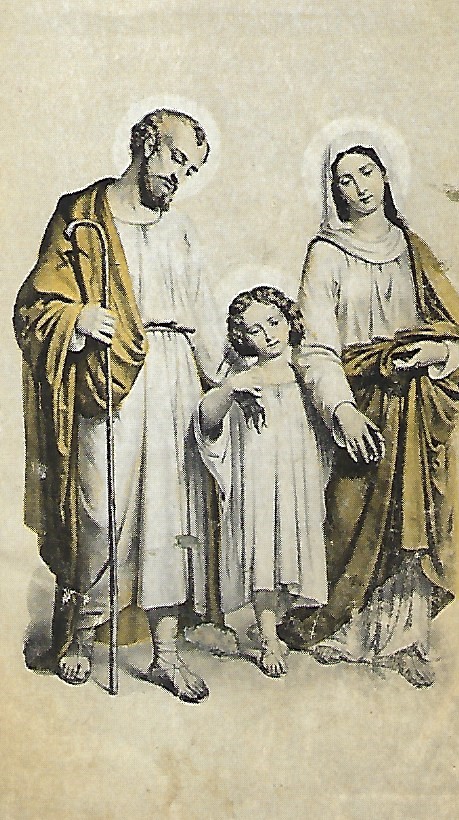
On this first Sunday after Christmas, we are invited to turn our eye to the Holy Family of Nazareth, a sensible thing to do, with the crèche not packed away yet, with members of our own family visiting us over the holidays, with gifts exchanged among family members on Christmas, making these days a perfect time to think about what being a family means to us. While the Scriptural texts today call our attention to Mary, Joseph, and the child Jesus, the focus of the day may be spent equally well in reflecting on our own family, a less-than-holy family, we would be quick to admit.
For some peculiar reason, sermons on this feast day often do the opposite, urging us to look at the family in Nazareth, especially in its presumed perfection, using that perfect family as a foil to our own imperfect families, guilting us into admitting the abyss between us and them.
Personally, I don’t find that approach to be either fair or true. The simple truth is that nothing we humans do is perfect and no family formed by human beings is perfect, including the family in Nazareth, since they were real people, just like the rest of us. And real people in the real world have real problems.
Listening to a sermon some years ago that listed the many virtues of the holy family, as if they were free of all turmoil or turbulence, no distress or disturbance ever in their home, the life in Nazareth as near to heaven as we can get on earth, I wasn’t sure what it offered us, ordinary people who face challenges in our families every day, heartbreak and heartache a common occurrence, families that understand that we are far from perfect, usually happy to get through the day without a major catastrophe.
As I listened to the preacher, his words painful at times, the picture he painted implausible most of the time, I looked around to see how many families could be squeezed into the prototype he presented to them, a picture-perfect family with a faithful husband, a loving wife, one child called Jesus, a family with Joseph the father sawing wood in his furniture shop, Mary the mother cooking lunch in her kitchen, and Jesus the boy moving effortlessly between the doorway that separated the two rooms. It was a Norman Rockwell painting for sure. The only thing missing was the dog.
With a cursory look around the circumference of the church, I concluded that none of our families fit smoothly into such a cookie cutter layout, especially with family now defined more often by bonds of love, less often by bonds of blood, and with hyphenation (single-mom, absent-dad, dual-income, blended-family, inter-religious, step-children, half-siblings, adopted-children, surrogate-parent, etc.) surely the norm, not the exception. I was left to wonder if any families today could measure up to those levels of virtue posed by the preacher and posited to the Holy Family. None I knew, at least.
But, upon further reflection and with a more careful look at the Holy Family of Nazareth, I concluded that maybe the preacher glossed over some inconvenient details that would have taken his talk a different direction, details that would have made the family life in Nazareth closer to our own family life than the cut-out, storybook version of family that was preached. As I saw it, there were some smudges on the picture that were ignored.
We only need to consider, for example, that the child Jesus was the result of a teenage pregnancy with disputed paternity, that Joseph hastily married Mary to minimize the scandal sure to spread in the corner barbershop, and that just about everything that could go south with his birth did go in that direction, including an out-of-town trip, a roadside RV park birth, a mad chase by the bad guys that forced them into becoming refugees in a foreign country, not to mention many a sleepless night with weird voices coming to them out of the blue. That, I feel, is a story to which most of us can relate, at least on some level.
The record would indicate that it really did not get any easier for the Holy Family, much the same as it really doesn’t get any easier in our families. We’re told that Mary and Joseph lose their twelve year old son on a trip to the big city, spending three days combing the countryside, searching the streets of the city, looking in all the places you’d think a twelve-year-old might be found, such as the video arcade at the Mall, finally finding him in the Temple, where he seems oblivious to the distress he has caused his parents, arguing that he wanted to stay where he was, with the same sass in his voice that we might expect from the tween living down the hallway in our own house.
While there isn’t much more said about the Holy Family as a whole in the Scriptures–except much later when we’re told that Mary and some close relatives have come to the conclusion that Jesus, now a tent preacher traveling the back roads of Galilee, has lost his mind, and so they go in search of him, determined to bring him back home until he gets back his good sense–it is enough to let us know everything back in Nazareth was not peachy, which should give us some comfort, since rarely are things peachy in our families, especially on rainy weekends or on Monday mornings or when our teenager misses his curfew.
Of special interest, particularly if we might want a fuller picture of the Holy Family, is a second-century text attributed to a writer called Thomas that wants to fill in some of the blanks for us. For sure, no one claims that the text is historical or factual, but it clearly intends to present the Holy Family as having many of the same problems that we have. These are the type of stories you might expect to hear a mom tell the future in-laws at Junior’s rehearsal dinner.
For example, stories about how Jesus butts heads with some of the neighborhood kids, especially the ones he doesn’t like, often using his super powers to win an argument, exhausting his parents who have to explain or excuse his bad behavior to the parents down the street, until the day when Joseph tells Mary not to let Jesus go outside anymore because the boy can’t control his temper when he is upset by other kids. Does any of this stuff sound familiar? It should. We see it almost every day in our own homes, except maybe when our kids are asleep for the night or gone to the grandparents for a week during the summer.
Refreshing if nothing else, these stories allow us to see that family life is never perfect and it is never holy, regardless of whether it is a family in Nazareth or a family in New Jersey. And yet, the beautiful truth we discover–if we just look close enough–is that God wants to join us in these messy places, where sometimes children become runaways, where plans for our children don’t go the way we want, and where misunderstandings, hurt feelings and bruised egos are an ordinary day in the ordinary life of an ordinary family.
That is precisely the point of Jesus’ being born in a barn in Bethlehem to poor people who had the same struggles we do. God comes to us where we are, not where we wish we were. As one wise writer admitted, “It’s very unlikely that those living down the road from the ‘Holy Family’ saw much that was extraordinary about them.” And right there is the breathtaking beauty of the Incarnation, God-in-flesh-and-blood, that he would feel right at home with the likes of us, imperfect parents with imperfect children with imperfect everything.
The real lesson, then, for us on this day when we honor the Holy Family of Nazareth is that just as God’s presence was found in the day-in, day-out, sometimes humdrum, sometimes hectic life of the family of Nazareth, so God can and must be found in the far-from-perfect situations that we find in our family, where we accept the lunacy of our Uncle Harold, where we ignore the loud-mouth of our brother Tom, where we forgive our mom for favoring our older sister over us.
So, surprising as it may sound, it is within the unholy family, with its mistakes, frictions, and challenges, that God is most likely to be found, urging us towards kindness and goodness, asking us to forgive one another, leading us to compassion and gentleness. He comes to us in the everyday messiness of our lives, and–for most of us–that means he’s there when an argument breaks out at the table, when we’re rushing out the door to get the kids to school on time, and when our teenager refuses to speak to anybody else in the house. We can expect to find God among us–Emmanuel– in the ups and downs of ordinary family life.
Some years ago, the writer Shirley Abbott wrote about her growing up years in the South. We find this quote in her book, “Within our family there was no such thing as a person who did not matter. Second cousins thrice removed mattered . . . We knew who was buried where. We all mattered, and the dead most of all.”
I like to think those words come closest to defining what a holy family is—it is a place where everybody matters. And that is, I like to believe, something God is trying to tell us everyday when he sits down with us at the kitchen snack bar as we eat take-out from McDonald’s. We all matter to him.
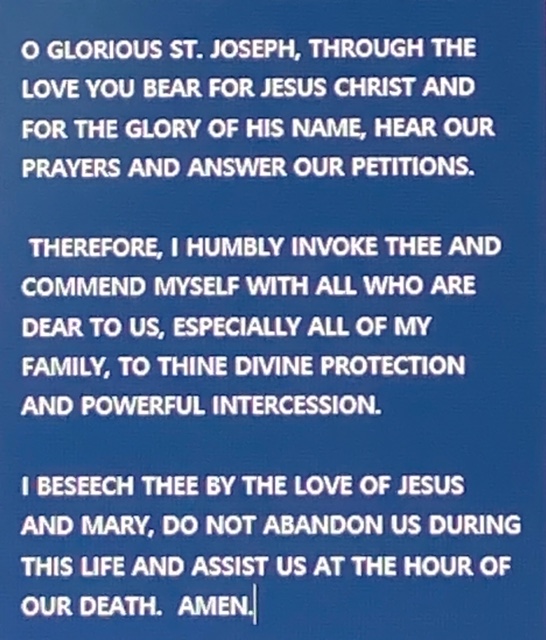
that my mother prayed every day.
—Jeremy Myers

 Sunday Brunch