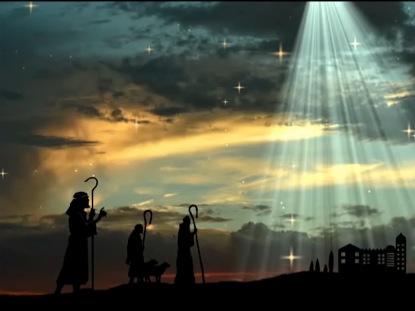
“Let us go, then, to Bethlehem” these shepherds said, one to the other, solitaries in the night watch, when the silence they knew so well–a monotonous quiet like too many other nights spent on the hillside, watchful even as their heads drooped to their chests from the deep-down tiredness of the long day behind them, with their sheep snoring in their sonorous sleep–was shattered by a sound above them in the silent skies, unknown and unfamiliar, the air crackling around them as though the wings of angels fluttered on the winds, as if a symphony had floated softly down to them, like so many delicate snowflakes dropping from the heavens.
“Let us go, then, to Bethlehem.” With these whispered words, these simplest of men, never free of the smell of the sheep they tended, set out towards the small village that slept a mile or more away, second-guessing themselves, unsure of what awaited them there, especially in the night when all shops were shut and all streets were silent, stillness before and behind every door, these men searching for a path through the darkness, stumbling as their feet caught on a slippery stone, standing again as they steadied themselves, secured only in knowing they must take the next step until they stood within the rickety rocked wall of this sleepy town.
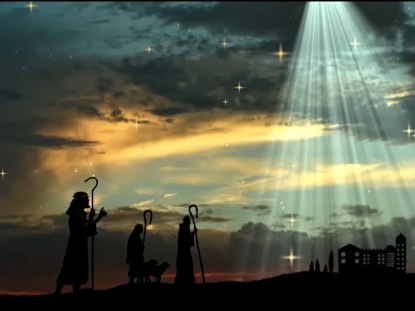
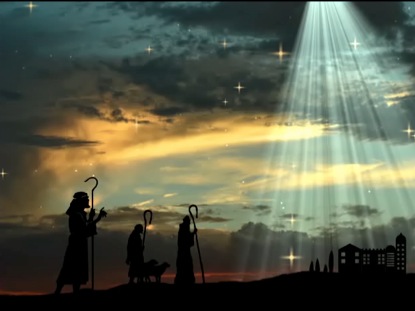
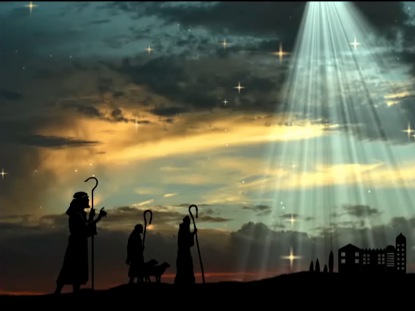
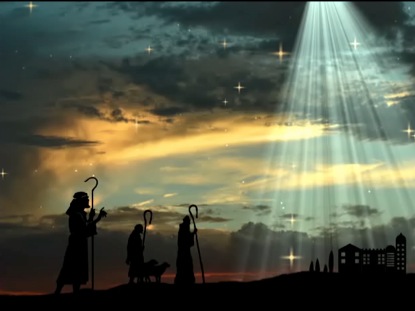
“Let us go, then, to Bethlehem” the breathless shepherds spoke, as they neared a lean-to stable on the outskirts of town, a silhouette seen only because of a singular star that shone overhead, rays bouncing upon this small spot in the universe, a smidgen of warm light sneaking through a crack in the cold door to earth, these night stalkers slowing their steps as they neared, now too shy to take another step, asking themselves if they had only dreamed those words each swore they had heard back on the hillside, wondering what the sign was that had been assured them when the skies were peppered with light and had popped with sound.
“Let us go, then, to Bethlehem.” First one, then another walked into the unsteady shelter, until all had passed through the doorway, the ones in front coming to a sudden stop, while the ones behind stood on their tip toes to see what the others might be seeing, this thing, shattering the silence of the night, opening the moonless skies, this thing, a promise, a prayer, an impossibility in a war-torn, bone-weary, dead-tired world, where every day was a repeat of the day before, where tomorrow was sure to be no different than today. “What,” they asked themselves, “awaited them, in that place?”
“Let us go, then, to Bethlehem” they had told themselves, and now they stood, surrounding a crib filled with straw, on which a newborn baby rested, his small hand held near his mouth, his clear eyes staring into the depths of their souls, with his lips forming the smallest of smiles, seemingly unsurprised by these strangers, while he gurgled a few sounds that may have been a welcome of sorts to them, surely a warmth in the shed that came more from the child than from anything else in the night air, inviting one after another of the shepherds to come nearer and to see.
“Let us go, then, to Bethlehem.” No longer on their feet, somehow on their knees instead, the shepherds spied upon this new life that squirmed before them, so delicate, so precious, so special, some of the men dropping their eyes as the tears dropped to the earthen floor, others blowing damp noses into rags they held in their hands, most all finding a lump in their throat, a catch in their breath, and a tightness in their chest as they knew in their hearts that nothing would ever be the same, not in the world, not in the heavens, not in them, as if the earth itself had shifted on its axis, throwing everything and everyone off balance.
“Let us go, then, to Bethlehem.” The shepherds, toughened skin and just as tough hearts, watched as the young mother leaned over the crib and brought the whimpering child from the animal crib into the crib of her arms, holding him close to the beating of her chest, looking into his sinless face, and, then, standing, held out the child to the one nearest her, placing the divine life into the arms of him who shook as his muscled arms embraced an innocence he had not known in years, touched a beauty he had not found in the world, saw a goodness he had not known existed. And he held that stainless soul tightly, not wanting ever to let him go, fearing the world so full of wrongs would wreck this fragile life now in his arms.
“Let us go, then, to Bethlehem.” One after another of the men similarly opened their arms to this beautiful life before them, until all had held him in their own hands, their hearts creaking open like a door shut for too long, each of them finding a tenderness in their stone-cold hearts that had been lost for years, each seeing himself reflected in the child’s eye, a reflection that seemed not to carry the stain or soil or smudges on their soulless faces only too familiar to them, but instead a hitherto lost inner beauty that found itself once again on the face of each man, as the holiness of the child changed the unholiness of the one who held him, as the goodness of the baby resurrected again a goodness long dead within each of them, as the hope wrapped in this new life now opened a hopefulness they had vanquished for ages.
“Let us go, then, to Bethlehem, to see this thing that has taken place.” So we speak to one another on this day, for where the shepherds stood so long ago, we stand now, gathered around the same crib, in our own Bethlehem, seeking to find that which they found in that place, soul-weary as they were, also worn by a world too far from heaven, hoping still that the same promise first made to them is made anew to us, a promise that was heralded on that holy night when the light broke into the darkness, when the godly touched the ungodly, when the holy embraced the unholy, when the heavenly kissed the earthly, this promise spoken to shepherds in fields and now to us who live in our own fields, a promise that refuses to die even now– the promise that God is with us.
–Jeremy Myers

 Sunday Brunch