“When Joseph awoke, he did as the angel of the Lord had commanded him and took his wife into his home.” (Matthew 1.24)
Back in the day, I usually ended up playing Joseph in the school Christmas programs. As I recall, getting the part of Joseph didn’t cause the same buzz for us boys as grabbing the part of Mary did for the girls in the classroom. There always seemed to be more prestige in the Mary role, as well as more lines to memorize.
Remembering those occasions in my past, long lost feelings conjured up out of oblivion, I empathized with the little boy who more recently had the same role. When he was asked which part he had in the Christmas program, he answered that it was a small part. He admitted that he had hoped to be one of the three kings, or at least a shepherd. He even would have taken the part of one of the animals in the stable. But, as he said, he was small for his age, so the teacher made him take the part of Joseph. “I don’t even get to say anything,” he said.
As that boy made clear, the part of Joseph in the Christmas story often seems to be a bit part, always overshadowed by Mary, nor as impressive as the Magi from the East, wearing those bright gold crowns, his a role without a cool costume like one of the sheep or camels. At most, Joseph gets to knock on the door of the innkeeper, but who is shouted away before he can get out a word.
Joseph—the real Joseph—gets overlooked and underestimated, not only in school programs, but in Scripture as well. The writer Matthew is the only one that seems to give him any attention in the telling of the Christmas story, but even here Joseph says nothing. In fact, there isn’t a single word that Joseph speaks anywhere in the whole of Scriptures. After the Christmas story, he doesn’t show up again, with the exception of the lost son in the Temple story. In later stories, he gets mentioned only when people refer to Yeshua as “the son of a carpenter.”
So, there is something right and just about Joseph occupying the front and center role in the gospel today, at least for this brief moment before Christmas. As we know, once Christmas begins, he will be shuffled to the side or, at best, will stand silently in the crèche with his head bowed. For a few moments now, we can take a closer look at this silent man who is, in fact, the second disciple, following closely behind his wife, Mary.
A disciple, as we know, is someone who listens to the word of God and who then does what God wants of him or her. Mary earns her title as the first disciple because her answer to the angel’s invitation to become the mother of God’s only son is “Be it done to me as you say.” Joseph earns the title of “disciple” for much the same reason.
The man named Joseph listens to the word of God that comes to him in a dream in the dead of night, and then he does exactly what God has directed to do. He marries Mary, although she is carrying a child that is not his own. He ignores the Hebraic laws that would have him announce Mary as an adulteress, resulting in her being ostracized, if not stoned to death. Putting aside his own reservations or personal desires, he follows the instructions that God has spoken to him.
For this reason alone, but surely for others as well, Matthew describes Joseph simply as “a righteous man.” That’s all he says. But that may be all that needs to be said. A righteous person is someone who always does the right thing. Whatever the circumstances, whatever the challenges, a righteous person chooses to do what is right and good, avoiding the easy way out, adhering to inner principles that are not compromised, principles that always point to the right way.
With that simple description, we come to see that Joseph is an exemplar for those of us who also want to be a disciple of his son, the Galilean Rabbi, who was born in Bethlehem as the Word of God in flesh and blood. In this way, Joseph exemplifies the disciple who is not a mere passive listener to the Word. He is an active doer of the Word. And that always is the mark of the true disciple—the one who does what the Word-Made-Flesh asks us to do in our time and in our place.
Joseph, then, is the disciple who is known not by what he says—since he says nothing—but by what he does, the disciple who is guided by God’s word to do the right thing in the circumstance in which he finds himself, not wavering, not reconsidering, not compromising, just following through. And in his actually doing what God has asked of him, he becomes that righteous person that all of would like to become.
As Christmas draws closer—just days away now—we can allow ourselves a few moments to look more closely at Joseph, the second disciple, and learn lessons in life from him before he is overshadowed by the other, more prominent characters in this Christmas pageant, those who have things to say and those who seem more interesting. When we finally give Joseph more than a cursory nod of the head, we may discover that he is far more than just a bit player in God’s plan.
The writer Walter Wangerin clearly understands this truth when he has Mary speak of Joseph to their son in the book, “Jesus.” Mary is remembering the day that Joseph came into her life. Here is how she tells the story to her son, Yeshi, when he is twelve years old:
“One morning my father came to me puffing his cheeks. ‘None of the young ones fancy you,’ he said. ‘So,’ said my papa, suddenly breaking into smiles, ‘we have arranged or you to marry an older man, a good, reliable man.’”
“Joseph the carpenter could have lifted ten of me in one of his strong arms. Joseph the carpenter came to our house and blushed . . . truly it was the blush that made me like him. I surprised myself. Me, I was going to outshine any man my father would bring, outthink him, outrun him, outtalk him. Talk the poor dope dizzy!”
“But this man, this Joseph, actually listened to me. And nodded, paid attention, never interrupted. Never, in fact, felt the need to talk at all. Well, and in the months to come his huge hands touched me only on my elbow by the tips of his fingers. That made me like him. And on the day of our betrothal he wept and smiled together, big drips at the end of his nose.”
“That, too: I liked him. But love him? Oh, Yeshi, what made me love him was that, never minding I was pregnant, Joseph refused the rules and all the laws, and married me anyway, married me as I was.”
As we see in Mary’s words, God had good cause to choose this man Joseph for a primary role in salvation history. God knew well that Joseph would be a doer, a person who would do the right thing, even in the most difficult situation. And so, the evangelist, Matthew, in retelling the same story, sums it up beautifully in one sentence, “When Joseph awoke, he did as the angel of the Lord had commanded him and took his wife into his home.”
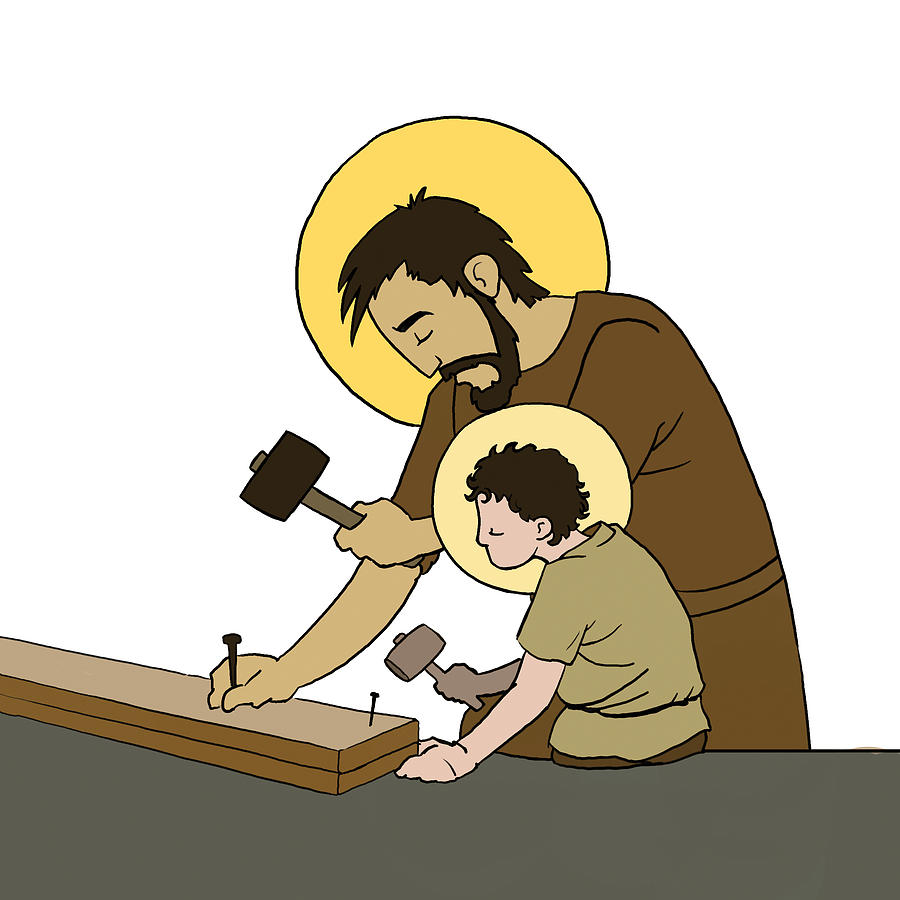
—Jeremy Myers

 Sunday Brunch