As a small child in a small school in a small town, life was simple. Except when the old nuns from Switzerland who taught us insisted each year at Christmas that we learn to sing “O Christmas Tree.” The problem was not with the song, but with the insistence on the sisters’ part that second graders learn the song in its original German. Still struggling with English at this stage, now we were being asked to sing the three verses of “O Tannenbaum” in this strange tongue, not far removed from asking a dove to coo in Gaelic.
It was not the first time the good sisters set a language challenge in front of us. The same thing happened when we second graders—at least the boys—were expected to learn the Latin responses to the prayers of the priest at Sunday Mass. Looking back, there was an element of absurdity, combined with a tinge of comedy, in the silly notion that little kids had to memorize meaningless Latin responses that nobody in the world understood, while the grown-ups knelt in their pews, passing the time thumbing their rosaries, catching a Latin phrase or two floating overhead like a gang of clucking geese. Still we did it.
And it was the same with “O Tannenbaum.” We sang through the German clutter of words, uninhibited as only children can be, talented to various degrees, convinced we were wunderkinds from Bavaria on tour through the states. Looking back, I am quite sure we were not proficient in anything but enthusiasm. Still, when the afternoon of the Christmas program came, the old sisters smiled profusely and the young parents clapped loudly, although we didn’t have a clue as to the content of the carol. I doubt if any of the adults were any wiser than we were about the words.
Certainly upping the challenge, rightly assuming that we couldn’t read German any better than we could read English, no one provided us with a printed page of the song, relying instead on a child’s power of memorization, a skill honed by memorizing the alphabet, further tested by remembering all the classroom rules, and advanced by calling colors by their right name. It is a lot for a child to remember. Having no choice but to memorize the unintelligible German words, we proceeded as we did with everything else that was required in second grade, with blind obedience and without second guessing. Childhood, as we know from long personal experience, is made up many do’s and don’ts,
“O Christmas Tree, O Christmas Tree, your branches green delight us! They are green when summer days are bright, they are green when winter snow is white. O Christmas Tree, O Christmas Tree, your branches green delight us.” Sung in English, the song would have made sense, whereas in German it was a regurgitation of words that sounded like clattering cars on a freight train. If children still are expected to learn the Christmas carol, I am fairly certain it is with the words in English, not in German, unless the kids are in Munich.
Along with dark brewed beer and Black Forest cake, German immigrants brought the Christmas tree to America, not just the song, but the tradition of the holiday tree. The Puritans, always such sour-pusses, did not allow the singing of carols or decorating of trees at Christmas, fearing contamination by what they considered pagan practices, wanting no distractions from what they called the sacred event. So serious and so severe and so sober were the Puritans that a person could be thrown into the stocks for putting up anything festive on Christmas. Years later, Dickens popularized the phrase, “Bah Humbug,” but the Puritans had been living it for hundreds of years by that time.
The Germans, unencumbered by Puritanical sobriety or by tyrannical anxiety, carried their tradition of a Christmas tree into their homes on these far shores in the early 19th century, decorating the trees with lighted candles and with various fruits. When Queen Victoria married the German prince, Albert, the Christmas tree made it into the royal palace, quickly jumping across the pond, gradually making its way into every American home, eventually becoming such a part of Christmas in this country that anyone without a tree was considered a Scrooge or a Satanist.
Being the child of just such German immigrants, my grandmother always had a Christmas tree, placed in the parlor of her farmhouse, decorated with nuts and candies, enjoyed by all who saw it, especially her children and their cousins who were allowed to pick pieces of candy off the tree to eat. Carrying memories of her Christmas tree with them through the decades, her grandchildren still speak in solemn sounds of it, aged eyes lighting up as they see it again, smiling with wrinkled faces as they speak of sweet childhood memories beneath Grandma’s Christmas tree. Reflecting on those bygone holidays, there is a reverent tone to their voices, something you’d expect to hear in a church, not around a dining room table, a clear sign it still is a sacred memory.
Growing up with that Christmas tree in the farmhouse as a cherished part of her childhood, my mom loved Christmas trees, favoring the real tree that came out of the woods, not liking the fake tree that came out of a box, claiming she needed the smell of a real tree, a smell she hoped would swim from room to room with her like salmon in summer streams. Raised in West Texas, she didn’t allow the scarcity of trees to stifle her Christmas spirit, turning the scarcity into an afternoon scavenger hunt, much like seeking a water park in a desert.
Hearing our constant childhood inquiries about when we could get our Christmas tree, showing immense patience even on the hundredth call, she would tell us that we had to wait a while because real trees would not live long after they were chopped down, explaining to us that dry needles would fall off the tree, turning the tree brown and barren.
As the days drew closer to Christmas, aware that we were about to pop with impatience like a tick with blood, she would tell us to get into the car and she would drive us to a nearby stretch of near desolate ranch land where the search for the perfect tree would begin, a search consuming hours, each of us scattering across the rocky terrain, looking for that few and far between evergreen tree, recognizing flaws in the scrawny ones we found, shooting us in a different direction in the hope of still finding that perfect tree.
I have since wondered who owned the ranch land where we did our Christmas tree “shopping.” My brother, older and wiser, assures me our mom probably asked the rancher for permission. As children charged up with Christmas energy, we weren’t detoured by adult details such as property rights, believing the whole area as far as our eye could see was ours to scour, racing across the rocky terrain with singular intent. Propelled by a propensity to be the first and the best, we wanted to be the winner, beating out the others in finding that year’s Christmas tree.
Intermingled with the many memories of those tree searches was the year we thought we had lost my brother somewhere in that empty landscape. As the oldest in the family, he was granted greater liberties and he took them. Also, it always was assumed he knew what he was doing, which generally proved to be true, even now. Firstborns tend to get more than a fair share of the smarts in the family.
His absence became clear as the clock ticked and the sun began its descend in the west. He had gone his own way, searching for the right tree, going it alone, telling no one which way he went. Waiting for him to return, we fought back concerns that he was lost somewhere in that lonely landscape, hoping he was using his scout-trained mind to find his way back to us. My mom, always a pillar of strength like one of those columns in the Coliseum in Rome that has stood for centuries, comforted the rest of us, assuring us that he was not lost, making promises that he would return.
Our fears rising as the sun was setting, his little figure was spotted walking our way, showing no sign of worry, perplexed that we were perplexed. These years later, I still can feel the relief we felt when we spotted him in the distance, moving towards us, making our world right again, returning joy to our Christmas adventure. When asked more recently if he remembered that day, he said he did not, making more credible the likelihood that he was not lost. Kids who genuinely are lost, whether in a grocery store or in the woods, easily recall that scary time in their lives.
When the right tree was found, my mom brought an ax to the task, chopping steadily on the trunk, our eyes watching intently, each chop bringing the tree closer to becoming our Christmas tree. As my older brother got older, he chopped down the tree, while my mom watched. Later, when my younger sisters were the only ones still at home, they would go and do the honors. Hoisting and heaving, we would tie the tree to the top of the car, using heavy rope, utilizing some of the fancy knots we had learned in scouting.
Something interesting happened to the perfect tree on the way home. Once it was unloaded and stood up in the yard before bringing it into the house, it never looked as perfect as it did in its natural habitat, now seeming unshapely and unruly. No matter. My mom would send us to my dad’s workshop for some baling wire, twisting and turning and tying and tucking the wire between the branches until the tree had a good shape again, not unlike a plastic surgeon snipping and stretching and smoothing and sewing skin to make a face look youthful again.
Searching again in the shop for an empty five gallon can, we’d heave the tree up and place it into the bucket, securing its base with dirt from a nearby field. Next, we joined forces as we picked up tree and bucket to bring them into the house, not easily done, accusatory grunts and inflammatory words sure to result from the effort. My mom let us choose where to put the tree. Unlike others who thought there was only one place for the tree, she saw many places in the living room as possibilities. As a result, the Christmas tree stood in near every spot in that room at one time or another. Some seasons, it would be moved to a different place, like a girl changing into different dresses before her big date.
Another funny thing happened to the tree on the way to the living room. It grew. What looked small outdoors now looked large indoors. I don’t recall a single time when the tree we brought in was too small. Often, it was too large, especially for doorways, but we huffed and puffed and stuffed until the tree was inside and in its place. We had the scratches and the scraps and the slices on our skin to show we had shoved the tree through the door, much the same as squeezing and squashing and strapping a baby elephant into a child’s car seat.
My mom wasn’t finicky about decorating the tree, believing that the whole purpose was not in achieving beauty, but in allowing us children to have a fun time. For the early years, we didn’t have fancy decorations or heirloom pieces that were wrapped carefully and stored away year after year. In later years, we started a tradition of each family member having a personalized ornament on the tree.
Back then, we would pop popcorn on the stove and make popcorn ‘garlands,’ using needle and thread to bring the popcorn kernels together into long white strands that surrounded the tree. She welcomed any homemade art work that we had made in school and had made on our own. She preferred multi-colored lights, our breaths halted as she plugged them in and our eyes dazzled as the lights burst forth with all those bright colors.
It was the same every Christmas for all of our childhood. Nothing changed until we changed, with the boys growing up and moving out, with the younger girls left at home, chopping and hauling a tree back, a tradition as rooted as one of those trees in that rugged and rocky terrain. With all of the kids gone from home, my mom depended on one of her sons-in-law to chop her tree each year, which he did for many years, the same way we had done, using the same bailing wire to bring the tree into shape.
One Christmas, my mom, now old in body, but not in spirit, seemed to have more than the usual respiratory complaints, her chest congested and her breathing labored. Making a visit to her doctor, she came back with the sad news that he had told her that the real Christmas tree had to go, her body reacting to the pollen on the evergreen, her lungs taking in these toxins with each breath. The same air that carried the woodsy scent of the evergreen that she loved also carried the particles of pollen that aggravated her allergies.
Seeing the sadness in her eyes and hearing the heartbreak in her voice, one of my sisters hurriedly drove to a nearby city to buy a “store-bought” tree, something never before seen in Mama’s house, removing the “real” tree and replacing it with the “fake” tree. All the familiar decorations went on the fake tree and the lights shone just as brightly on it, but the smell just wasn’t there. You can’t buy the smell of a real tree, regardless of how it is peddled in wax pellets in a package for wall plug-ins.
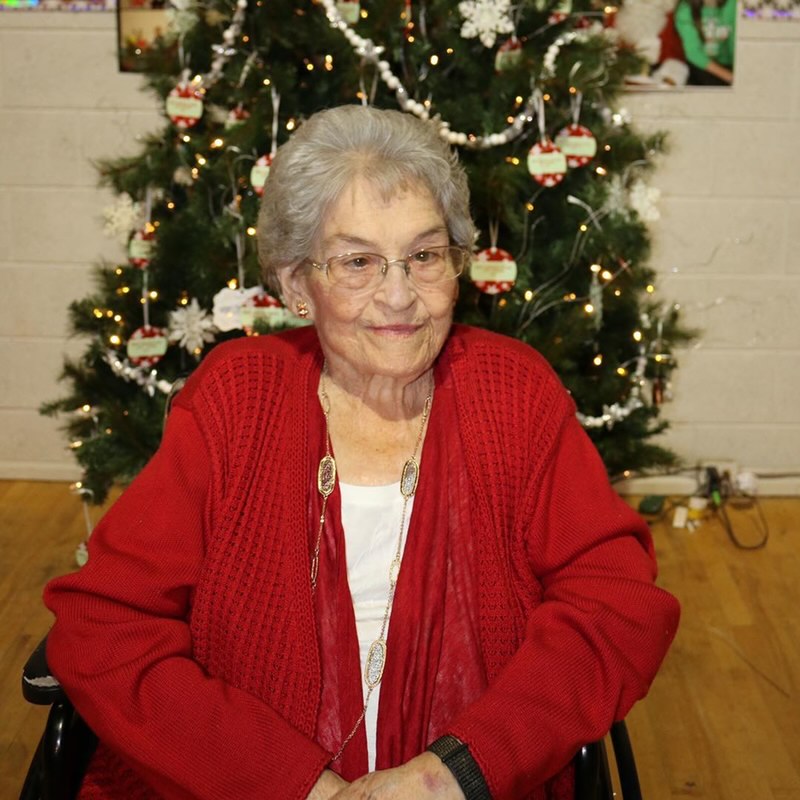
Her last Christmas with us, although we did not know it then, my mom sat in her chair in the living room, her Christmas tree positioned so that she could see it easily, colored lights sparkling on it, a store-bought base beneath it turning like a merry-go-round, bringing her the same joy that every Christmas past had brought her. I am sure that as she looked at the tree, she saw—not just this tree—but all the many trees she had chopped with her children on that ranch land along the South Wichita River all those years ago, and I like to believe that those memories brought her even greater joy.
O Tannenbaum, O Tannenbaum, Wie treu sind deine Blatter! Du grunst nicht zur Sommerzeit, Nein, auch im Winter, wenn es schneit. O Tannenbaum, O Tannenbaum, Wie treu sind deine Blatter!
—Jeremy Myers

 Sunday Brunch