“If you are the King of the Jews, save yourself!” (Luke 23.37)
As he waited for his wife to come out of the office where she worked, his eagerness to call it a day apparent in his face, the not-old, but not-young man used the minutes to wipe off the water from his new black compact car that he had just washed. He hoped his wife would be on time.
As he moved the cloth across the hood of his car, he saw a stranger come his way, his clothes sloppy and stained, his beard scruffy and stain-colored, with a face hardened from a life lived hard. “Just what I need,” the man thought to himself, as he tried to mop up more of the drops off the car, moving to the back to rub down the rear bumper, keeping an eye on stranger with the beat-down-by-life look coming his way.
Today wasn’t one of those days when he felt generous, just tired, and not in the mood to be bothered by some scammer looking for a buck or two. He’d made up his mind he wasn’t going to give the bum anything anyway. The man opened his trunk, threw in the wet rags, closed it, and walked around to the side of his car, just waiting for the stranger to give his pitch for a few pennies.
But the poor man said nothing, just sat down on the curb near the bus stop, although there was no way in the world this guy had money for a bus ride. As he sat on the dirty and trash-stained sidewalk, the stranger looked at the his car and said, “You’ve got a nice car there, man.” His voice was level and clear, no sign of a smoker’s cough or a drinker’s rasp in it. Almost normal, the guy with the nice car thought to himself.
“Thanks,” he said to the stranger, still waiting for the inevitable start of a story that was sure to end in a solicitation. But nothing more was said and there was no sign anything else was going to be said, as the poor man lowered his head to stare at his over-sized shoes with their untied laces, likely picked out of a dumpster, not out of a store. The silence ate at the guy with the car, the silence so strong he could hear the small voice in his soul that he never liked to hear saying to him, “Ask him if he needs some help!” But he already knew what the answer would be.
Taking a breath, hoping to shut up the guilt gaining more of his soul space, he looked at the unkempt man on the sidewalk and said, “Do you need any help?” The other man looked up at him with clear eyes from his place on the curb and he spoke three short words. There was no long story designed to get pity, nor did he open his dirt-covered hands in the hope of getting anything. All he said was those three small words, but they were enough to stop the other guy in his tracks. The poor man said, “Don’t we all?”
And with those three words, “Don’t we all?” the bum leveled the playing field and put the other guy right on the curb beside him, if not physically, then materially. The man with the car, a second or two ago feeling so superior to the bum on the street, saw in an instance that his self-interest and his self-importance were shields to the truth, a self-protection that the bum had removed with three words from his calm and pensive voice. “Don’t we all?”
The man with the car reached for his wallet and gave the bum with the dirt-crusted clothes money for the bus, money for a meal, and money for a place to spend the night. Those three words wormed their way into his soul and shook him to his shoe soles. “Don’t we all?” It was one of those rare moments in life when something important becomes really clear. “Yes,” he thought, “we all need some help.” He hoped he’d never forget it.
This same truth was taught and was lived by the Galilean Rabbi, who saw the helpless and the hapless and the hopeless as his brothers and his sisters and his kinfolks, and with compassion and with generosity he helped them in whatever way he could. He fed them. He clothed them. He embraced them. Unlike everyone else who had nothing to do with the cast-offs and the down-and-outs of the world, he listened to them and he loved them. Why? Because we all need some help in this ruthless and sin-ridden world.
And for this he was crucified, first in word, and then on wood. The Teacher was criticized for his walking and talking with the wrong kind of people, and when the criticism didn’t change his mind, the people with all the power nailed him to a cross and, as an afterthought, tacked a sign above his blood-soaked head that read, “King of the Jews,” a snide inscription that was pure mockery born of pure snobbery.
While the life of the crucified one bled out of him drop by drop, the self-righteous rulers sneered and said, “He saved others, let him save himself.” Soldiers who had lost their souls on the battlefields of life jeered, “If you are the King of the Jews, save yourself.” And were that not enough, a thief on the cross next to his added his own insult, “Are you not the Christ? Then save yourself and us.”
“Save yourself.” Here would be the last temptation for the Teacher as his last breath drew close, to succumb to the ways of the world, where saving oneself always trumps saving others. Would the world win yet again? But, in that moment, there was a solitary voice in the crowd that spoke different words, first to the convict, and then to the condemned Teacher.
This voice came from the other criminal crucified on that hillside graveyard, a man who saw something in the so-called King of the Jews that the others in their rabid thirst for blood could not. “We have been condemned justly, but this man has done nothing criminal.” Then he turned from the selfish one to the selfless one and he said, “Rabbi, remember me when you come into your kingdom.” The Teacher quietly spoke to him, “You will be with me today in Paradise.”
Everybody got it wrong except for the one poor soul who saw something in the Rabbi nobody else could see, all these other people puffed up with their self-importance and blinded by their self-interests. He saw that the real sign of power is not in the one whose hands hammered the nails, but in the one whose hands were nailed to the beams. This low-life con with the long rap-sheet saw crystal clear what everybody else with so-called clean sheets missed. The true king is the one who saves others, not the one who saves his own a**.
And so it was right that the King on the cross would save still another soul at the end of his life, as he had done all his life long, promising Paradise now to the thief who saw that saving oneself is not God’s way, but man’s way. He was an other-worldly king, one that gave away his life, not one who took lives. This was the Rabbi’s last lesson, done from a wooden cross, a wooden platform of a different sort. He showed again that while the only game in town is looking out for one’s self, the only game God knows is looking out for others.
And it is that same reversal of the world’s ways, lived everyday by the Holy One, that he asks his followers to live, a reversal that will become the fight of their lives if it is lived well. In a world with kings who rule with self-interest, self-preservation, and self-importance as their only thought, can the message of saving others instead of oneself make its way into this quagmire of self-serving schemes and in this quicksand of selfishness? Those who try can expect to find the same sneers and jeers as the Rabbi did. The kings of this world do not abdicate their thrones quietly or humbly.
Yes, the Galilean Rabbi, with that blood-splattered sign above his head, “King of the Jews,” is a king unlike any our world has seen, then or now, one that does not put down the powerless, but lifts them up, a king that does not rant and rave against the weak and the poor, but who puts clothes on their backs and washes their dirty feet. He is a king whose first concern is to save others, and his last concern is to save himself.
That image of the king on the cross stirs our hearts and pricks our consciences, as we stare upon his beaten and bruised body, a simple but profound message staring us in the face, calling us to our better selves and asking us to do as he did—to put ourselves out there for others, not to put ourselves out there only for our own ends. That confounding way of life will stand a chance in our world only when self-interest dies on the cross of selflessness.
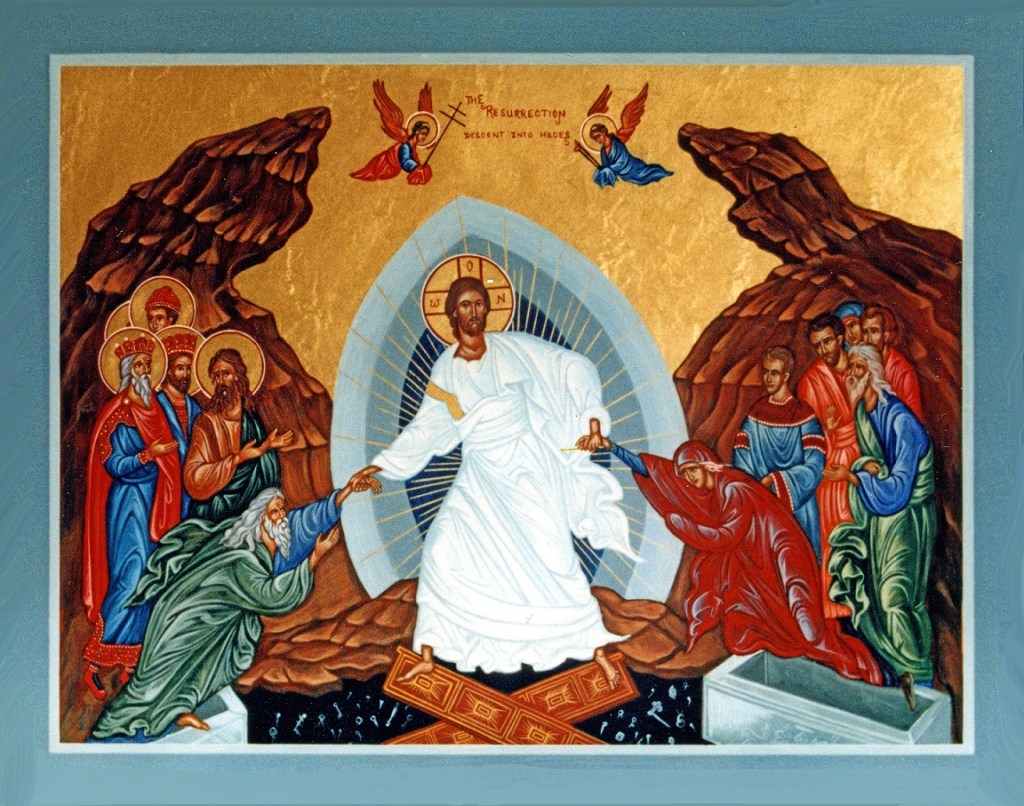
Some years ago, a couple went on a cruise that took them on the Black Sea. While on their trip, they had the opportunity to visit a number of Greek Orthodox churches and monasteries. Upon their return, they brought back with them a photograph of a particular icon in Istanbul that had caught their eye. The icon shows the Crucified Yeshua bar Yossef, his cross shattered on the ground, his hands reaching out to two people who have been locked in their tombs. On one side, he grabs the hand of Adam. On the other side, he grabs the hand of Eve.
That icon needs no words to speak the same lesson that the Rabbi lived on the roads of Galilee and showed from the cross. The message is clear. The King of the Universe does not save himself. He saves all of us.
—Jeremy Myers

 Sunday Brunch