A tall mulberry tree old as the hills stood alongside a curve in the road to tell us young boys we were on the home stretch. The tree signaled to us, standing watch like a sentinel in the night, as we walked past it on our way back from the river. Over the years, and with many mutual nods of the head, it had become our friend, our trusted ally, our road marker that told us we were halfway home.
Seeing the tree, we also knew the final leg was uphill, just as the walk to the river had been downhill. Young boys that we were, the climb scarcely was felt on our bare feet, as we set our eyes on the small town around the curve where people who loved us waited for us to find our way home after hours of play at the river.
Then, one day, the mulberry tree flagged a warning to us, like an orange-vested workman on the highway would do. A stout silhouette, it signaled to us with its branches–now arms waving back and forth in the wind–these words, “Not all boys will make it home.” It was a sudden and a scary change in information. Never before had the tree signaled any such warning to us.
Afterwards, we never looked upon that tree in the same way. It was as if the tree had become a traitor. However, the terrible threat that the tree promised on that day echoed inside our heads until the old tree died years later. We were not sorry to see it leave us. We had said goodbye to it years earlier.
Perhaps it was old age that took it away, or–just maybe–the tree felt down to its roots the fear deep in our own bones as we raced past it. The tree, as a last act of kindness, left us so that we might forget that it once had stood there on that spot. Men pulled its roots out of the ground with a tractor and put its dead limbs into a makeshift bonfire.
The problem was that its removal did not erase the reminder of it. It was not until grown-up concerns weighed heavy on our minds that we could bury that mulberry tree in the grave of youthful memories. Then, the last trace of the young boys we once were was gone. But that would take many more years.
Few probably remember the mulberry tree anymore. Only gray-haired people who would sooner forget. No one tells its story these days. Where it stood, a plowed field now stands. It would be difficult even for us who knew it so well to tell another seeker exactly where it stood. Maybe there is an old photograph somewhere that could help us map its exact grave.
Yet, even today, near half a century later, there comes a rare evening, as dusk draws near, and as the headlights of a car brings the curve into view, when a person’s mind likes to play a trick, and we might think we see the shadow still there of that old street orator. As we round the curve, we slow the car, looking into the darkness, but we see nothing.
The first century Roman poet, Ovid, recounts a still older story of two young lovers, Pyramus and Thisbe, whose parents forbade their love. The lovers agree to meet one night underneath a mulberry tree, where Thisbe arrives early and Pyramus arrives late. The girl leaves and the boy, when he arrives, believes Thisbe has been killed by a lioness he sees nearby. So, because he has lost the one he loved, Pyramus stabs himself with a sword. His blood splatters on the white mulberries hanging on the branches of the tree.
When Thisbe returns later, she finds her lover dead and she kills herself with his sword so that they might be together again. According to the ancient text, the gods changed the color of the white mulberry to red-purple to honor their love. Anybody who has stepped on a mulberry on the ground, or smashed it in their fingers, knows its juice is blood-red. The stain is almost impossible to remove.
In another place, and in another time, and north of another mulberry tree with the same fruit flowed the Brazos River. The distance between tree and river was about half a mile. The tree, should it have desired, could see from its heights the banks of the river that short distance away. The Brazos was given the high-minded name “The River of the Arms (Brazos) of God” by early Spaniards in Texas.
The name burdens it with a lot to live up to, what with its shallow beds and short banks. Sometimes you can find a few fishing holes here and there as it flows on its southeastern trek to the Gulf of Mexico. But it takes a lot of hard rains upstream–a rare event in West Texas–for the river to have any reason to boast of its might.
When immigrants from Germany settled in our part of Texas in the late 19th century, they liked to say it reminded them of the Rhine River in their homeland, although that had to require a stretch of the imagination. Still, the Brazos indisputably has its own beauty, even if on a less grand scale. And it is so much a part of who these pioneers would become–and who we are today–that to take it away from us would be to reinvent our history and replace our persons. It is our river, at least this mile or two of its near 1300 miles, and we remain proud of it. Perhaps poor in water, it is rich in sentiment.
A mile away from our small community, as young boys we’d walk on the side of the little-traveled highway to get to the Brazos River. It was our favorite playground, our amusement park. Often we walked there on bare feet, which required we stay in the ditch because the asphalt was too hot. If it was a summer day and if there was any water in the Brazos, we might splash around in the burnt-orange puddles it provided as it slowly snaked its way south.
A bridge stretched across its width, a stretch of highway suspended on sturdy concrete pillars. We often looked over the sides of the bridge to see what we could, which usually was red sediment. For boys surprised by most anything, we’d see an occasional carcass of some animal, especially if the waters had risen. A tied burlap sack could be found once in a while in the water. We never opened it because we feared—rightly—it might be baby kittens put there to drown. Sometimes, we’d see signs of life—deer, looking for a drink of water; snakes, wanting to sunbathe; swallows, swimming in the air since they didn’t like to swim in the water.
Once underneath the bridge, we’d slide down the slope until we were on level ground. We’d have to hold a barbed-wire fence up with our skinny arms so that each of us could pass through safely. Sometimes, we’d get pricked by one of the barbs, enough to draw blood, but not enough to make us turn around. Looking up, we could see hundreds of mud nests sticking to the underside of the bridge, upside down igloos made of dirt instead of ice. The renters who lived in these mud-crusted apartments did not like visitors. Swallows–like humans–we learned can be unfriendly when annoyed.
The bank of the river was a little further to the North, if we entered by way of the South, or to the South, if we entered by way of the North. Both were accessible entrances, although we preferred the North entrance because it had better worn paths through the mesquite and willow trees that grew along the edges. Sometimes we took the south entrance because it was closer. Since we were boys, we weren’t bothered all that much by how many footsteps we had to take. Also, it always was fun to cross the bridge. Everything, for a boy, is part of the adventure.
As we grew older, we carried fishing poles with us, but that depended on if there was water in the riverbed and if there were fish in the water. We didn’t have a rod and a reel. For some of us, that would come later when fishing turned into an adult thing. For now, the bamboo poles we broke off from the patch in our grandma’s yard worked, and these poles synced well with the silliness of throwing a string overhead as far as we could, with a weight and a hook dangling from the end. Sometimes it hit the water. Other times it hit one or another of us. This, too, became a great game of dodge ball.
We didn’t go to the river only when we wanted to fish. More often than not, we went there simply because it was there. It offered possibilities limited only by our imaginations. We fought battles on the slopes, played king of the mountain on the banks, floated on our backs in the shallow waters, searched for arrowheads in the dunes, chased snakes and just about anything else that moved, and muddied up our clothes so much so that the stains stayed after countless washings. White underwear was never the same. Not that boys cared.
That river was our sanctuary. It is something only a boy can understand. There, we were away from the supervision of parents, away from the smiles of girls, away from the strictures of right and wrong. We were our own bosses, which meant we made the decisions, and we followed our own rules, which meant there weren’t any. When we had disagreements—a necessary part of a boy’s life—we argued about it for a while, and then we went back into the water. On rare occasions, one of us would take leave of the group after a skirmish and would walk the mile back home alone.
Almost always in our group was Jerry. He was my first-cousin and my younger brother’s best friend. Where one was, the other was. For the first seven years of his life, Jerry had lived on the old family farm, with the river just a short hike through a pasture. Later, the farm was sold and his family moved into our community. He, along with his siblings, became part of the pack of first cousins that skipped down the roads, shared baloney sandwiches, and survived the summer heat.
Jerry was the first-born in his family. He preceded his twin sister by just a few minutes. Being twins, and the only twins we knew, they were special to us right away because they came as a set. While they shared the same birthday, they did not share the same personality, nor did they look all that much alike. But then, they were fraternal twins. People like to say Jerry tended to take after their mom in looks and in personality, while Sherry looked and acted more like their dad. Grown-ups make those assessments. We simply took each of them as he or she was.
Jerry was a busy person from birth, bouncing on his feet as soon as he could walk, always breathless as he moved from one adventure to another one. A later generation might have found him hyperactive. Sherry was quieter and more reserved in speech and in motion. And while she was like embers with a low, soft heat, Jerry was like a flame with high and hot heat. She burned slow and he burned fast. They formed a perfect circle.
Jerry belonged to the outdoors and it belonged to him, like it belongs to sparrows and raccoons and four-legged deer. He visibly wilted indoors. You’d see him run inside for a drink of water or to grab something to eat, but little else, except to recharge his batteries at night. The rest of the time he lived and breathed the fresh air, where he found freedom and flight.
Temperatures outside mattered little to him. He was at home both in the heat or in the cold. In the summer he took off his shirt and ran under the sun. In the winter, he threw on a loose jacket and rolled in the snow. The hours at school were restrictive to his free-spirit and homework was a restraint on his need for fresh air. Both were like confining cages to him.
There was the cold and windy winter day when we huddled beneath the canvas cover on the 4020 John Deere tractor that his dad drove across the field as he shredded cotton stalks. The cover provided the weakest of shelter from the inclement weather, but Jerry still smiled as we squirmed in that tight space to feel a bit of the runoff heat from the motor of the tractor, even as our teeth shook and our arms shivered in the brisk winter air.
Jerry always spoke fast. He spat out his words, like he did the juice from the chewing tobacco he liked to put underneath his lower lip, something his dad also did. Seeing him take up chewing, we began calling him “Juice”, because the tobacco juice would run down the sides of his mouth when he had too much chew in it. The nickname stuck. He liked it.
At some point, he got a pair of glasses, which helped him see, but got in the way of most everything else he wanted to do. He was lean, not a pound to spare on his body. His metabolism, like his movements, registered high. He was not tall for his age. In fact, his sister stood a little taller than he did. He spoke with a hoarse voice with hints of a baritone beneath it.
Also, like any other good-natured outlaw, he ran in a gang. Most often, he and my brother worked as a team. They were Tom and Huck, except they lived near the Brazos, not the Mississippi. They could have been a young version of Lewis and Clark, if you calculated a strong streak of mischief in with their desire to explore. And like Butch Cassidy and the Sundance Kid, they often enough were within one step of trouble, if not in it. They worked best–although not always in their best interests–as a dynamic duo.
At fourteen, there still was enough boy left in Jerry that his thoughts tended towards play and playfulness, although the previous summer had been spent chopping weeds out of acres of young cotton plants. His parents had decided he was old enough to chop cotton, as his parents had done in their younger days. It was necessary in the day before herbicides took out the weeds.
Anybody who has chopped cotton knows it is hard work. Jerry, while he preferred play, took to it. After all, it was not all bad. He was outdoors, he made some money for his family, and he was good at it. Certainly, his high energy compensated for his small build. The handle of the hoe stood well above his head, but he held it in his hands with the same hardiness he did most everything.
There, he steadily walked those many rows of cotton alongside his mom and his younger brother in the hottest days of June and July and early August. The temperatures soared into the low 100’s. His skin turned brown from the days underneath the sun. They appreciated the occasional breeze in the air that cooled their skins and the cup of water at the end of the row that slackened their thirst.
It was a Friday afternoon in mid-May of the next year when he and his brother rode to the river on their bicycles, nothing unusual in it. School was done for the week and summer was just a week away, so close you could feel it in the sun beating down and in the sounds the birds made as you surprised them in their tree houses. There was much to look forward to for two boys—no more studying, no more shirts, no more shoes until and unless they wanted them.
They did at the river as we all had done since we were old enough to walk there. They whiled away the afternoon with all the entertainment that the river bottom offered and, seeing the sun slowly dropping from the sky, they jumped on their bicycles to make the mile ride back home. Doubtless, they shouted a word or two across the handlebars as their feet pedaled in fast circles, with the river behind them and home before them. There was still enough light to see the road.
They rode around the curve and passed the mulberry tree, the church steeple now visible and Mick’s filling station up ahead. Supper was minutes away. But Jerry—still a boy—would not go home that night. It was as the mulberry tree had said. A driver in a car came around the curve and struck the two boys on their bicycles. Jerry would be killed from the impact of the car and his brother’s leg would be broken in the collision. A boy’s life ended beneath the mulberry tree. Boyhood ended for a lot of other boys on that same night.
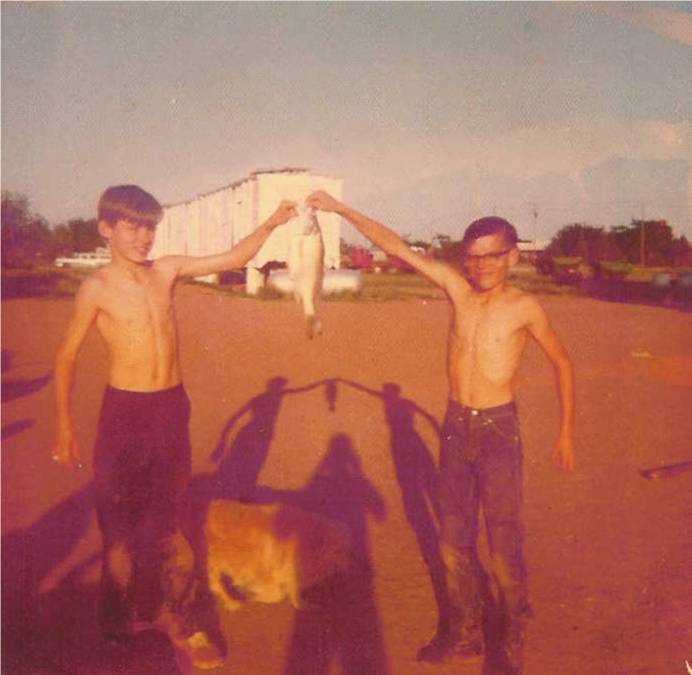
His mother kept a picture on her dresser in her bedroom until she would die a quarter century later. The picture shows two boys, both shirtless, both with pants wet and muddied from the river. They hold between them in their hands a large fish they had caught. Both boys face the west and squint into the sunlight, while a dog stands between them. On the right stands Jerry. On the left stands my brother, Jerry’s best buddy in all the world.
It was a perfect picture of a perfect moment in an imperfect world. The framed picture always faced her bed and it was the last thing she saw when she went to sleep at night, and it was the first thing she saw when she awoke from sleep in the morning—that perfect picture of her son, Jerry, on that perfect day when he and his buddy caught the big fish, when all was perfect in a boy’s life.
—Jeremy Myers

 Sunday Brunch